
Market Overview
| Study Period | 2021 - 2031 |
|---|---|
| Forecast Data Period | 2026 - 2031 |
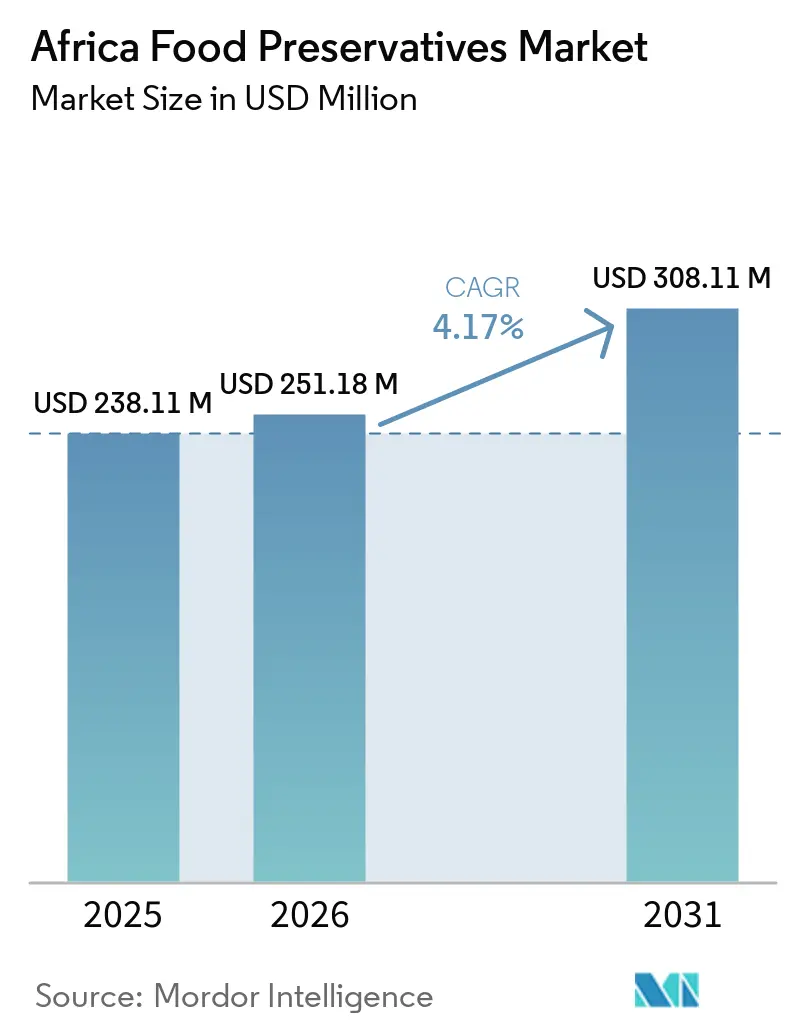
| Base Year Market Size (2025) | USD 238.11 Million |
| Market Size (2026) | USD 251.18 Million |
| Market Size (2031) | USD 308.11 Million |
| Growth Rate (2026 - 2031) | 4.17 % |
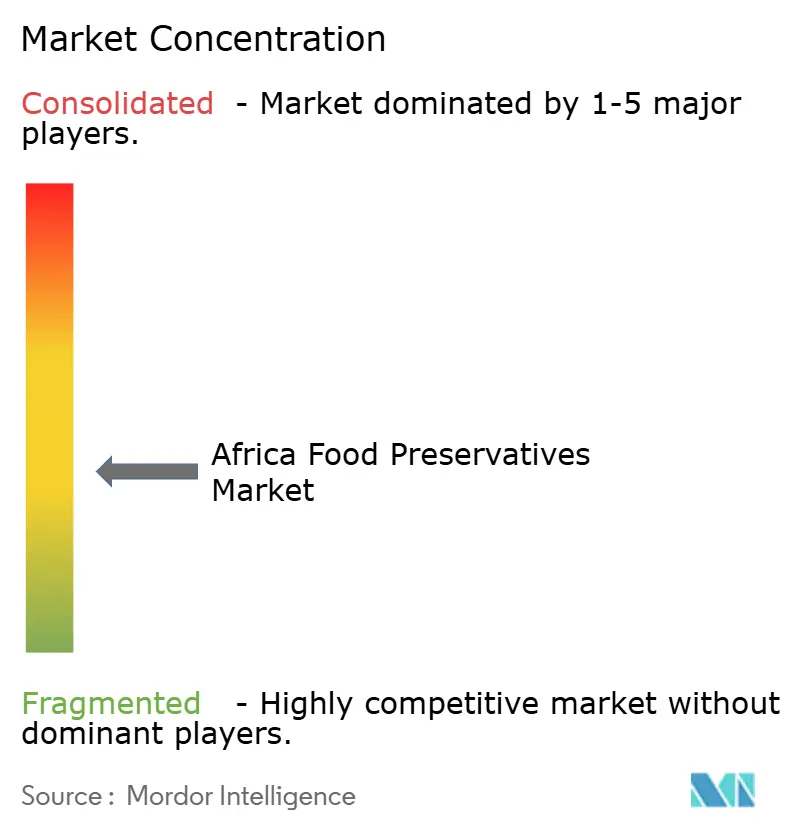
| Market Concentration | Medium |
Major Players *Disclaimer: Major Players sorted in no particular order Image © Mordor Intelligence. Reuse requires attribution under CC BY 4.0. | |
Africa Food Preservatives Market Analysis by Mordor Intelligence
The Africa food preservatives market size was valued at USD 238.11 million in 2025 and estimated to grow from USD 251.18 million in 2026 to reach USD 308.11 million by 2031, at a CAGR of 4.17% during the forecast period (2026-2031). The Africa food preservatives market is supported by urban growth, wider packaged-food distribution, and the need to reduce spoilage during long supply journeys. Food losses and longer transport routes make shelf-life management an operational requirement for processors rather than an optional product feature. New agro-industrial facilities can bring smaller processors into formal manufacturing, where documented additive use and quality controls are more common. The Africa food preservatives market also faces a shift toward natural solutions, although their higher cost limits adoption outside larger formal processors. Regulatory alignment across the continent may raise compliance requirements while creating a clearer route to market for suppliers with established registrations.
Key Report Takeaways
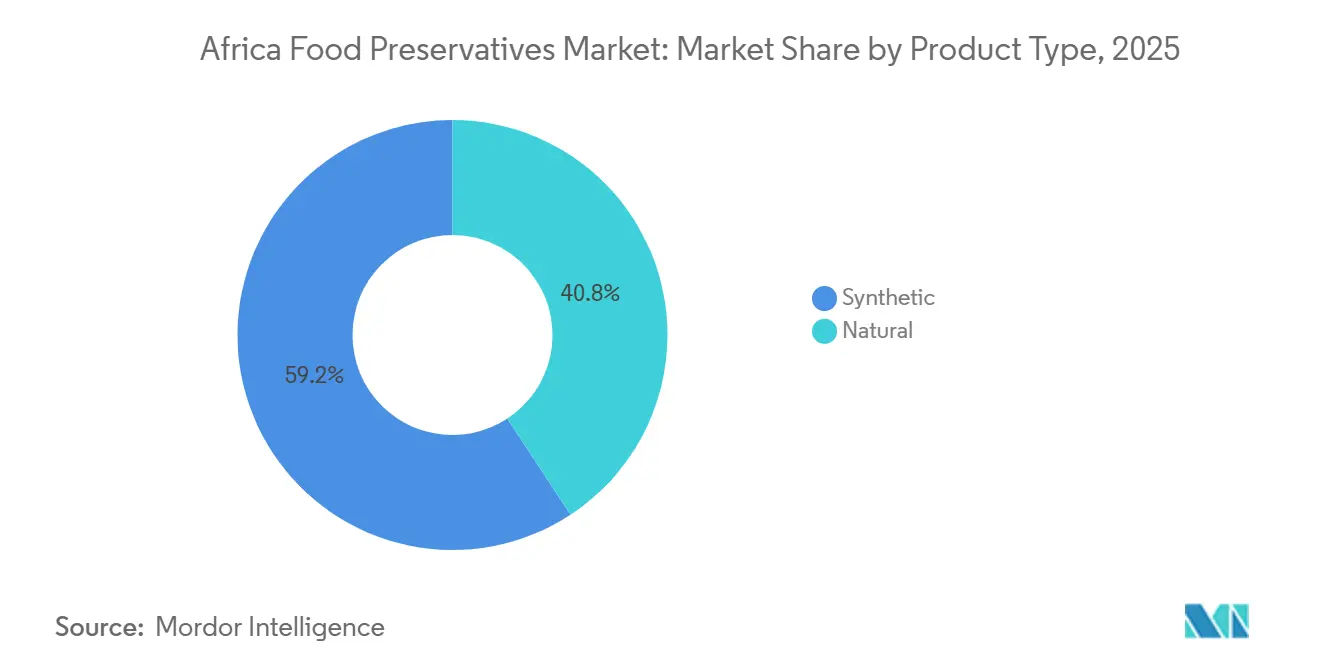
- By product type, synthetic preservatives held 59.24% of the Africa food preservatives market share in 2025, while natural preservatives are projected to grow at a 5.41% CAGR through 2031.
- By function, antimicrobials accounted for 61.17% of the Africa food preservatives market size in 2025, while antioxidants are projected to grow at a 5.63% CAGR through 2031.
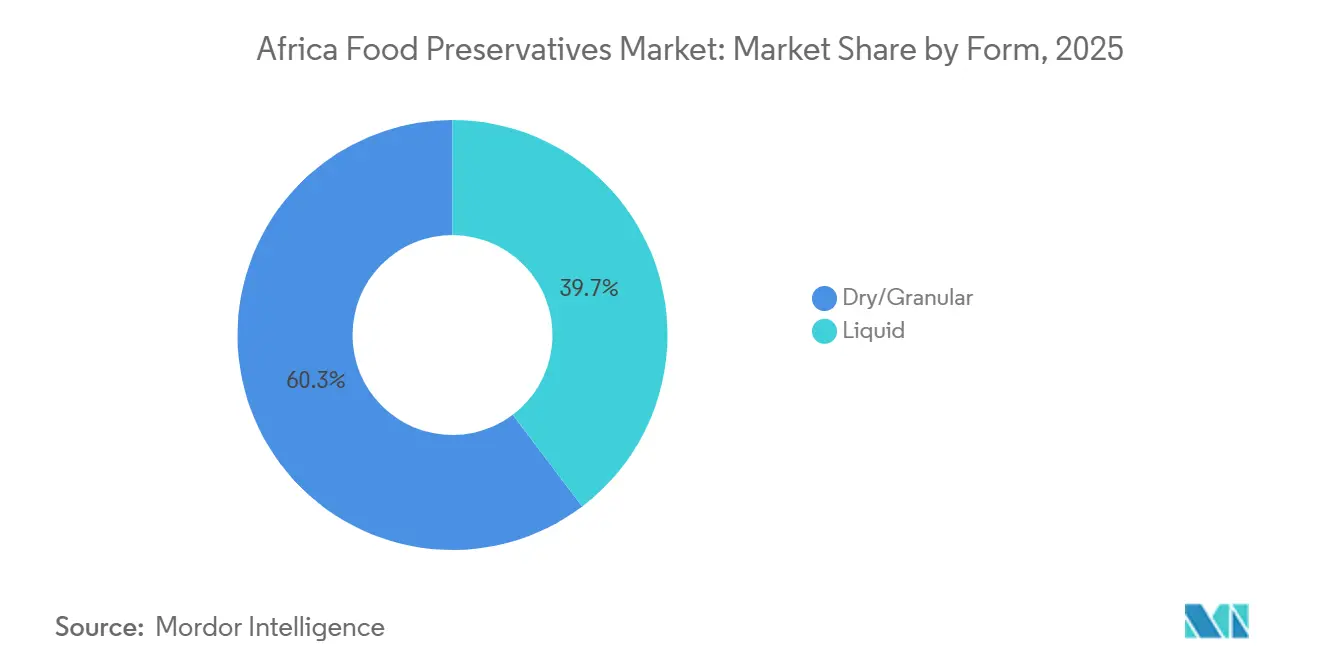
- By form, dry or granular products held 60.31% revenue share in 2025, while liquid preservatives are projected to grow at a 5.88% CAGR through 2031.
- By application, bakery and confectionery held 28.91% revenue share in 2025, while ready meals are projected to grow at a 5.32% CAGR through 2031.
- By geography, South Africa held 27.47% of the Africa food preservatives market share in 2025, while Nigeria is projected to grow at a 5.73% CAGR through 2031.
Note: Market size and forecast figures in this report are generated using Mordor Intelligence’s proprietary estimation framework, updated with the latest available data and insights as of January 2026.
Africa Food Preservatives Market Trends and Insights
Drivers Impact Analysis*
| Driver | (~) % Impact on CAGR Forecast | Geographic Relevance | Impact Timeline |
|---|---|---|---|
| Growing Demand for Processed and Packaged Foods | +1.4% | Regional; concentrated in Nigeria, Egypt, South Africa, Kenya | Medium term (2–4 years) |
| Increasing Need to Reduce Food Spoilage and Post-Harvest Losses | +1.0% | Sub-Saharan Africa, especially Nigeria, Kenya | Short term (≤ 2 years) |
| Expansion of the Food and Beverage Processing Industry | +0.7% | Nigeria, South Africa, Egypt, Morocco | Medium term (2–4 years) |
| Growth in Demand for Ready-to-Eat and Convenience Foods | +0.8% | Urban corridors — Lagos, Nairobi, Cairo, Casablanca | Medium term (2–4 years) |
| Increasing Consumption of Packaged Meat, Poultry, and Seafood | +0.5% | South Africa, North Africa, Kenya | Long term (≥ 4 years) |
| Expansion of Bakery and Confectionery Products | +0.4% | Nigeria, Egypt, South Africa, Morocco | Medium term (2–4 years) |
| Source: Mordor Intelligence | |||
Growing Demand for Processed and Packaged Foods
Growing urbanization across Africa is accelerating demand for processed and packaged foods, supporting the use of preservatives to extend shelf life and maintain product quality. According to the World Bank, 45% of the population in Sub-Saharan Africa lived in urban areas in 2025, reflecting the growing importance of urban food distribution and retail networks[1]. Urban consumers increasingly rely on convenient products such as packaged bakery items, beverages, dairy products, sauces, and ready-to-eat meals. Food manufacturers use preservatives, including sorbates, benzoates, and propionates, where permitted, to control microbial growth and reduce spoilage during storage and distribution. This is particularly important where products must travel through extended supply chains or face inconsistent refrigeration. Consequently, continued urbanization and the expansion of packaged food consumption are expected to support growth in Africa's food preservatives market.
Reducing Food Spoilage and Post-Harvest Losses
Reducing food spoilage and post-harvest losses is an important driver of the Africa food preservatives market, as food manufacturers seek to maintain product quality and extend shelf life across storage and distribution networks. High temperatures, humidity, inadequate storage facilities, and limited cold-chain infrastructure increase the risk of microbial growth and spoilage in perishable foods. Food processors therefore use preservatives such as sorbates, benzoates, and propionates, where permitted, to inhibit spoilage organisms and maintain product stability. Demand is particularly relevant for bakery products, beverages, dairy products, sauces, and processed meat distributed over long distances.
Expansion of Food and Beverage Processing
The Africa food preservatives market benefits when processors move from informal production to documented manufacturing practices. New agro-industrial zones can link agricultural inputs, processors, and distribution infrastructure within the same operating area. These settings make it easier to apply consistent recipes, sanitation controls, and shelf-life procedures. The African Development Bank’s Special Agro-Industrial Processing Zones program covers 8 Nigerian states and has funding of USD 538 million[2]. Processing facilities also need suppliers that can provide ingredients in smaller, dependable batches. This favors preservative suppliers that pair products with technical support and local distribution.
Growth in Ready-to-Eat and Convenience Foods
Demand for ready-to-eat foods is growing in major urban corridors and supports higher-value preservation systems. Ready meals are often made from several ingredients with different moisture levels and spoilage risks. This requires manufacturers to manage microbial control and oxidation across the finished product rather than in one ingredient alone. Scientific research published in 2025 described growing interest in hybrid preservation systems combining natural antimicrobials and organic acids. The Africa food preservatives market can benefit where processors use formulated blends for these products. The growth opportunity is strongest where modern retail, delivery services, and formal food preparation are expanding together.
Restraints Impact Analysis*
| Restraint | (~) % Impact on CAGR Forecast | Geographic Relevance | Impact Timeline |
|---|---|---|---|
| High Cost of Food-Grade Preservatives and Preservation Technologies | -1.0% | Pan-African; most acute in Sub-Saharan Africa | Medium term (2–4 years) |
| Limited Cold-Chain and Food Storage Infrastructure | -0.8% | Sub-Saharan Africa, Central Africa | Long term (≥ 4 years) |
| Volatility in Raw Material and Ingredient Prices | -0.5% | Regional, amplified in import-dependent markets | Short term (≤ 2 years) |
| Stringent Food Safety Regulations and Compliance Challenges | -0.4% | North Africa (Morocco, Algeria, Egypt), East Africa | Long term (≥ 4 years) |
| Source: Mordor Intelligence | |||
High Cost of Food-Grade Preservatives and Preservation Technologies
The cost of compliant ingredients limits access to the Africa food preservatives market for small processors. Natural variants are priced 40% to 60% above comparable synthetic products. That difference matters for micro and small enterprises that operate with limited working capital and irregular procurement volumes. A 2025 scientific review found that fewer than 9 of 54 African countries had legally recognized toxicovigilance systems. Limited regulatory capacity can make the use of compliant, labeled products harder to monitor. Larger producers in South Africa, Egypt, and Morocco are better positioned to absorb the cost of nisin, natamycin, and other specialty systems.
Limited Cold-Chain and Food Storage Infrastructure
Cold-chain limits affect both food losses and the effectiveness of preservation practices in the Africa food preservatives market. The World Bank reported that 37% of locally produced food is lost in transit and that African supply chains average 4 times the length of those in Europe. Preservatives can help manage shelf life, but they cannot resolve temperature abuse or poor storage conditions. The United Nations Environment Programme has documented crop losses of up to 40% among Kenyan cooperatives before refrigerated transport became available[3]. Investment in refrigeration and storage is therefore complementary to chemical and biological preservation. Better infrastructure can widen the range of products that processors can preserve safely and distribute reliably.
*Our forecasts treat driver/restraint impacts as directional, not additive. The impact forecasts reflect baseline growth, mix effects, and variable interactions.
Segment Analysis
By Product Type: Synthetic Products Hold the Larger Base While Natural Options Gain Ground
Synthetic preservatives held 59.24% of 2025 revenue, while natural preservatives are projected to grow at a 5.41% CAGR through 2031. Sorbates, benzoates, and propionates remain widely used because they are cost efficient and supported by established supply channels. Calcium propionate is widely used in bread, while potassium sorbate is used in beverage and dairy processing. These established applications give synthetic products a broad base across price-sensitive manufacturing. Natural preservatives are gaining attention in dairy, meat, and export-oriented products. Nisin and natamycin are relevant where manufacturers seek food safety controls with a label-friendly positioning.
Natural preservation is more relevant for formal manufacturers that can pay for formulation work and higher-priced inputs. Rosemary extract and mixed tocopherols are used as natural antioxidants in edible oils and snacks. Documented additive compliance remains important for manufacturers supplying formal retail and export channels. The cost gap between natural and synthetic products will continue to separate their customer bases. Natural products are more likely to be selected for export, premium, and clean-label formulations.
By Function: Antimicrobials Lead While Antioxidants Expand Faster
Antimicrobials accounted for 61.17% of the Africa food preservatives market size in 2025. They are used in bakery, meat, poultry, and ready-meal applications where microbial spoilage is a major shelf-life issue. Their high share reflects the importance of mold and bacterial control in warm climates and long distribution channels. East African regulatory discussions have focused on harmonized interpretation of Codex Standard 192-1995 on food additives.
Antioxidants are projected to grow at a 5.63% CAGR through 2031, the fastest function in the Africa food preservatives market. Edible oils require oxidation protection during processing, storage, and distribution. This creates a steady use case for antioxidant ingredients in markets where ambient temperatures can shorten product stability. A 2025 Journal of Food Quality review found that citrus peel, grape pomace, and carrot peels can provide natural antioxidants that reduce oxidative processes in meat and baked products.
By Form: Dry Products Retain the Larger Share While Liquids Grow Faster
Dry or granular preservatives held 60.31% of 2025 revenue in the Africa food preservatives market. Powder formats fit manual dosing systems that are common in small and medium bakeries. They also have longer ambient shelf life and do not require refrigeration during handling. These attributes are valuable for processors working across variable transport and storage conditions. Calcium propionate and potassium sorbate are frequently supplied in dry formats for bakery applications. The format is practical for production sites that do not use automated liquid dosing equipment. Its established role gives dry ingredients a strong position in current demand.
Liquid preservatives are projected to grow at a 5.88% CAGR through 2031. Buffered vinegar, liquid natamycin, lactic acid, and acetic acid solutions can be applied at the point of production. This can give processors more flexibility when they need to adjust dosing for a particular product or batch.SGS South Africa introduced accredited lactic acid and acetic acid testing services in March 2025. Testing services can support validation of liquid bio-preservation programs. Liquid systems may gain share as formal processors adopt more controlled production methods.
By Application: Bakery and Confectionery Lead While Ready Meals Grow Faster
Bakery and confectionery held 28.91% of 2025 revenue in the Africa food preservatives market. Bread is a widely consumed urban staple, and humid conditions can accelerate mold growth. Calcium propionate and sorbates are therefore common tools for commercial bakeries. Bakery products also benefit from dry ingredients that are easy to store and dose. This use case extends from Casablanca to Cape Town through both formal and smaller commercial bakeries. The segment’s large share reflects a familiar, high-volume application rather than a niche formulation need. Its demand remains connected to population growth, urban food consumption, and the expansion of packaged bread.
Ready meals are projected to grow at a 5.32% CAGR through 2031. The segment includes multi-component foods that can require combined antimicrobial and antioxidant protection. Their preservation requirements are more complex than those of many bakery and snack products. Research on hybrid systems indicates that natural antimicrobials can be combined with organic acids in these applications. The United States Department of Agriculture identified ready-to-eat meals as an opportunity for packaged-food businesses serving Ghana and Nigeria.
Geography Analysis
South Africa held 27.47% of the Africa food preservatives market in 2025, supported by its relatively developed food processing industry, established retail networks, and demand for packaged and convenience foods. Food manufacturers use preservatives to maintain product quality, extend shelf life, and reduce spoilage across bakery products, meat and poultry, dairy products, sauces, and ready-to-eat foods. The country's organized food manufacturing sector and cold-chain infrastructure also support the use of preservatives in products distributed through supermarkets and other retail channels. Demand is further supported by the need to maintain product stability across storage and distribution networks.
Nigeria is projected to record a CAGR of 5.73% through 2031, driven by population growth, urbanization, and increasing consumption of packaged and processed foods. The expansion of bakery operations, beverage production, packaged sauces, and convenience food categories is creating opportunities for preservatives that help maintain product safety and extend shelf life under varying storage conditions. Food manufacturers also rely on preservatives to manage spoilage risks associated with distribution challenges and inconsistent refrigeration in some areas. As domestic food processing expands and packaged food penetration increases, demand for preservatives is expected to strengthen across both established and emerging product categories.
Other African markets, including Egypt, Morocco, Algeria, and Kenya, contribute to regional demand through their food processing industries and expanding packaged food sectors. In Egypt, demand is supported by bakery, dairy, beverage, and processed food manufacturing, while Morocco benefits from food processing activities serving domestic consumption and export markets. Algeria's demand is linked to packaged foods, bakery products, and beverage production, with preservatives helping manufacturers maintain product stability and shelf life. In Kenya, urbanization, the growth of modern retail, and increasing availability of packaged foods support preservative consumption across bakery, beverage, and processed food applications.
Competitive Landscape
The Africa food preservatives market is moderately fragmented, with several multinational ingredient manufacturers competing to meet the requirements of food and beverage producers across the region. Leading players, including Kerry Group plc, Cargill, Incorporated, Archer Daniels Midland Company, Corbion N.V., and Tate & Lyle PLC, compete through their ingredient portfolios, application expertise, product innovation, and established customer relationships. The presence of these companies supports the availability of preservation solutions for bakery products, beverages, dairy products, sauces, and other processed foods.
Kerry Group plc, Cargill, Incorporated, and Archer Daniels Midland Company leverage their broad food ingredient portfolios and technical capabilities to serve manufacturers seeking improved shelf life, product stability, and consistent quality. Their application development expertise and established ingredient supply networks help them address the varied formulation requirements of regional food processors. Competition is also influenced by manufacturers' demand for solutions that support clean-label positioning, meet regulatory requirements, and maintain product quality under different storage and distribution conditions.
Corbion N.V. and Tate & Lyle PLC contribute to the competitive landscape through their food ingredient technologies and formulation capabilities. Corbion's expertise in food preservation, including organic acid-based solutions, supports applications requiring microbial control and extended shelf life, while Tate & Lyle's specialty ingredients and formulation expertise serve a range of processed food applications. Overall, competition in the Africa food preservatives market is shaped by product differentiation, technical support, distribution reach, and the ability to meet evolving food manufacturer requirements. The presence of established multinational suppliers alongside regional ingredient providers sustains the market's moderately fragmented structure.
Africa Food Preservatives Industry Leaders
-
Kerry Group plc
-
Cargill, Incorporated
-
Archer Daniels Midland Company
-
Corbion N.V.
-
Tate & Lyle PLC
- *Disclaimer: Major Players sorted in no particular order
Recent Industry Developments
- April 2025: Kerry Group opened its first taste manufacturing facility in Kigali, Rwanda, part of a EUR 1 billion, USD 1.11 billion, emerging-markets investment commitment. The zero-waste-to-landfill facility brings Kerry's African manufacturing footprint to 7 sites across Rwanda, Kenya, Tanzania, Uganda, Cameroon, South Africa, and Nigeria.
- April 2025: Nigeria's Standards Organisation, in partnership with ECOWAS and GIZ, conducted the second phase of a capacity-building workshop at its Lagos laboratory complex to strengthen HACCP principles, food safety risk analysis, and aflatoxin testing capability across West African food supply chains.
- March 2025: SGS South Africa launched accredited lactic acid and acetic acid testing services, enabling bio-preservation validation for food processors across Southern Africa and certifying lactic acid bacteria-based preservation methods for commercial use.
Africa Food Preservatives Market Report Scope
Food preservatives are substances added to food products to inhibit microbial growth, slow down oxidation, and prevent spoilage, thereby extending shelf life and maintaining food quality, safety, flavour, colour, and texture during processing, storage, and distribution. The African food preservatives market is segmented by product type, function, form, application and geography. Based on product type, the market is segmented by synthetic and natural food preservatives. Based on function, the market is segmented into antimicrobials and antioxidants. Based on form, the market is segmented into dry/granular and liquid. Based on application, the market is segmented into bakery and confectionery, meat and poultry, ready meals, sweet and savory snacks, sauces and dressings, edible oils, and other food applications. Based on geography, the report provides an analysis of South Africa, Egypt, Nigeria, Morocco, Algeria, Kenya and the Rest of Africa. For each segment, the market sizing and forecasts have been done on the basis of value (in USD million).
By Product Type
| Synthetic | Sorbates |
| Benzonates | |
| Propionates | |
| Other Synthetic Predervatives | |
| Natural | Nisin |
| Natamycin | |
| Vinegar | |
| Rosemary Extract | |
| Mixed Tocopherols | |
| Other Natural Predervatives |
By Function
| Antimicrobials |
| Antioxidants |
By Form
| Dry/Granular |
| Liquid |
By Application
| Bakery and Confectionery |
| Meat and Poultry |
| Ready Meals |
| Sweet and Savory Snacks |
| Sauces and Dressings |
| Edible Oils |
| Other Food Applications |
By Country
| South Africa |
| Egypt |
| Nigeria |
| Morocco |
| Algeria |
| Kenya |
| Rest of Africa |
| By Product Type | Synthetic | Sorbates |
| Benzonates | ||
| Propionates | ||
| Other Synthetic Predervatives | ||
| Natural | Nisin | |
| Natamycin | ||
| Vinegar | ||
| Rosemary Extract | ||
| Mixed Tocopherols | ||
| Other Natural Predervatives | ||
| By Function | Antimicrobials | |
| Antioxidants | ||
| By Form | Dry/Granular | |
| Liquid | ||
| By Application | Bakery and Confectionery | |
| Meat and Poultry | ||
| Ready Meals | ||
| Sweet and Savory Snacks | ||
| Sauces and Dressings | ||
| Edible Oils | ||
| Other Food Applications | ||
| By Country | South Africa | |
| Egypt | ||
| Nigeria | ||
| Morocco | ||
| Algeria | ||
| Kenya | ||
| Rest of Africa | ||
Key Questions Answered in the Report
What is the projected value of food preservatives in Africa by 2031?
The Africa food preservatives market is projected to reach USD 308.11 million by 2031, growing at a 4.17% CAGR from 2026.
Which product type has the largest share in Africa?
Synthetic preservatives held 59.24% of 2025 revenue, supported by cost efficiency and established supply channels.
Which food preservative function is growing the fastest in Africa?
Antioxidants are projected to grow at a 5.63% CAGR through 2031, supported by demand from edible oils, snacks, and other oxidation-sensitive foods.
Which form of preservative is expected to grow fastest?
Liquid preservatives are projected to grow at a 5.88% CAGR through 2031, helped by flexible dosing and use in bio-preservation systems.
What is the leading application for food preservatives in Africa?
Bakery and confectionery held 28.91% of 2025 revenue, while ready meals are projected to be the fastest-growing application at a 5.32% CAGR.