
Market Overview
| Study Period | 2020 - 2031 |
|---|---|
| Forecast Data Period | 2026 - 2031 |
| Historical Data Period | 2020 - 2024 |
| Growth Rate | 7.12 % |
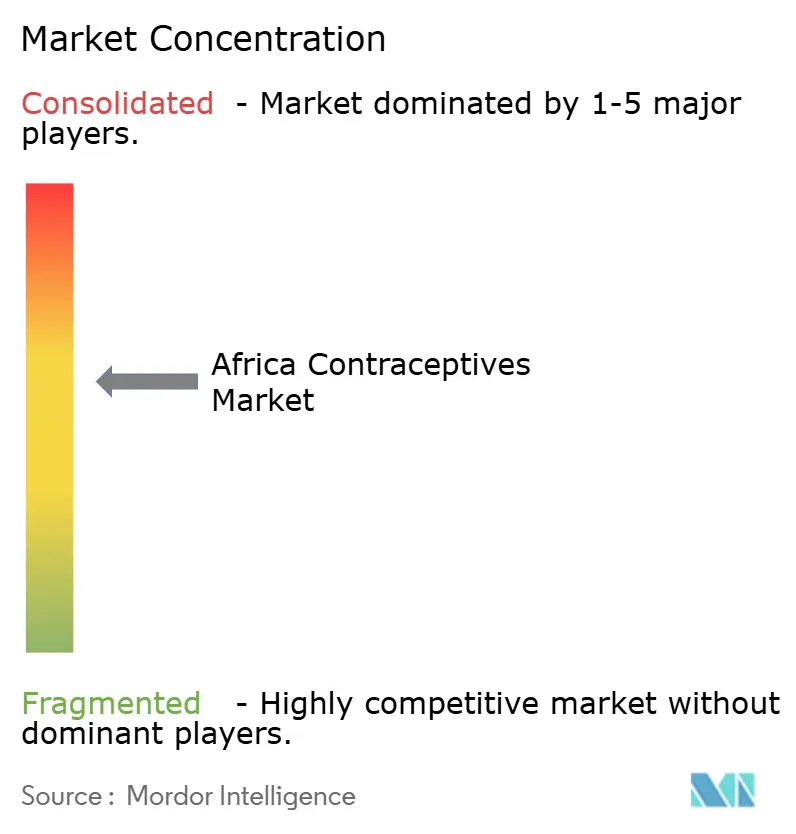
| Market Concentration | Medium |
Major Players *Disclaimer: Major Players sorted in no particular order Image © Mordor Intelligence. Reuse requires attribution under CC BY 4.0. | |

Africa Contraceptives Market Analysis by Mordor Intelligence
The Africa contraceptives market size is expected to grow from USD 1.86 billion in 2025 to USD 1.99 billion in 2026 and is forecast to reach USD 2.81 billion by 2031 at 7.12% CAGR over 2026-2031.
The outbreak of the COVID-19 pandemic has pushed the healthcare industry into action, with a race to develop both therapeutic and preventive drugs. Exponentially increasing cases of the coronavirus worldwide are leading to the need for the development of novel treatments, with several clinical trials underway. Initially, the global COVID-19 outbreak and the lockdown scenario in various countries have imposed some challenges on the market, as hospitals and clinics were forced to suspend services to prevent the spread of the SARS-CoV-2 virus. The restrictions imposed by the government have significantly impacted the growth of the studied market during the initial period of the pandemic. As per the study published in August 2022 by the African Journal of Primary Health Care & Family Medicine, the COVID-19 pandemic aggravated the risk of sub-Saharan African women to HIV infection because of a multitude of factors, including child marriages, teenage pregnancies, dropping out of school, increase in the incidence of sexual and gender-based violence and reduced access to preventive and treatment services for HIV and sexually transmitted infections. In addition, the market growth is stabilizing in the current scenario after COVID-19 as the worldwide restrictions have eased down and various services have been resumed.
Certain factors propelling the market growth are increasing incidences of sexually transmitted diseases, an increasing rate of unintended pregnancies, and rising government initiatives.
An unintended pregnancy occurs from not using contraception or inconsistent and incorrect use of contraceptive methods. The growth of contraceptive markets is necessary to avoid unwanted pregnancies and their complications, especially in teenagers. Teenage pregnancy is a big problem in Africa. For instance, as per the data published by the UNFPA in June 2022, in Southern Africa, 65% of pregnancies were unintended, and 36% ended in abortion. The predominant cause of unintended pregnancy is sexual activity without effective contraception through choice or coercion. In many cases, unintended pregnancy is linked to gender-based violence, including early sexual debut that is non-consensual and child marriage. An increase in unplanned pregnancies has helped in the growth of the market.
In addition, the rising prevalence of sexually transmitted diseases among the population is expected to increase the market growth. For instance, the WHO estimates, updated in July 2021, that sub-Saharan Africa bears approximately 40% of the global burden of STIs. Additionally, as per the study published in April 2021, by BMC Public Health, STI prevalence was 7.7% and did not differ by HIV status. Prevalence differed by syndrome (3.5% vaginal discharge, 1.5% genital ulcer, 2.1% lower abdominal pain, 0.2% inguinal bubo). Thus, the rising burden of sexually transmitted diseases is expected to increase the demand for contraception to avoid getting diseases, thereby propelling market growth.
Moreover the products launches by the key players are expcted to boost thw growth of the market. For instrance, in March 2022, Medicines360, Population Services International, and Society for Family Health launched Avibela (levonorgestrel-releasing intrauterine system) 52 mg hormonal intrauterine device in Nigeria.
However, the high cost of devices and treatment and side effects associated with the use of contraceptive drugs and devices are some of the factors that are likely to impede market growth over the forecast period.
Note: Market size and forecast figures in this report are generated using Mordor Intelligence’s proprietary estimation framework, updated with the latest available data and insights as of 2026.
Africa Contraceptives Market Trends and Insights
The Oral Contraceptives Segment is Expected to Show Better Growth in the Forecast Years
Oral contraceptive pills are considered the easiest method of contraception in the industry. They prohibit implantation within the uterus if taken within 2-3 days of unsafe sexual contact. These are easily marketed across large regions by several companies and thus easily consumed by a large population.
According to WHO data updated in June 2021, around 214 million women of reproductive age in developing countries who want to avoid pregnancy are not using a modern contraceptive method. In Africa, 24.2% of women of reproductive age have an unmet need for modern contraception, as per the WHO estimates. Hence, the rising demand for contraceptives to avoid unintended pregnancies and rising government initiatives are expected to drive the market in the forecast period.
Moreover, as per the study published in January 2022 by Contraception and Reproductive Medicine, the awareness of emergency contraceptives among women of reproductive age in South America has increased. South Africa reported the level of emergency contraceptive (EC) awareness to be 57% compared to the previous year. Therefore, the rising awareness among the population about contraceptives is expected to increase the demand for contraceptive pills, which is expected to boost the market's growth over the forecast period.
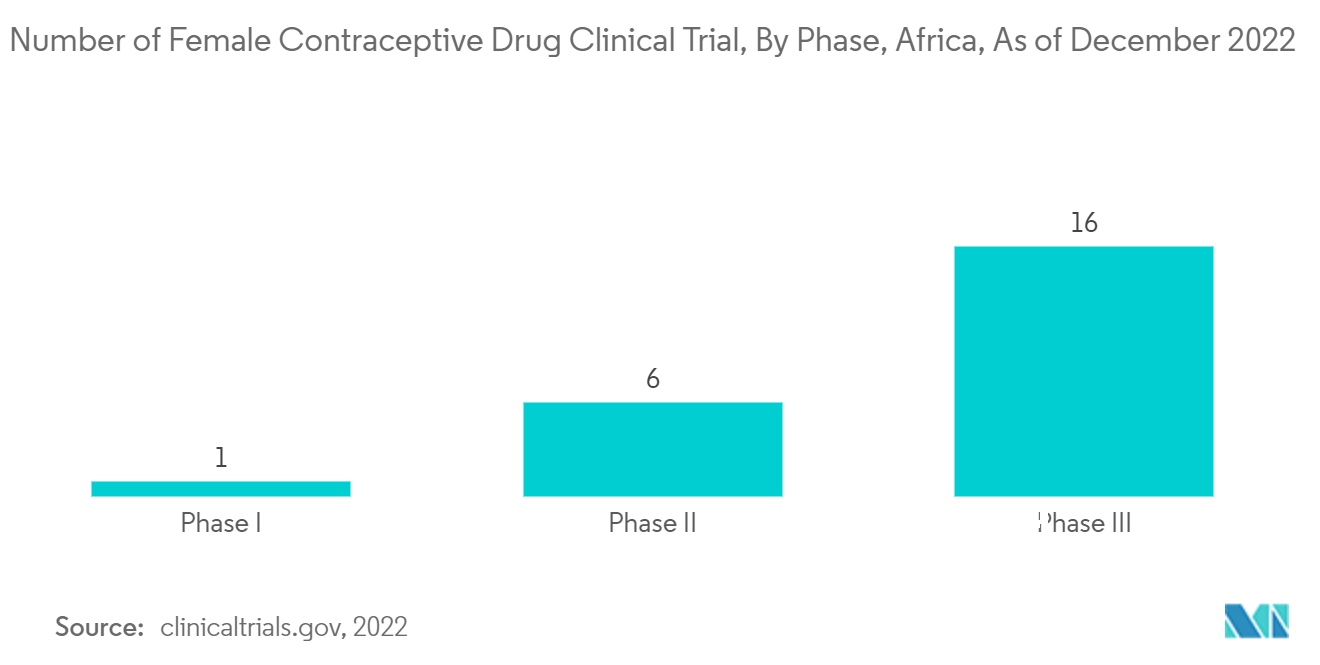
South Africa is Expected to Show High Growth in the Forecast Years
South Africa has one of the highest numbers of HIV-infected adults and children in the world. The epidemic is generalized across the country's population and is primarily driven by sexual transmission.
As per the data updated in June 2021 by population.un.org, in 2021, nearly 51% of women aged 15-49 years in Southern Africa used contraceptives - either traditional or modern methods. The region registered the highest contraceptive prevalence rate in Africa. Thus, the increasing usage of contraceptives is expected to increase in South Africa which is further expected to boost the growth of the market over the forecast period in the country.
Moreover, as per the data updated in June 2022, by Statistics South Africa, as of 2021, approximately three percent of females aged 14 to 19 years in South Africa stated that they were going through different stages of pregnancy within the last 12 months. The prevalence of pregnancy increased with age. Moreover, as per the study published in December 2021 by the National Library of Medicine, the prevalence of unintended pregnancy was significantly higher among adolescent girls aged 15 19 years (76.3%) and young women aged 20 24 years (56.5%). Thus, the rising burden of unintended pregnancies among young age women and girls is expected to boost the demand for contraceptive drugs and devices which in turn is anticipated to boost the market growth over the forecast period in South Africa.
Thus, the above-mentioned factors, such as the increasing usage of contraceptives coupled with the rising number of unintended pregnancies, are expected to boost the growth of the market studied in the country.
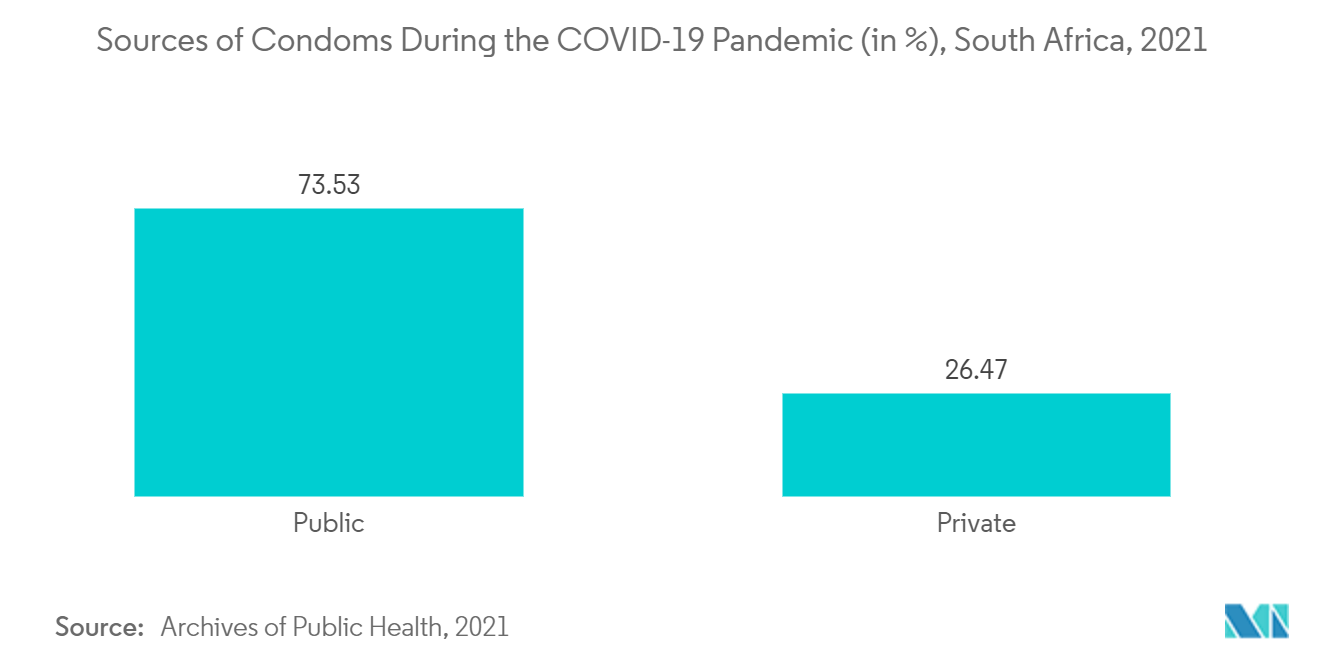
Competitive Landscape
Africa contraceptives market is moderately competitive, and several local and international companies deal with contraceptives. The major players in the market are Allergan PLC, Bayer AG, Johnson & Johnson, Lupin Limited, Merck & Co. Inc., Mylan NV, Pfizer Inc., and Teva Pharmaceutical Industries Ltd.
Africa Contraceptives Industry Leaders
-
Bayer AG
-
Merck & Co. Inc.
-
Pfizer Inc.
-
Teva Pharmaceutical Industries Ltd.
-
AbbVie
- *Disclaimer: Major Players sorted in no particular order
Market Opportunities and Future Outlook
Access expansion through policy and channel broadening is a clear whitespace for injectables and other modern methods. Kenya Ministry of Health updated its National Family Planning Guidelines in March 2026 to permit pharmacists and pharmaceutical technologists to provide injectable contraceptives. This shifts delivery beyond traditional public facilities and gives private retail pharmacy networks a larger role in method provision and counseling.
Supply security and affordability initiatives also create room for portfolio and tender-led growth across drugs and devices. In May 2026, Africa CDC announced results of the first African Pooled Procurement Mechanism (APPM) tender for 10 priority RMNCH products across 10 African Union member states, with reported 30-90% lower prices than benchmarks. Manufacturing localization is gaining traction alongside pooled purchasing, including Marbio opening a contraceptive hormone production facility in Benslimane, Morocco (April 2026). Nigeria-focused access partnerships such as VIYA Healths April 2026 collaboration with the Federal Ministry of Health and Social Welfare, which includes rollout of WHO-prequalified DMPA-SC products, also support opportunities in LARC and injectable supply. Together, these actions point to headroom in local packaging and production and in-country distribution scale-up.
Recent Industry Developments
- July 2026: Bayer agreed to sell a minority stake in its newly established long-acting reversible contraceptives (LARC) business to Apollo for USD 3.4 billion, covering brands such as Mirena, Kyleena, Jaydess, and Jadelle, with closing targeted for Q3 2026. The transaction reshapes ownership and capital allocation around a major LARC portfolio while keeping the product suite centralized in a dedicated business unit.
- November 2025: Bayer and Minapharm signed a cooperation agreement to strengthen pharmaceutical manufacturing in Egypt, with coverage that includes womens health and family planning products and a stated regional export orientation. This supports shorter supply lines for selected categories and aligns with government and partner efforts to localize essential health product production.
- June 2024: USAID published an implementation roadmap on manufacturing injectable contraceptives in sub-Saharan Africa, outlining practical steps to develop local production capability for products such as DMPA-SC. The roadmap informs investment and partnership discussions by clarifying technical, regulatory, and supply-chain requirements for shifting part of injectable supply closer to end markets.
Research Methodology Framework and Report Scope
Market Definition and Coverage
For this study, the market covers the sales value of contraceptive drugs and contraceptive devices used to prevent pregnancy across Africa, counted at the point of sale into healthcare and retail channels.
Scope exclusions: We exclude infertility treatment, prenatal vitamins, and other reproductive health products that do not have a contraceptive indication.
Segmentation Overview
- By Products
- By Drugs
- Oral Contraceptives
- Topical Contraceptives
- Contraceptive Injectable
- By Device
- Condoms
- Diaphragms
- Cervical Caps
- Sponges
- Vaginal Rings
- IUD
- Other Devices
- By Drugs
- By Gender
- Male
- Female
- Geography
- South Africa
- Nigeria
- Morocco
- Uganda
- Democratic Republic of the Congo
- Rest of South Africa
Data Sources, Market Sizing, and Validation
Desk Research
Desk research was used to set the demand and supply context and to ensure the model inputs match what is observable in public datasets. We reviewed family planning and contraceptive prevalence indicators from sources such as the World Health Organization and the United Nations population and health statistics, and we cross-checked country level signals with Demographic and Health Surveys where available. To ground policy and funding assumptions, we also referred to sources such as UNFPA publications and public procurement and health tender disclosures that indicate program scale and timing.
On the supply side, we used manufacturer disclosures like annual reports and investor presentations, along with reputed press coverage on capacity additions, product registrations, and distribution changes. In addition, paid subscriptions that aggregate company financials, news, and patent records were used selectively to confirm product portfolios and to validate the direction of pricing and mix over time. The desk sources mentioned are illustrative, and we used many other public and paid references to collect, validate, and clarify data points throughout the work.
Primary Interviews and Surveys
We use interviews and surveys with public procurement specialists, clinicians, distributors, pharmacy and retail participants, and family-planning program managers in Africa. Their feedback helps clarify method uptake, public and private supply, stock availability, price movement, and gaps in country data. Analysts use these findings to revise assumptions and compare modeled results with conditions reported across African markets.
Distribution of primary research fieldwork respondents
| Company type | Respondent position |
|---|---|
| Top tier: 27% | CXOs: 18% |
| Mid tier: 48% | Functional/Unit leaders: 32% |
| Smaller Players: 25% | Managers: 50% |
Market-Sizing & Forecasting
Sizing starts from a top-down build where contraceptive demand is reconstructed using country level female population cohorts, modern contraceptive prevalence and method mix, and then adjusted for access and purchasing patterns across public programs and private channels. Once that demand pool is formed, value is estimated by applying realistic pricing ranges by method and channel, then aligning the totals with observable supply signals such as import dependence, local manufacturing presence, and stock availability patterns.
To keep the results grounded, we corroborated the totals with selective bottom-up approximations, such as rolling up sampled supplier revenues where disclosures exist. We also validated implied unit volumes against method specific usage assumptions, for example annualized pill cycles, injection dosing frequency, and multi year protection for long acting methods. Where bottom-up visibility was incomplete, we used conservative coverage ratios and then stress-tested the output so the final market does not hinge on one player or one country assumption.
For forecasting, scenario analysis was used so the model can reflect plausible differences in public funding cycles, outreach intensity, and product mix shifts, which are converted into growth paths for volumes and average selling prices. The model tracks variables such as contraceptive prevalence trends, urbanization and age cohort growth, share of public procurement, exchange rate movements that affect import costs, and mix change between short acting methods and long acting reversible contraception, with primary feedback used to keep those trajectories realistic.
Data Validation & Update Cycle
Outputs were validated through triangulation across independent checks, including method level volume reasonableness, price bands by channel, and country contribution sanity checks against demographic and program signals. Any sharp swings were re-reviewed, and the assumption trail was revisited until the variance could be explained by a clear driver such as funding timing, currency movement, or mix change.
Before sign-off, the model went through multi-step analyst review so arithmetic, logic links, and country roll-ups are consistent. Reports are refreshed annually, and interim updates are made when material events occur such as policy changes, large tenders, or major pricing resets. Right before delivery, a fresh pass is completed so clients receive the most current view supported by the same repeatable steps.
Mordor Intelligence's Africa Contraceptives Market Size Measured Against Other Published Estimates
It is common to see different market sizes for Africa contraceptives because publishers do not always count the same products, years, and price points in the same way, even when the market name looks identical. Differences also come from how public sector purchasing is treated versus private retail demand, and from the timing used for currency conversion when a market has meaningful imports.
A refresh-led gap shows up most clearly when price and mix are updated at different points in the year. For Africa, tenders, donor funded shipments, and exchange rates can shift quickly, which changes the implied average selling price. Using a consistent currency timing rule and re-checking method level pricing during the latest update cycle is what keeps the 2025 value stable in Mordor Intelligence, while other figures can drift if earlier pricing assumptions are carried forward.
Benchmark comparison
| Source | Market Size | Gaps in Research Methodology |
|---|---|---|
| Mordor Intelligence | USD 1.86 B (2025) | |
| Industry Publisher A | USD 0.94 B (2025) | Often reflects a narrower priced basket or a different channel mix assumption, with lower implied ASPs for long acting methods and limited adjustment for tender timing. |
| Global Consultancy B | USD 1.21 B (2024) | Uses a combined Middle East and Africa lens and a different base year, which can dilute Africa-only sizing and apply regional averages for pricing and uptake. |
The spread across the table is mainly explained by timing and scope choices, followed by how pricing is updated and validated at the method level. By keeping the year definition consistent, checking currency timing, and pressure-testing ASP and volume logic against program and channel signals, the estimate stays traceable to clear inputs that can be repeated when conditions change.
Key Questions Answered in the Report
What is the current Africa Contraceptives Market size?
The Africa Contraceptive Drugs and Devices Market is projected to register a CAGR of 7.12% during the forecast period (2026-2031)
Who are the key players in Africa Contraceptives Market?
Bayer AG, Merck & Co. Inc., Pfizer Inc., Teva Pharmaceutical Industries Ltd. and AbbVie are the major companies operating in the Africa Contraceptive Drugs and Devices Market.
What years does this Africa Contraceptives Market cover?
The report covers the Africa Contraceptive Drugs and Devices Market historical market size for years: 2019, 2020, 2021, 2022, 2023 and 2024. The report also forecasts the Africa Contraceptive Drugs and Devices Market size for years: 2025, 2026, 2027, 2028, 2029 and 2030.