
Mexico Aerospace Market Size and Share
Market Overview
| Study Period | 2019 - 2031 |
|---|---|
| Forecast Data Period | 2026 - 2031 |
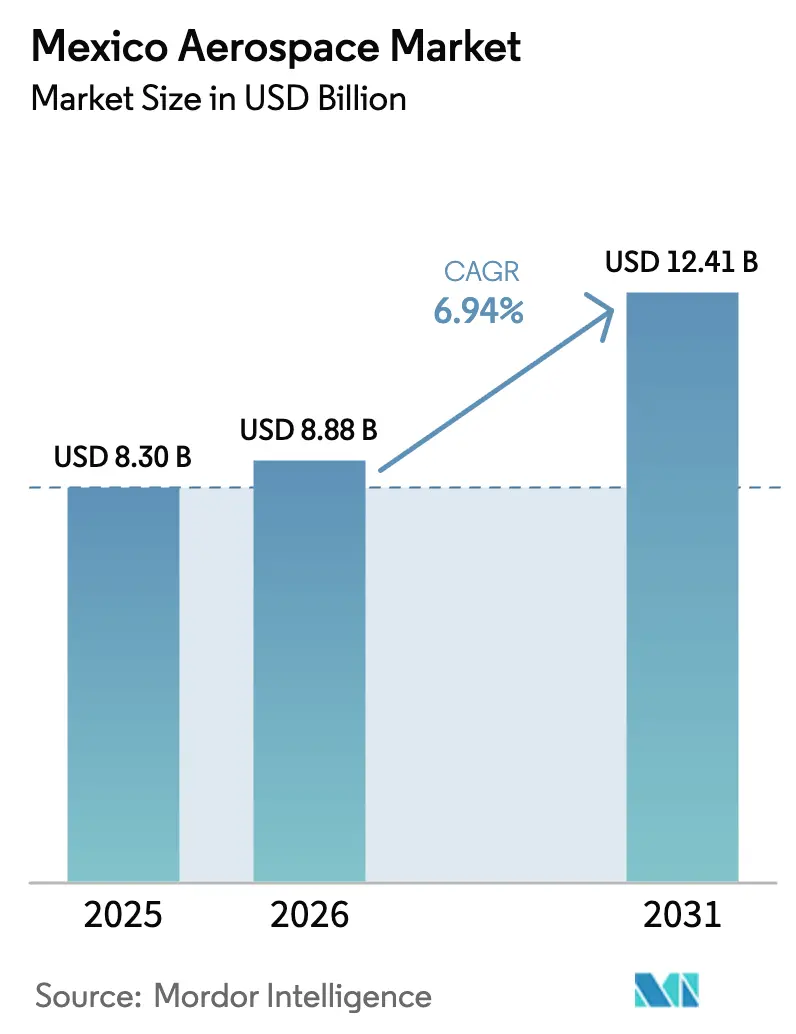
| Base Year Market Size (2025) | USD 8.30 Billion |
| Market Size (2026) | USD 8.88 Billion |
| Market Size (2031) | USD 12.41 Billion |
| Growth Rate (2026 - 2031) | 6.94 % |
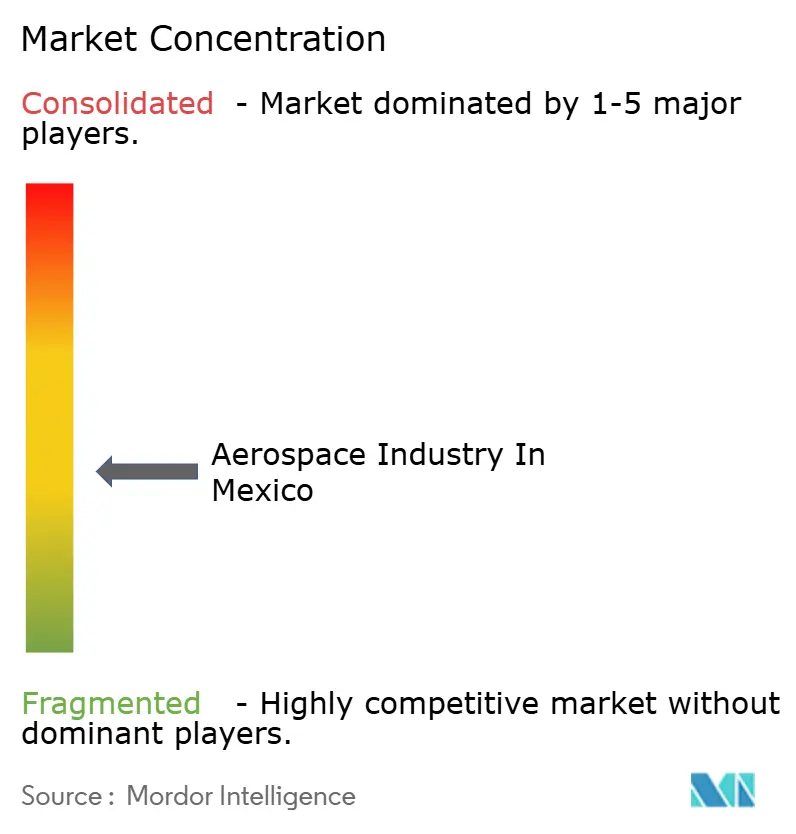
| Market Concentration | Medium |
Major Players *Disclaimer: Major Players sorted in no particular order Image © Mordor Intelligence. Reuse requires attribution under CC BY 4.0. | |
Mexico Aerospace Market Analysis by Mordor Intelligence
The Mexico aerospace market size is expected to grow from USD 8.3 billion in 2025 to USD 8.88 billion in 2026 and is forecasted to reach USD 12.41 billion by 2031 at a 6.94% CAGR over 2026-2031. Current momentum stems from tightened USMCA rules of origin that encourage near-shoring, new government incentives, and the restoration of Mexico’s FAA Category 1 rating, all of which reinforce Mexico’s role as a strategic production base in North America. Fixed-wing aerostructure exports already support the ramp-ups of A320 and B737 MAX, while helicopter and engine programs diversify the pipeline. Domestic suppliers are transitioning from labor-intensive fabrication to composite tooling, avionics integration, and data-driven MRO services, facilitated by university–industry partnerships in Querétaro and Chihuahua. At the same time, multimodal infrastructure, such as the Interoceanic Corridor of the Isthmus, reduces logistics costs and shortens delivery windows for US and Canadian customers.
Key Report Takeaways
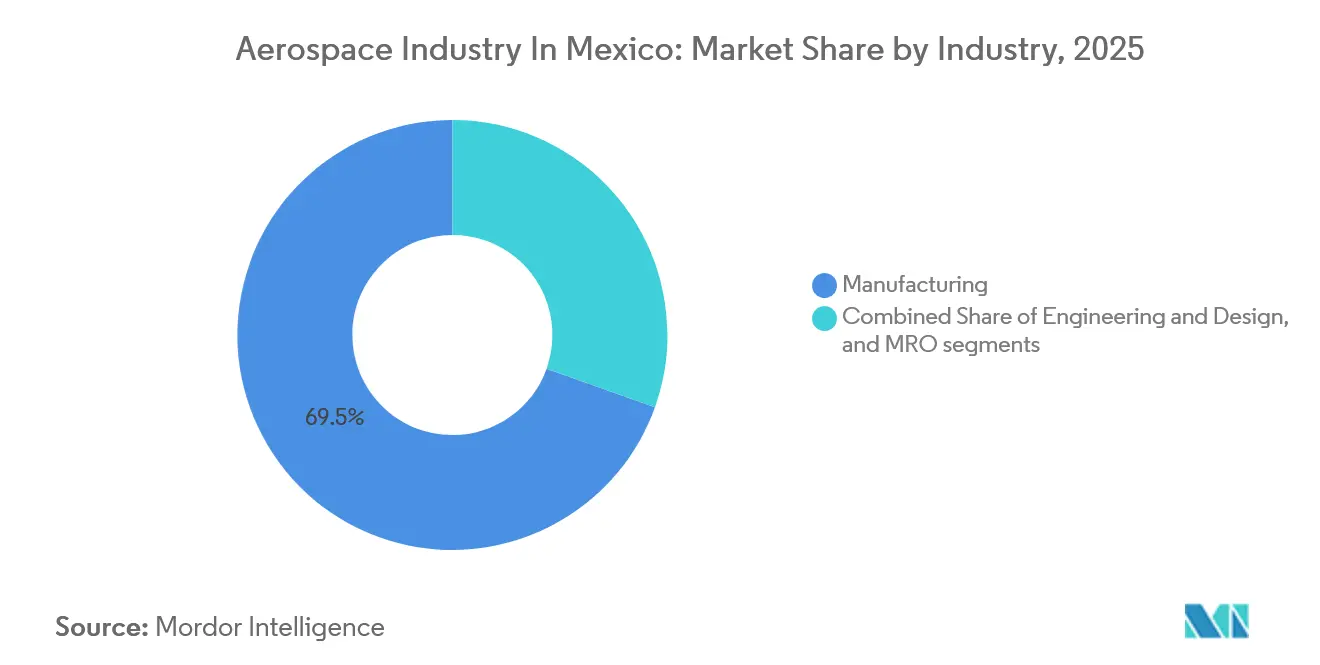
- By industry, maintenance, repair, and overhaul will grow at 8.27% through 2031, while Manufacturing retained 69.54% of the Aerospace Industry market share in Mexico in 2025.
- By platform type, fixed-wing aircraft accounted for 83.42% of revenue in 2025; rotary-wing programs are forecasted to advance at a 7.40% CAGR through 2031.
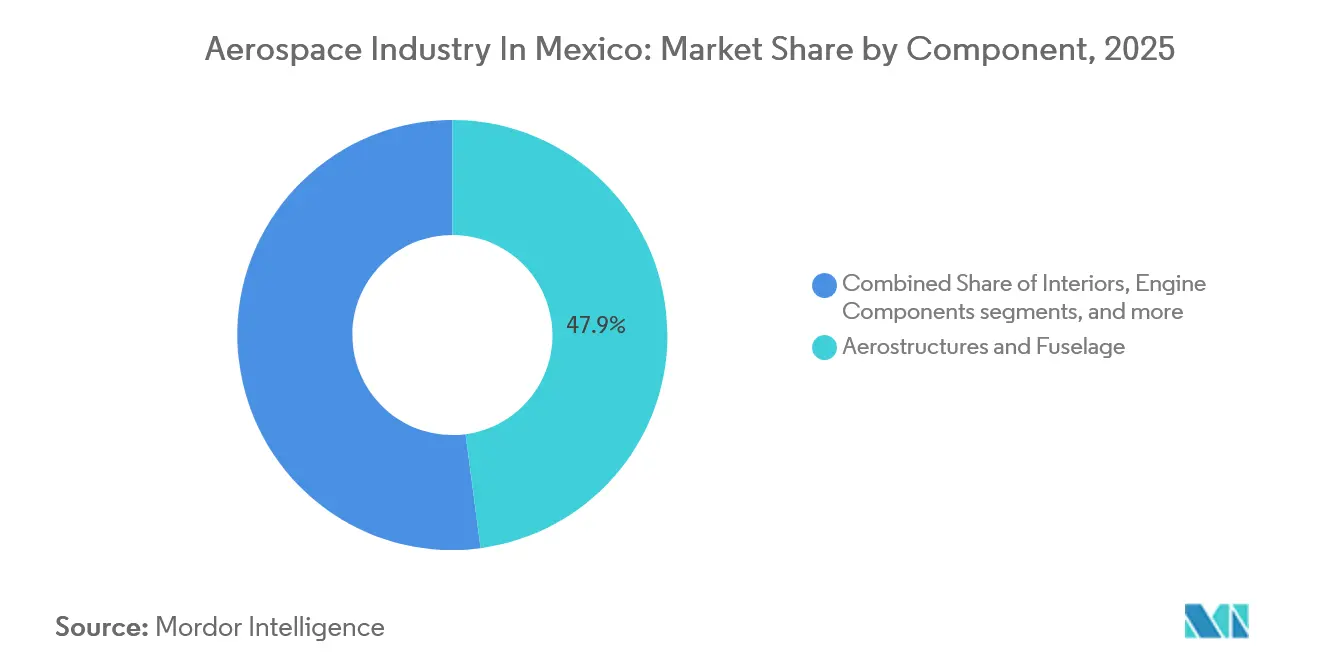
- By component, aerostructures and fuselage secured 47.91% of 2025 revenue; however, engine components are poised to expand at a 7.56% CAGR during 2026-2031.
- By end user, commercial operators accounted for 78.12% of 2025 demand, whereas military procurement is projected to rise 8.19% annually through 2031.
Note: Market size and forecast figures in this report are generated using Mordor Intelligence’s proprietary estimation framework, updated with the latest available data and insights as of January 2026.
Mexico Aerospace Market Trends and Insights
Drivers Impact Analysis*
| Driver | (~) % Impact on CAGR Forecast | Geographic Relevance | Impact Timeline |
|---|---|---|---|
| Nearshoring acceleration from USMCA | +1.80% | Querétaro, Sonora, Chihuahua, Baja California | Medium term (2-4 years) |
| Expanding skilled aerospace workforce | +1.20% | Querétaro, Sonora, Chihuahua, Nuevo León, Baja California | Long term (≥ 4 years) |
| FAA Category 1 recovery and BASA expansion | +0.90% | Nationwide with cross-border spillover | Short term (≤ 2 years) |
| Aging North-American fleet boosting MRO | +1.40% | Nationwide, especially Querétaro and Nuevo León | Medium term (2-4 years) |
| AI-enabled design and predictive maintenance | +0.70% | Early adopters in Querétaro and Monterrey | Long term (≥ 4 years) |
| New multimodal corridors | +0.60% | Southern Mexico corridor benefiting national distribution | Medium term (2-4 years) |
| Source: Mordor Intelligence | |||
Nearshoring Acceleration from USMCA And Supply-Chain Remapping
USMCA regional-value thresholds of 60% have redirected significant tier-one sourcing from Asia to Mexico, protecting a 15-20% landed-cost edge over European production after tariffs. Safran’s new test cell in Querétaro and Diehl Aviation’s 8,200-square-meter interiors plant illustrate capital inflows aligned with the agreement. Mexican suppliers built buffer inventory during pandemic shocks and now report higher readiness for production-rate hikes, indicating resilience to continued demand surges. Although the 2026 USMCA policy review introduces uncertainty on labor and dispute-settlement clauses, Mexico’s Plan México industrial strategy is set to cushion potential shocks by promoting domestic composite material and tooling output. Political stability around these negotiations will influence the aerospace industry in Mexico market trajectory in the medium term.[1]
Expanding Skilled Aerospace Workforce and Specialized Clusters
Mexico employed 58,000 aerospace workers in 2024, with 35% located in Querétaro. Universities such as UNAQ tailor AS9100-aligned curricula that cut onboarding times for tier-one suppliers by 30%. Honeywell’s Chihuahua site, operating over 1,300 machines under a vertically integrated model, exemplifies the demand for multitasking technicians skilled in CNC programming and composite lay-up. Wage inflation is expected to increase average engineer compensation by 17% by 2030, prompting local firms to consider automation to maintain their margins. The Consejo Mexicano de Educación Aeroespacial forecasts a net requirement for 15,000 additional professionals over the decade, underscoring the need for continuous talent-pipeline expansion and upskilling.
Government BASA And FAA Category 1 Recovery
In September 2023, the reinstatement of Category 1 status paved the way for Mexican carriers to expand their US route network and for MRO shops to service US-registered aircraft. Following this, Viva Aerobus unveiled plans for an MXN 4 billion (USD 231.76 million) widebody maintenance complex in Querétaro.[2] Simultaneously, the government allocated MXN 1.5 billion (USD 86.96 million) to rejuvenate the erstwhile Mexicana de Aviación hangar. Over 87% of Mexican suppliers have now obtained AS9100 certifications, a move driven by OEM demands for consistent traceability. Furthermore, participating in FAA joint audits not only reduces recertification costs but also accelerates newcomers' entry into the lucrative aftermarket segment.[3]
Aging North American Fleet Raising Local MRO Demand
Delivery delays have pushed the average global fleet age to 13.4 years, raising airframe and engine maintenance requirements. Mexico’s proximity to operators in the United States and Canada positions its MRO centers to absorb spillover work. Safran’s USD 80 million LEAP engine shop in Querétaro went live in January 2026, offering 350 shop-visits annually by 2030, while GE Aerospace expanded overhaul lines for CFM56 and GE90 engines in Sonora. As predictive-maintenance platforms like Airbus Skywise gain traction, downtime avoidance aligns directly with the growth of local digital service providers.
Restraints Impact Analysis*
| Restraint | (~) % Impact on CAGR Forecast | Geographic Relevance | Impact Timeline |
|---|---|---|---|
| Global material and engine-parts shortages | -1.10% | Querétaro and Sonora manufacturing clusters | Short term (≤ 2 years) |
| High OEM power limiting local value-addition | -0.80% | Nationwide, chiefly tier-2 and tier-3 suppliers | Long term (≥ 4 years) |
| Brain-drain of senior engineers | -0.50% | Border states Baja California, Sonora, Chihuahua | Medium term (2-4 years) |
| Energy-price volatility | -0.40% | Energy-intensive machining and heat-treatment facilities | Medium term (2-4 years) |
| Source: Mordor Intelligence | |||
Global Material and Engine-Parts Shortages Delaying Production
The absence of domestic titanium sponge production forces reliance on foreign inputs at inflated prices, thereby stretching lead times for critical aerostructures. Parallel delays for turbine blades and combustion liners extend aircraft delivery schedules, trimming 2024 supplier revenue. Personnel shortages at machining firms exacerbate the bottleneck, underscoring the need for supply-chain risk diversification strategies and strategic stockholding.
High OEM Power Limits Local Value-Addition Margins
Design authority and intellectual property remain with OEMs, leaving Mexican firms in lower-margin fabrication niches with operating margins around 5%. Take-or-pay clauses and 90-day payment cycles diminish cash flow and deter investments in avionics integration or additive manufacturing. Access to certification data packages often entails fees that absorb a fifth of added revenue, reinforcing the structural profitability ceiling facing domestic suppliers. Bridging this gap requires coordinated policy incentives and collaborative R&D frameworks that involve system integrators.
*Our forecasts treat driver/restraint impacts as directional, not additive. The impact forecasts reflect baseline growth, mix effects, and variable interactions.
Segment Analysis
By Industry: MRO Outpaces Manufacturing Growth
Maintenance, repair, and overhaul spending is projected to increase at an annual rate of 8.27% through 2031. The aerospace industry in Mexico market size for this activity benefits from the FAA-restored bilateral approvals, an aging North American fleet, and investments such as Safran’s 14,000-square-meter LEAP engine shop in Querétaro. Viva Aerobus follows suit with a 160-aircraft capacity complex slated for 2027. Manufacturing still accounts for 69.54% of Mexico's aerospace industry market share in 2025, anchored by aerostructure flowlines in Querétaro and Sonora. Near-shoring, USMCA compliance, and automation reinforce manufacturing relevance, yet growth lags MRO given softer rate increases on new aircraft platforms. Engineering and Design remains a small yet strategic slice, gaining interest where composite tooling and jig design are required for next-gen programs.
Future competitiveness will rest on suppliers’ ability to broaden their value proposition. Establishing integrated MRO-plus-parts-manufacturing campuses reduces logistics costs and fosters cross-functional skills. Government incentives that subsidize tooling or AS9100 certification further narrow the gaps with higher-cost jurisdictions, keeping the Mexican aerospace industry market attractive for green-field entrants.

By Platform Type: Rotary Wing Gains Altitude
Fixed-wing aircraft held 83.42% of 2025 revenue, driven by narrow-body builds for Airbus and Boeing. However, helicopter airframes are poised for 7.4% CAGR growth through 2031 as Bell ramps cabin production and Safran Landing Systems expands landing-gear overhaul capacity. The military procurement of 11 UH-60M and H225M helicopters supports the demand for rotary-wing components and avionics. Space remains nascent but gains visibility after the AztechSat-1 nanosatellite mission and the planned 2027 low-earth-orbit satellite.
Market participants are collaborating across various platform types to share knowledge of composite fabrication. Fixed-wing suppliers utilize out-of-autoclave technology, which is subsequently applied to helicopter rotor heads and space-capsule structures. This cross-pollination diversifies revenue streams, smoothing cyclicality.
By Component: Engine Components Accelerate
Aerostructures and fuselage captured 47.91% of the aerospace industry's market size in Mexico in 2025, a position secured by high-volume metallic machining and composite lay-up lines concentrated in Querétaro and Sonora. This dominant share reflects two decades of supplier specialization in wing ribs, floor beams, and Section 15 fuselage panels for Airbus A320 and Boeing 737 MAX programs. Engine components, however, are set to narrow the gap, expanding at a 7.56% CAGR through 2031 on the back of Safran’s 14,000 m² LEAP maintenance hub that opened in January 2026 and GE Aerospace’s MXN 550 million upgrade of CFM56 and GE90 overhaul cells in Hermosillo and Saltillo. ETU Aerospace’s titanium and Inconel machining portfolio for Trent XWB and PW1000G programs further diversifies domestic capability, while additive-manufacturing pilots for fuel-nozzle swirlers promise cycle-time cuts of up to 40% and first-pass-yield gains of 15%.
Avionics and space electronics occupy a growing mid-tier, buoyed by Collins Aerospace’s Mexicali lines for SATCOM antennas and the Mexican Space Agency’s export of the SCMI nanosatellite command module in October 2025, the country’s first space-electronics shipment. Interiors retain predictable aftermarket pull as single-aisle cabin retrofits surge; Safran’s Tijuana and Chihuahua complexes supply overhead bins, lavatories, and the world’s largest wiring-harness plant servicing 350 aircraft sets yearly. Landing-gear work remains concentrated in Safran’s Querétaro MRO center. At the same time, new production gear is still sent offshore due to certification hurdles that can add USD 15 million and three years to project timelines. Suppliers able to integrate AI-driven quality-inspection rigs report scrap reductions of nearly 12%, a margin enhancer that encourages reinvestment in higher-value engine casing and hot-section work. Collectively, these shifts signal a gradual re-balancing of the aerospace industry in Mexico's market share away from legacy aerostructures toward digitally enabled, higher-margin propulsion and electronics niches.
By End User: Military Segment Surges
Commercial operators generated 78.12% of 2025 revenue, anchored by Airbus’s over 50% share of Latin America’s active fleet and Boeing’s extensive narrow-body backlog. Recovery in cross-border travel after the FAA’s 2023 restoration of Category 1 status has reignited narrow-body utilization, feeding continuous demand for Mexican-made interior kits, nacelles, and quick-turn engine overhauls. Low-cost carriers also deepen the pipeline: Viva Aerobus is building a MXN 4 billion (USD 222.482 million), 160-aircraft MRO complex in Querétaro, which is set to open in 2027, guaranteeing steady shop-visit volumes for domestic suppliers.
The military end user, although smaller, posts the fastest growth at an 8.19% CAGR as the Mexican Air Force modernizes its 325-aircraft inventory, including orders for seven UH-60M Black Hawks and four H225Ms, with delivery scheduled for 2027. Helicopter upgrades trigger ancillary demand for Safran gearbox MRO and Bell cabin spares, while surveillance and disaster-relief missions extend flight hours, lifting parts consumption. Defense outlays reached USD 8.54 billion in 2022 (0.61% of GDP) and remain skewed toward internal security, making multi-role transport aircraft, utility helicopters, and associated support contracts the primary spending targets. As predictive-maintenance suites like Airbus Skywise connect a growing share of military transports, domestic analytics firms are gaining entry into defense workstreams that have historically defaulted to US contractors, cementing a virtuous loop of data-driven upgrades and localized sustainment within the aerospace industry in the Mexican market.
Geography Analysis
The five-cluster structure, Querétaro, Sonora, Chihuahua, Nuevo León, and Baja California, contributes 95% of national employment and value. Querétaro alone houses a third of the workforce as well as marquee investments from Safran, ITP Aero, and Bombardier. Sonora and Chihuahua specialize in engine overhauls and helicopter cabin builds, while Nuevo León leverages Monterrey’s electronics base for avionics and wiring harnesses. Baja California’s Mexicali-Tijuana corridor combines interior and composite expertise with border-crossing efficiency.
Southern diversification is facilitated through the Interoceanic Corridor industrial parks, which offer tax incentives and multimodal freight routes. Airport infrastructure upgrades worth MXN 126.6 billion between 2025 and 2030 expand cargo throughput, facilitating just-in-time delivery of high-value components. Cross-border exports reached USD 10 billion in 2024, with an 80% share destined for US and Canadian OEMs. The target of USD 22.7 billion by 2029 implies a 17.8% export CAGR, well above the domestic consumption rate. Electricity supply remains a longer-term risk, requiring 64,595 MW of incremental capacity to sustain industrial momentum.
Regulatory Landscape
Mexico's civil aviation is regulated by the Agencia Federal de Aviacion Civil (AFAC) under the Ley de Aviacion Civil and its implementing regulation, which cover airworthiness, operations, licensing, and oversight across commercial and general aviation. A key recent standards anchor is NOM-064-SCT3-2023, which sets Safety Management System (SMS) requirements for aircraft operations and is effective from December 2024, increasing compliance obligations for operators and service providers.
For market entry and operating continuity, AFAC procedural instruments shape certification timelines, including Circular Obligatoria CO-AV-119-01-24 that details processes to obtain or amend an Air Operator Certificate (AOC). On the industrial side, aerospace manufacturing and MRO participants commonly use trade-facilitation mechanisms such as IMMEX and VAT Certification (linked to the 16% VAT) to manage cash flow on import-intensive inputs, while Chapter 98 tariff provisions (e.g., 9806.00.05 and 9806.00.06) provide potential duty relief for authorized aircraft maintenance, subassembly, or production goods. In 2026, the sector has been engaged through Ministry of Economy working groups, with FEMIA reporting participation tied to USMCA review-related trade adaptation discussions, keeping policy alignment and documentation discipline central for exporters.
Value Chain Analysis
Mexico's aerospace value chain is export-oriented and clustered, with OEM and Tier-1 led manufacturing and assembly supported by specialized industrial parks and cross-border logistics. Roughly 80% to 82% of output ships to the United States, reinforcing dependence on North American demand cycles and customs throughput. Upstream inputs include metals and composites, tooling, machining, and electronics, while midstream activities cover aerostructures fabrication, wiring harnesses, engine-component machining, interiors, and an expanding MRO footprint concentrated in hubs such as Queretaro, Sonora, Chihuahua, Nuevo Leon, and Baja California.
A recurring structural constraint is the inverted supplier pyramid: Tier 1 suppliers and large multinational operations are relatively mature, but Tier 3 and Tier 4 specialists remain underrepresented. This limits scalability and increases reliance on imported subcomponents and certified special processes. Entry and progression through the chain are gated by aerospace quality standards (AS9100 for design/manufacture, AS9110 for MRO, and AS9120 for distribution), and short-term cost volatility has been amplified by US trade actions, including steel and aluminum tariffs taking effect in June 2025. As a result, supplier development, certification readiness, and logistics resilience (including border-crossing lead time management) are central levers for improving local value-add and delivery performance.
Competitive Landscape
Market concentration is moderate. Safran leads the employment sector with 14,000 workers across 30 sites. Other global OEMs, Airbus SE, The Boeing Company, Honeywell International Inc., RTX Corporation, and Bombardier Inc., retain design authority, keeping Mexican operations focused on fabrication and sub-assembly with single-digit operating margins. This structure leaves room for domestic challengers such as ETU Aerospace to climb the value chain into additive manufacturing and titanium machining. Automation and digital twins emerge as common strategic themes. Honeywell’s vertically integrated Chihuahua plant reduces lead times by 25% through in-house machining and assembly, while Airbus leverages Skywise analytics to extend the life of parts and cut flight disruptions. Regulatory readiness for space technology and AI integration suggests competitive boundaries will shift toward software-enabled services in the coming decade.
Mexico Aerospace Industry Leaders
-
Safran SA
-
Airbus SE
-
Honeywell International Inc.
-
Bombardier Inc.
-
RTX Corporation
- *Disclaimer: Major Players sorted in no particular order
Market Opportunities and Future Outlook
Named capacity additions in 2026 highlight whitespace in higher-value production and support services beyond labor-led fabrication. Airbus expanded its Colon, Queretaro operations with an MXN 646.7 million investment to raise output of passenger doors (including for A321 and A330) and add helicopter-related work content. Safran inaugurated a new electrical wiring factory in Chihuahua that expanded its campus to over 71,000 m2, strengthening Mexico's position in complex electrical interconnect systems. Together, these moves increase the addressable opportunity for qualified local Tier 2 and Tier 3 suppliers in precision machining, special processes, electronics, and certified distribution that can meet traceability and delivery-window requirements.
Aftermarket and propulsion-related services also present a second opportunity lane tied to new facilities: Safran opened a dedicated LEAP engine maintenance shop in Queretaro in 2026, reinforcing the shift toward engine shop visits, test capability, and rapid-turn repair ecosystems. Industry participation in 2026 USMCA review working groups reported by FEMIA points to a near-term need for compliance-enabled supply chain localization, documentation, and labor-standard alignment, which creates demand for advisory, digital quality systems, and certified process capacity to help exporters maintain preferential access. In parallel, Plan Mexico's stated push toward space-related frameworks (including an Outer Space Law concept) and announced national space-mission goals creates a niche for avionics and space-electronics assembly and test capability, where Mexico has early activity but will still need capability buildout around certification, clean-room processes, and export-control aware workflows.
Recent Industry Developments
- July 2026: Safran inaugurated a new electrical wiring factory in Chihuahua, adding a 10,600 square meter facility and expanding the site to more than 71,000 square meters. The expansion increases Mexico-based capacity for complex electrical interconnect systems supporting multiple aircraft programs, strengthening local content and shortening lead times for North American supply chains.
- June 2026: Safran opened a new maintenance shop in Queretaro dedicated to CFM LEAP engines as part of its MRO hub buildout in the Americas. The facility strengthens in-country engine aftermarket capability and supports higher-value shop-visit activity that ties Mexico more tightly to airline and lessor maintenance cycles.
- November 2024: Safran announced an expansion of engine production capacity in Queretaro as part of strengthening its footprint in Mexico. The capacity upgrade supports increased throughput for propulsion-related manufacturing work and reinforces Queretaro's role as a core cluster for engine-component and industrial-process capability.
Research Methodology Framework and Report Scope
Market Definition and Coverage
For this study, the Mexico aerospace market is defined as the value generated in Mexico from aerospace manufacturing and related services that support aircraft and space systems, including engineering and design work and MRO activity tied to aerospace platforms.
Scope exclusions: We exclude purely military operations spending that is not linked to equipment manufacturing or lifecycle services, and we also exclude passenger airline ticket revenue and airport operations.
Segmentation Overview
- By Industry
- Manufacturing
- Engineering and Design
- Maintenance, Repair and Overhaul (MRO)
- By Platform Type
- Fixed-Wing
- Commercial Aviation
- Narrowbody Aircraft
- Widebody Aircraft
- Regional Transport Aircraft
- Business and General Aviation
- Business Jets
- Light Aircraft
- Military Aviation
- Combat Aircraft
- Transport Aircraft
- Special Mission Aircraft
- Commercial Aviation
- Rotary Wing
- Commercial Helicopters
- Military Helicopters
- Space
- Satellites
- Launch Vehicles
- Fixed-Wing
- By Component
- Aerostructures and Fuselage
- Engine Components
- Avionics and Space Electronics
- Interiors
- Landing Gear
- Others
- By End User
- Commercial
- Military
Data Sources, Market Sizing, and Validation
Desk Research
Desk work was used to set the starting structure of the market and to select practical indicators that can be checked year to year. We used public sources such as Mexico trade and customs statistics, the International Trade Administration country guide, and official statistical agencies for national accounts and industrial output series. We also relied on central bank FX and inflation time series for currency and timing adjustments.
For aviation and defense context, we reviewed publications and datasets from bodies such as ICAO, IATA, and SIPRI, and we incorporated peer reviewed papers on aerospace supply chains and manufacturing clusters. We then cross-checked this foundation with company filings and investor presentations for operators with Mexico exposure, plus official announcements and reputable press coverage for plant expansions and new programs.
Where needed, subscribed tools were used for company financials and intelligence, aircraft and engine fleet details, patent lookups, and shipment level import and export checking. The sources listed above are illustrative only, and many other public references were also used for data collection, validation, and clarification.
Primary Interviews and Surveys
Primary work focused on validating what portion of Mexico aerospace activity is captured as manufacturing, engineering and design, and MRO, then stress-testing the pricing and volume assumptions behind each stream. We spoke with a mix of OEM and supplier side roles, MRO and engineering services participants, and demand side experts tied to commercial and defense aviation, with coverage across the main Mexico aerospace clusters and external buyers that influence Mexico output.
Distribution of primary research fieldwork respondents
| Company type | Respondent position |
|---|---|
| Top tier: 39% | CXOs: 15% |
| Mid tier: 42% | Functional/Unit leaders: 32% |
| Smaller Players: 19% | Managers: 53% |
Market-Sizing & Forecasting
Sizing started with a top-down build where production and trade data reconstruct the Mexico aerospace value pool, then it is allocated into manufacturing, engineering and design, and MRO using shares validated in interviews. The totals were then checked through selective bottom-up approximations, where sampled facilities and programs were translated into volume indicators and average value per unit, to keep the final numbers realistic.
Key inputs used in the model include aerospace export and import trends, the pace of aircraft deliveries and aftermarket cycles that drive MRO, the mix of commercial versus military demand, manufacturing capacity additions in major clusters, and USD to MXN conversion timing for reported values. For forecasting, we used scenario analysis supported by expert consensus, since near-term output depends on program ramps, supply chain constraints, and air traffic driven fleet utilization. Where bottom-up references had gaps, assumptions were filled using comparable plant types and service intensity ranges, followed by another review with interview feedback.
Data Validation & Update Cycle
Validation was done through multiple checks so the final totals do not move only because one input changed. Model outputs were compared with independent signals like aerospace trade values, known capacity expansions, and MRO activity trends, and any large variance was reviewed and corrected with a clear reason noted. Before sign-off, the work goes through a multi-step analyst review, and respondents are re-contacted when a major mismatch shows up or when new policy or program news changes assumptions.
The report is refreshed annually, and we also do interim updates when there are material events such as a major plant opening, a sharp FX move, or a shift in defense procurement plans. Before delivery, an analyst performs a fresh pass across the key data series so clients receive the latest updated view.
Mordor Intelligence's Mexico Aerospace Market Size Measured Against Other Published Estimates
Published market sizes for Mexico aerospace do not always match, even when the same years are quoted, because groups often mix different revenue pools and treat trade flows differently. Differences also come from how fast pricing is allowed to rise over the forecast period, and whether the model is refreshed after new export and program announcements.
The main gap comes from scope around what gets counted as Mexico aerospace output versus broader aviation activity. Mordor Intelligence counts manufacturing, engineering and design, and MRO tied to aerospace platforms, and avoids folding in airline operations or airport services that can inflate totals.
Benchmark comparison
| Source | Market Size | Gaps in Research Methodology |
|---|---|---|
| Mordor Intelligence | USD 8.30 B (2025) | |
| Government Trade Brief A | USD 10.70 B (2024) | Uses aerospace exports as the headline value, which can overstate the domestic industry size because it excludes local for-local activity and mixes price effects with volume shifts. |
| Market Publisher B | USD 11.73 B (2024) | Applies a wider definition that can blend in space and defense adjacent systems with limited visibility on Mexico-only value added, and it may assume faster price and capacity ramps across the forecast window. |
The spread is mostly explained by whether a figure is built from export totals, a broad aerospace umbrella, or a Mexico value-added market model. By anchoring the sizing to observable trade and production signals and then checking allocation shares with interviews, we keep the estimate traceable to clear drivers and easier to reproduce when inputs change.
Key Questions Answered in the Report
How large is the Mexico aerospace market in 2026 and what CAGR is expected to 2031?
The Mexico aerospace market size is USD 8.88 billion in 2026 and is projected to grow at a 6.94% CAGR, reaching USD 12.41 billion by 2031.
Which segment is expanding the fastest?
Maintenance, Repair and Overhaul shows the highest growth, advancing at 8.27% annually through 2031.
Where are the main aerospace clusters located?
Five regions dominate: Querétaro, Sonora, Chihuahua, Nuevo León, and Baja California together account for 95% of national output and employment.
What role does USMCA play in industry growth?
USMCA rules of origin raise regional content thresholds, encouraging OEMs to relocate component sourcing to Mexico and safeguarding a cost advantage versus offshore suppliers.
How does FAA Category 1 status benefit Mexican firms?
Category 1 enables Mexican carriers to open new U.S. routes and allows domestic MRO shops to service U.S.-registered aircraft, broadening aftermarket opportunities.
Which components are seeing the strongest demand rise?
Engine components are forecast to expand at a 7.56% CAGR, benefitting from new overhaul centers and higher shop-visit volumes for LEAP and CFM56 engines.