
Market Overview
| Study Period | 2020 - 2031 |
|---|---|
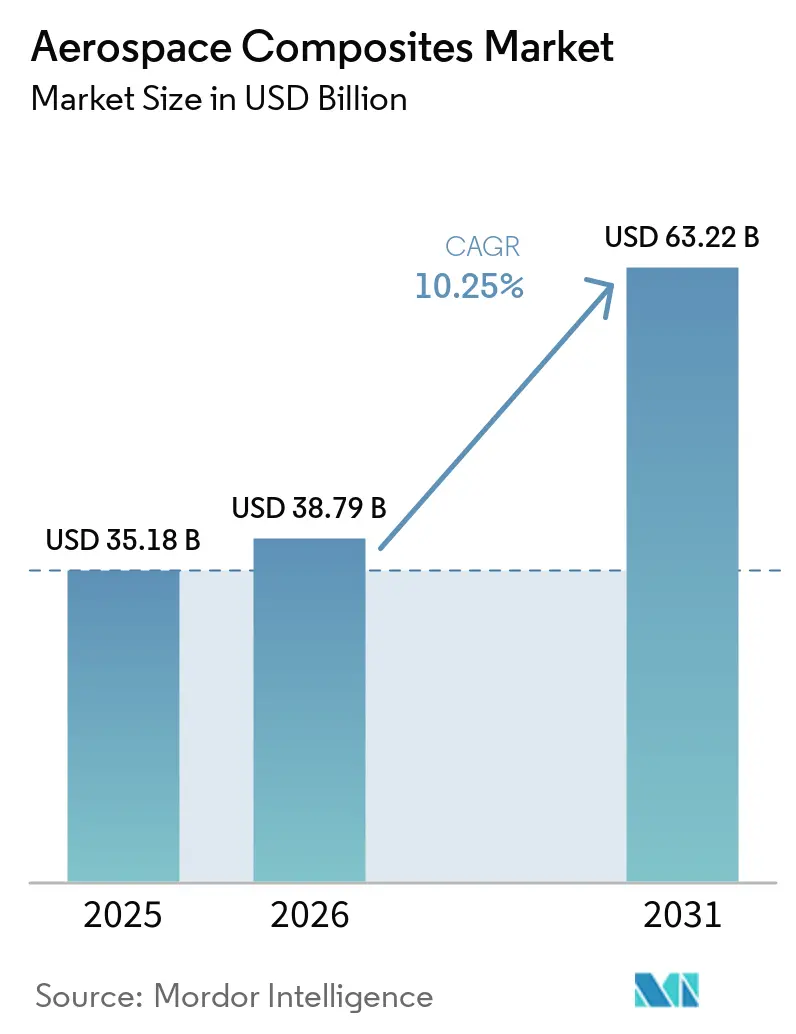
| Market Size (2026) | USD 38.79 Billion |
| Market Size (2031) | USD 63.22 Billion |
| Growth Rate (2026 - 2031) | 10.25 % |
| Fastest Growing Market | Asia Pacific |
| Largest Market | North America |
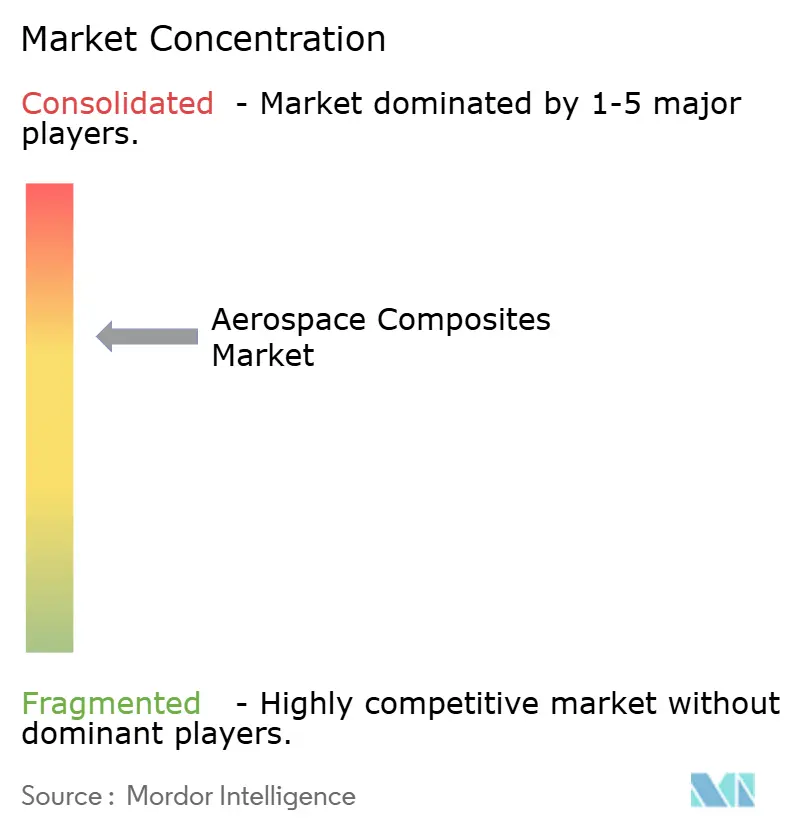
| Market Concentration | Medium |
Major Players *Disclaimer: Major Players sorted in no particular order Image © Mordor Intelligence. Reuse requires attribution under CC BY 4.0. | |
Aerospace Composites Market Analysis by Mordor Intelligence
The aerospace composites market size is expected to grow from USD 35.18 billion in 2025 to USD 38.79 billion in 2026 and is forecast to reach USD 63.22 billion by 2031 at 10.25% CAGR over 2026-2031. Strong demand for lightweight structures that enhance fuel efficiency, expanding hypersonic programs, and the growing need for recyclable materials are the central forces shaping the market. Automated fiber placement (AFP) systems delivering 4–8 times higher throughput than legacy lay-up lines, the rapid uptake of thermoplastics in single-aisle backlogs, and fleet electrification requirements for high-temperature parts are among the most influential growth drivers. Major aircraft OEMs vertically integrate composite production to control quality and cost, intensifying supplier competition and accelerating qualification cycles for novel resins. Asia’s expanding manufacturing base and rising investments in electric propulsion are turning the region into the fastest-growing hub in the market.
Key Report Takeaways
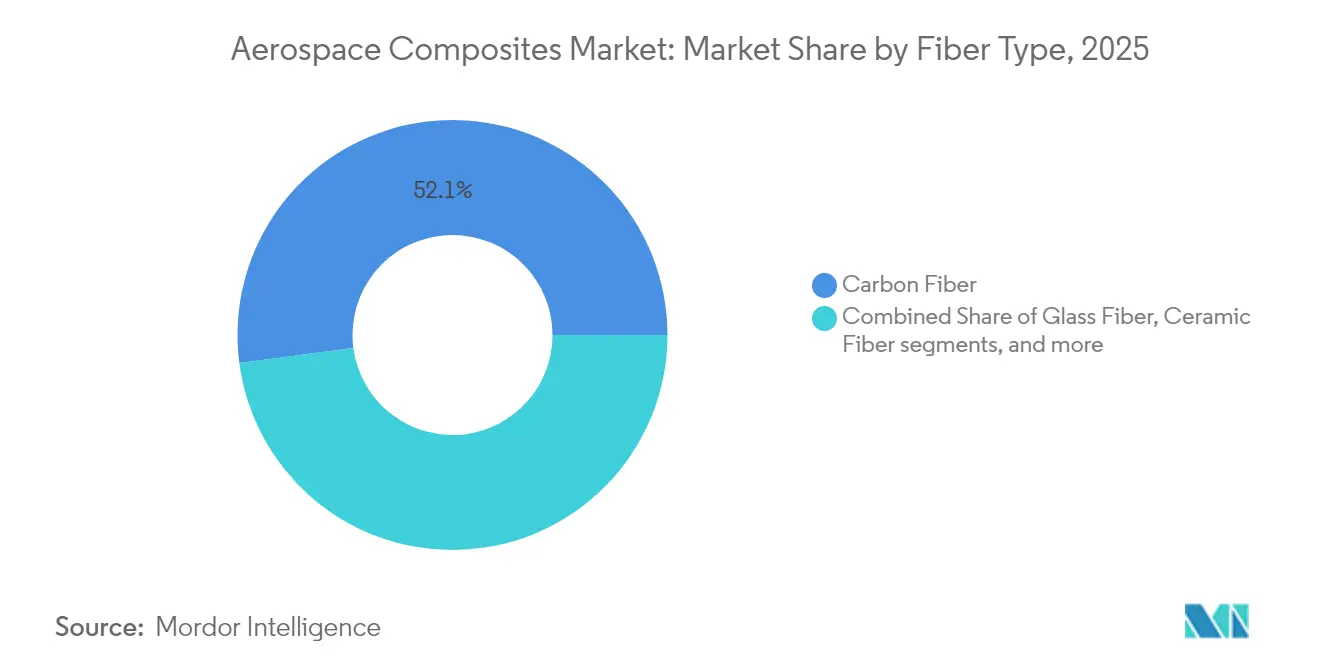
- By fiber type, carbon fiber held 52.08% of the aerospace composites market share in 2025, while ceramic fiber is forecast to expand at a 10.74% CAGR through 2031.
- By resin type, thermosets led with 45.73% revenue share in 2025, but thermoplastics are advancing at a 13.22% CAGR to 2031.
- By manufacturing process, prepreg lay-up accounted for a 44.25% share in 2025; AFP registered the fastest growth at a 12.76% CAGR, supporting growth in the aerospace composites market.
- By aircraft type, commercial narrow-body aircraft captured 38.02% of the market size in 2025, whereas spacecraft/launch vehicles are expected to grow at a 14.41% CAGR.
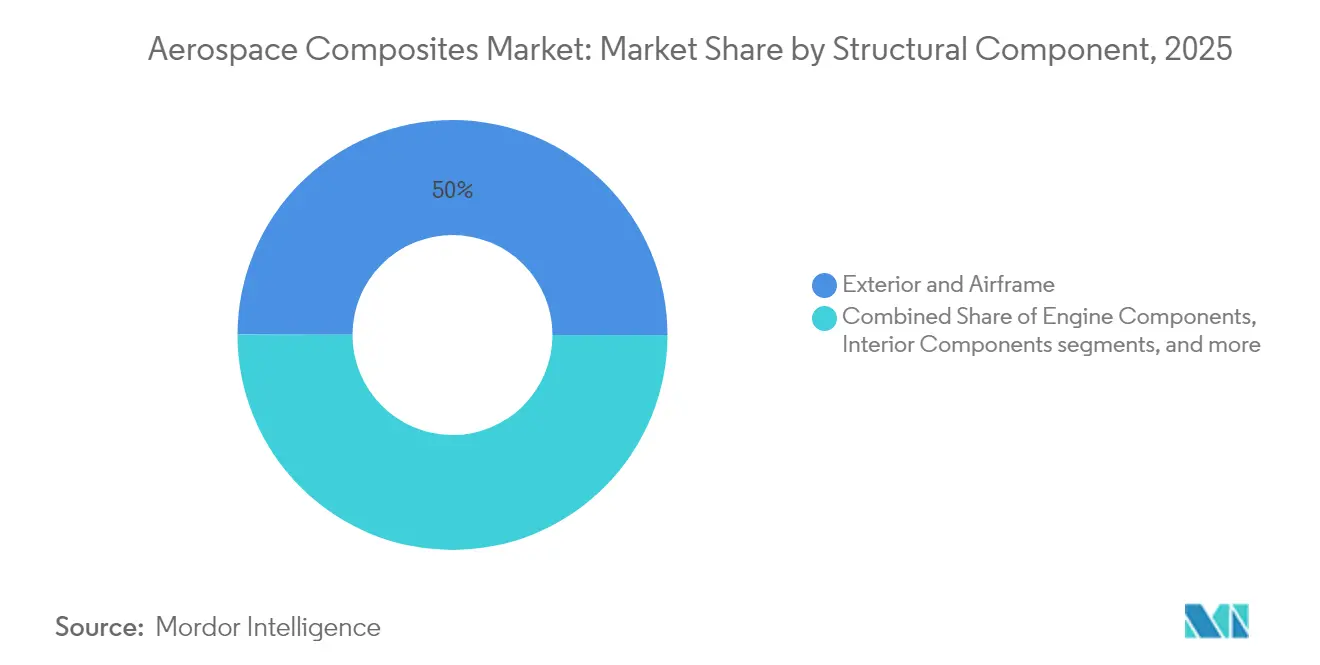
- By structural component, exterior and airframe parts represented a 49.96% share of the market in 2025; engine parts are growing the quickest at a 17.12% CAGR, supporting growth in the aerospace composites market.
- By end-user, OEMs dominated with an 79.88% share in 2025, while the aftermarket/MRO segment is projected to rise at 8.74% CAGR.
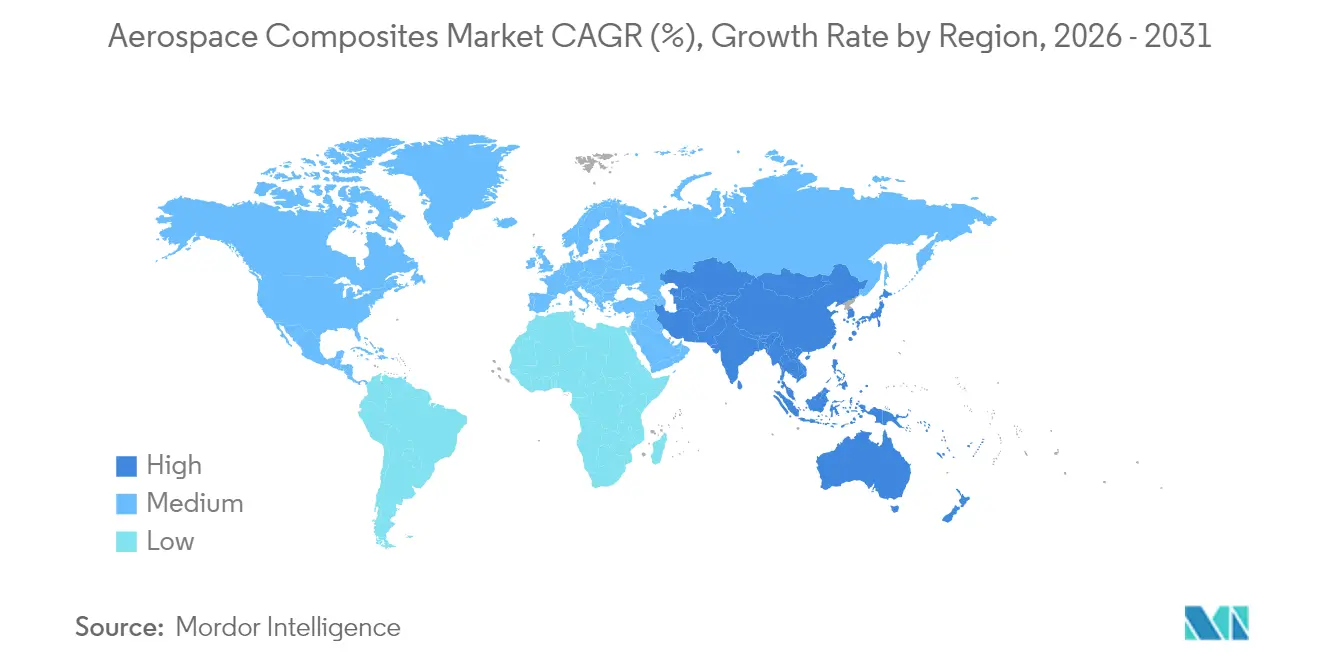
- By region, North America held 29.71% of global revenue in 2025; the Asia-Pacific region is poised for a 10.30% CAGR through 2031, supporting growth in the aerospace composites market.
Note: Market size and forecast figures in this report are generated using Mordor Intelligence’s proprietary estimation framework, updated with the latest available data and insights as of 2026.
Market Trends and Insights
Drivers Impact Analysis of Aerospace Composites Market*
| Driver | (~) % Impact on CAGR Forecast | Geographic Relevance | Impact Timeline |
|---|---|---|---|
| Rapid adoption of thermoplastic composites to accelerte production rates of single-aisle programs (Europe-led) | +2.5% | Europe-led global | Medium term (2-4 years) |
| Increasing penetration of carbon fiber in next-gen narrow-body wings in North America | +1.8% | North America, Europe | Medium term (2-4 years) |
| Fleet eletrification and more-electric aircraft (MEA) driving high-temperature composite demand in Asia | +1.2% | Asia, global | Medium term (2-4 years) |
| Space-launch commercialization boosing demand for lightweight composite structures | +2.0% | US, China, global | Short term (≤2 years) |
| Military stealth programs propelling ceramic-matrix composite uptake in hypersonic applications | +1.5% | US, China, Russia | Medium term (2-4 years) |
| OEM sustainability targets pushing recyclable composite solutions | +1.0% | Europe-led global | Long term (≥5 years) |
| Source: Mordor Intelligence | |||
Rapid Adoption of Thermoplastic Composites
Collins Aerospace demonstrates that thermoplastic aerostructures cut production cycles by 80%, eliminate autoclave curing, and are nearly 100% recyclable.[1]European single-aisle programs have embraced the material to reduce delivery backlogs. At the same time, an Arkema-Hexcel partnership produced the first fully thermoplastic commercial aircraft structure, validating large-scale out-of-autoclave fabrication. High recyclability aligns with emerging sustainability mandates, positioning thermoplastics as a cornerstone of future market expansion.
Increasing Penetration of Carbon Fiber in Next-Gen Narrow-Body Wings
Airbus’s eXtra Performance Wing testbed incorporates extensive CFRP skins to lower drag and cut CO₂, showcasing the build feasibility of 32 m-long carbon-fiber wingskins.[2] North American programs perform parallel studies, aiming to match or exceed European CFRP usage. Weight savings of up to 50% versus aluminum and AFP throughput gains directly address the backlog challenge.
Fleet Electrification and More-Electric Aircraft
Electric propulsion subsystems require composite housings that endure 450°F operating environments; Hexcel’s high-temperature Flex-Core HRH-302 honeycomb meets this need. Asian manufacturers leverage electronics experience to integrate thermal management layers into composite skins, driving regional demand. The evolution of battery and fuel-cell architectures is expected to stimulate orders for hybrid polymer-ceramic laminates across the aerospace composites market.
Space Launch Commercialization
Reusable launchers depend on lightweight fairings; Chinese supplier Monks Aviation delivered composite fairings 30% lighter than metal designs for the Ceres-1 program. Parallel European initiatives are developing all-composite LH₂ tanks to TRL 5, underscoring strong market pull from private launch ventures. The spacecraft segment’s 14.90% CAGR positions it as the most dynamic pocket of the market of the aerospace composites market.
Restraints Impact Analysis of Aerospace Composites Market*
| Restraint | (~) % Impact on CAGR Forecast | Geographic Relevance | Impact Timeline |
|---|---|---|---|
| High preform and autoclave capital costs limiting adoption in tier-2 suppliers | -1.8% | Global, emerging markets | Short term (≤2 years) |
| Supply-chain volatility for aerospace-grade precursors for PAN-based carbon fiber | -2.0% | Global | Short term (≤2 years) |
| Qualification and certification delays for novel resin systems with FAA/EASA | -1.5% | Regulated markets | Medium term (2-4 years) |
| Limited repairability expertise for advanced thermoplastics in MRO sector | -0.8% | Global | Long term (≥5 years) |
| Source: Mordor Intelligence | |||
High Preform and Autoclave Capital Costs
Aerospace-grade autoclaves cost USD 5–10 million and require extensive infrastructure, deterring Tier-2 entrants. Out-of-autoclave thermoplastic welding and resin infusion are emerging as lower-investment alternatives that can broaden supplier participation across the aerospace composites market.
Supply-Chain Volatility of Aerospace-Grade Precursors
Major OEMs formed the Aviation Supply Chain Integrity Coalition to harden vendor accreditation and part traceability after recurring precursor shortages disrupted deliveries. Efforts include stricter non-conformance audits and digital tracking, but raw-material lead times remain an ongoing risk within the aerospace composites market.
*Our forecasts treat driver/restraint impacts as directional, not additive. The impact forecasts reflect baseline growth, mix effects, and variable interactions.
Aerospace Composites Market Segment Analysis
By Fiber Type:
Ceramic Fibers Expand Heat-Resistant EnvelopeCarbon fiber retained 52.08% of the aerospace composites market share in 2025, thanks to mature supply chains and superior stiffness-to-weight ratios. Ceramic fibers, however, are pacing the segment with a 10.74% CAGR, propelled by hypersonic and space vehicle demand for 1,500 °C capability. Hybrid laminates combining carbon and ceramic plies are gaining favor among engine OEMs aiming to cut cooling air draw by 25%. Graphene-enhanced rovings under evaluation show 20–30% modulus boosts while embedding strain-sensing pathways, a step toward self-monitoring wingskins.
The cost-effective positioning of glass fiber maintains relevance in radome and fairing skins, while aramid fibers sustain a share in ballistic-resistant helicopter floors. Continued material innovation supports diversification, yet carbon and ceramic remain the backbone of the market size throughout the forecast horizon.

By Resin Type:
Thermoplastics Challenge Thermoset DominanceThermoset epoxy and BMI systems commanded 45.73% of 2025 revenue because of an extensive qualification pedigree. Thermoplastic PEKK and PEI families are surging at a 13.22% CAGR, driven by 80% cycle-time reductions cited by Collins Aerospace. The aerospace composites market size for thermoplastics is projected to exceed USD 19.38 billion by 2031 as AFP lines pivot to in-situ consolidation. Bio-based resins pioneered by SHD Composites offer near-100% renewable content and withstand 200 °C service, aligning environmental targets with mechanical integrity.
Qualification momentum is accelerating: the FAA has already cleared welded thermoplastic control surfaces for business jets, signaling an imminent broadening of use cases across the industry.
By Manufacturing Process:
AFP Transforms High-Rate ProductionPrepreg lay-up delivered 44.25% of the 2025 value, yet AFP and automated tape laying are expanding at 12.76% CAGR as Electroimpact’s AFP 4.0 attains 99% quality compliance while quadrupling throughput on identical capital. The market size linked to AFP equipment installations is expected to outpace all other processes through 2031. RTM adoption is climbing for complex engine nacelles; additive composite printing remains nascent but offers topology-optimized brackets that cut buy-to-fly ratios by 80%. Under FAA assessment, the resin infusion for transport fuselages promises to shave operating costs in thin-walled shells, widening market accessibility.
By Aircraft Type:
Spacecraft Lead Growth amid Commercial RecoveryAs Airbus and Boeing cleared pandemic order backlogs, commercial narrow-bodies contributed the largest slice, 38.02% in 2025. The spacecraft and launch-vehicle category will grow at a 14.41% CAGR, reflecting private-launch proliferation and satellite constellation demand. Aerospace and defense composites remain relevant across military fleets, with stealth fighters integrating radar-absorbing CFRP skins. Business jets and rotorcraft incrementally raise composite content for range and payload gains. Emerging eVTOL craft call for high-rate thermoplastic fuselages, adding a fresh volume stream to the aerospace composites market.
By Structural Component:
Engines Drive Advanced-Material UptakeExterior skins and primary airframe members occupied 49.96% of 2025 revenue, yet engine components will climb fastest at 17.12% CAGR as CMC shrouds enable 200°F higher turbine entries. The aerospace composites market size attached to engines could nearly triple by 2031 as geared turbofan and open-rotor concepts seek mass and thermal advantages. Multifunctional laminates combining energy storage layers with load paths are under lab trials, pointing to future integration leaps.
By End-User:
MRO Opportunities Rise in Composite FleetOEMs controlled 79.88% of 2025 spend, but MRO is accelerating at 8.74% CAGR. Collins Aerospace operates eight global autoclave sites to service growing shop visits for composite airframes. GE Aerospace’s USD 1 billion injection into its repair network targets engine composite fan-case throughput to contain airline downtime. As the installed base ages, demand for bonded-patch and scarf-repair expertise will enlarge the aerospace composites market.
Geography Analysis
North America Aerospace Composites Market
North America remains the largest regional contributor with a market share of 29.71%, anchored by The Boeing Company, GE Aerospace, and Lockheed Martin Corporation. The region accounts for roughly 75% of North American sales, with Canada’s Montréal cluster supplying high-end nacelles. NASA’s HiCAM program underpins thermoplastic welding certification, reinforcing domestic supply chains.
Europe Aerospace Composites Market
Europe follows, propelled by Airbus and a robust tier network in Germany, France, and the United Kingdom. Aggressive sustainability mandates, such as the EU’s Fit for 55 package, are catalyzing the adoption of bio-based composites. Thermoplastic wineskins under production in Wales exemplify Europe’s commitment to high-rate, low-carbon manufacturing.
APAC Aerospace Composites Market
Asia-Pacific is the fastest-growing territory with a CAGR of 10.30%, driven by China’s COMAC fleet ramp-up and electric-propulsion R&D hubs in Japan and South Korea. HRC’s new Chinese plant supplies AFP stringers for aerospace and high-speed rail, underscoring manufacturing scale advantages. India is nurturing a composites corridor around Bengaluru, supplying ISRO launch vehicles and HAL fighters, further enlarging regional aerospace composites market activity.
LATAM and MEA Aerospace Composites Market
Latin America, led by Brazil’s Embraer, integrates composites in E2 jet families, while Mexico’s Querétaro cluster fabricates nacelle doors for North American primes. In the Middle East and Africa, the United Arab Emirates’ Strata composites facility and South Africa’s Denel Aerostructures are emerging contributors, aided by offset agreements and skills transfer.
Regulatory Landscape
Certification and continued airworthiness for composite structures are shaped by harmonized guidance from major regulators, including EASA AMC 20-29 and FAA AC 20-107B. These references influence how damage tolerance, durability substantiation, and repair and inspection methods are defined for bonded and laminated structures. In parallel, EASA updates to guidance material, including ED Decision 2025/019/R referencing ASTM F3115-15 in the CS-23 AMC context, reinforce standardized methodologies that material suppliers and airframe integrators must support through test allowables, process control, and quality assurance.
Trade and procurement policies also feed into sourcing and localization decisions for composite materials and parts in civil and defense aerospace. The White House directive dated July 9, 2026, following a Section 232 investigation into imports of commercial aircraft, jet engines, and parts, increases the emphasis on supply-chain traceability and contingency planning while negotiations continue. For defense programs, tighter US defense procurement expectations under DFARS-aligned domestic content requirements raise the compliance burden for primes and tier suppliers supplying advanced composite materials.
Value Chain Analysis
The aerospace composites value chain starts with upstream precursors and intermediates, including PAN-based carbon fiber precursors, ceramic fibers, and resins such as epoxy/BMI and thermoplastics. These feed fiber and resin producers that manufacture semi-finished formats, including prepregs, tapes, fabrics, honeycomb core, and adhesive films supplied by material-focused companies. Part manufacturers and tier suppliers then convert these inputs into components using processes such as prepreg lay-up, AFP/ATL, RTM, filament winding, and press molding, followed by NDI, machining, and kitting before shipment to OEM final assembly lines and, separately, to the aftermarket/MRO ecosystem for repairs and replacement components.
Recent sourcing and partnering activity suggests tighter control of qualified materials, long-term agreements, and higher-rate manufacturing enablers in the midstream. Kongsberg signed a five-year partnership with Hexcel in June 2025 covering HexWeb engineered honeycombs and HexPly prepregs. In March 2025, Daher was selected by Boeing to supply thermoplastic composite structural parts for the 787, highlighting continued shift toward thermoplastics and out-of-autoclave capable supply. On the demand side, platform-driven pull is converting into multi-year component awards and qualification pathways for advanced air mobility, including Albany Engineered Composites receiving a seven-year Bell 525 composite components contract in April 2025 and Vertical Aerospace naming Aciturri (August 2025) plus Syensqo (December 2025) for VX4 airframe industrialization materials and structures. Across these examples, qualification status, throughput, and supply assurance increasingly govern selection.
Competitive Landscape
The aerospace composites market shows moderate concentration. Toray dominates intermediate-modulus carbon fiber supply, while Hexcel and Solvay leverage integrated prepreg and honeycomb offerings. Hexcel’s 2024 sales of USD 1.903 billion marked an 11.8% rise in commercial aerospace revenue.
OEM vertical integration is intensifying. Airbus is co-developing thermoplastic ribs with Stelia, and Boeing’s Charleston out-of-autoclave center fabricates B787 skin panels in-house. To maintain share, material firms are forming alliances—Arkema-Hexcel for PEKK tapes and Solvay-Safran for resin transfer-molded fan blades.
Strategic mergers and acquisitions are accelerating. Kineco’s full acquisition of Kineco Kaman Composites India boosts its defense footprint, while Daikin’s stake in Advanced Composite Corporation enhances resin chemistries for thermoplastic fuselages. Investment in AFP, CMC capacity, and recycling plants remains a priority as companies target differentiated positions within the aerospace composites industry.
Aerospace Composites Industry Leaders
-
Hexcel Corporation
-
Solvay
-
SGL Carbon
-
Mitsubishi Chemical Carbon Fiber and Composites, Inc. (Mitsubishi Chemical Group Corporation)
-
Toray Industries, Inc.
- *Disclaimer: Major Players sorted in no particular order
Aerospace Composites Market Companies Covered in this Report
- Toray Industries, Inc.
- Hexcel Corporation
- Solvay
- SGL Carbon
- Mitsubishi Chemical Carbon Fiber and Composites, Inc. (Mitsubishi Chemical Group Corporation)
- Teijin Aramid
- DuPont de Nemours, Inc.
- Spirit AeroSystems Inc.
- General Electric Company
- Rolls-Royce plc
- Safran SA
- Bally Ribbon Mills
- Materion Corporation
- Park Aerospace Corp.
- Lee Aerospace, Inc.
Market Opportunities and Future Outlook
Manufacturing-rate improvement and cycle-time reduction are creating near-term whitespace across materials, equipment, and qualification services, particularly for high-rate programs that require repeatable quality at scale. The direction is visible in both public and supplier activity, including NASA hosting a 2026 HiCAM project review on advancing high-rate composite aircraft manufacturing. On the supplier side, Toray Composite Materials America launched a fast-cure 3960 prepreg variant in July 2026 and Hexcel introduced a rapid-curing prepreg system (HexPly M51) in July 2026 to support press-molding approaches for structural parts. These developments support opportunities for automated production cells that combine AFP or robotic finishing with in-process inspection, as well as material systems that can be qualified for faster cure and consolidation while meeting damage tolerance expectations under FAA and EASA-aligned guidance.
Capacity expansion and longer-horizon supply agreements also point to additional opportunity across aerostructures and propulsion composites, with activity spanning multiple tiers and regions. In engines and other high-temperature components, Albany Engineered Composites secured a Pratt & Whitney contract in April 2026 to supply composite structural engine components through 2036, reinforcing demand for specialized composite architectures and certified processes tied to geared turbofan production and repair ecosystems. On the materials supply side, Syensqo broke ground on an expansion at its Havre de Grace, Maryland site in July 2026, citing over a 30% capacity increase, consistent with supply-chain localization and resilience needs. Hexcel also announced a long-term industrial partnership with Deutsche Aircraft in June 2026 to supply composite solutions for the D328eco program, supporting the market move toward multi-year, platform-linked material and part qualification pipelines.
Recent Industry Developments in Aerospace Composites Market
- June 2026: Hexcel announced a long-term industrial partnership and supply agreement with Deutsche Aircraft to provide composite solutions for the D328eco regional aircraft program. The agreement ties material and engineering support to an airframe development roadmap, reinforcing long-cycle qualification pipelines and supplier lock-in for next-generation structures.
- May 2025: Hexcel and Specialty Materials introduced a high modulus, high compression unidirectional prepreg developed under a US Defense Logistics Agency Phase II SBIR effort. The collaboration supports defense-driven material innovation where higher compression performance can translate into lighter, stiffer structures and improved structural efficiency in demanding applications.
- June 2024: Airbus flight-tested a bio-fiber nose panel on the H145 PioneerLab to validate performance parity versus conventional carbon-fiber solutions. Flight-test validation strengthens the case for alternative fibers and resin systems that align with OEM sustainability targets while preserving certification-relevant structural behavior.
Aerospace Composites Market Report Scope and Research Methodology
Market Definition and Coverage
This market covers composite materials and finished composite parts used in aerospace platforms, including structural and interior uses, where the output enters the aerospace manufacturing supply chain in value terms.
Scope exclusions: repair kits, scrap, and composites made mainly for non-aerospace end uses (such as automotive, marine, or wind) are not counted.
Segments Covered in This Report
- By Fiber Type
- Glass Fiber
- Carbon Fiber
- Ceramic Fiber
- Aramid Fiber
- Other Fiber Types
- By Resin Type
- Thermoset Composites
- Thermoplastic Composites
- By Manufacturing Process
- Lay-Up (Hand and Automated)
- Resin Transfer Molding (RTM)
- Filament Winding
- Injection/Compression Molding
- Automated Fiber Placement and Tape Laying
- Additive Manufacturing of Composites
- By Aircraft Type
- Commercial Aircraft
- Narrow-Body
- Wide-Body
- Regional Jets
- Freighters
- Business Jets
- Military Aircraft
- Fighter Jets
- Transport and Tanker
- Rotorcraft
- Helicopters
- Spacecraft and Launch Vehicles
- Commercial Aircraft
- By Structural Component
- Interior Components
- Exterior and Airframe
- Engine Components
- Auxiliary Structures
- By End-User
- OEM
- Aftermarket/MRO
- By Geography
- North America
- United States
- Canada
- Mexico
- Europe
- United Kingdom
- Germany
- France
- Rest of Europe
- Asia-Pacific
- China
- Japan
- India
- South Korea
- Rest of Asia-Pacific
- South America
- Brazil
- Rest of South America
- Middle East and Africa
- Middle East
- Saudi Arabia
- United Arab Emirates
- Rest of Middle East
- Africa
- South Africa
- Rest of Africa
- Middle East
- North America
Data Sources, Market Sizing, and Validation
Desk Research
Desk research started by mapping aircraft and rotorcraft build activity and the composite intensity of key programs, then tying those program volumes to known material flows and manufacturing outputs. We used public sources such as FAA and EASA airworthiness and fleet information, ICAO air traffic indicators that influence build plans, and USITC trade statistics for relevant material and intermediate product movements.
To avoid relying on a single lens, we also reviewed aerospace trade association publications, defense budget documents where platform production is discussed, peer-reviewed materials and manufacturing journals, plus company filings and investor presentations that disclose capacity additions and demand commentary. A paid subscription covering company financials and intelligence, and an aerospace and aviation database with aircraft-level details, were referenced to cross-check production ramps and program timing. These sources are illustrative, and many other public references were also used during data collection, validation, and clarification.
Primary Interviews and Surveys
Primary work was used to pressure-test what we built from public signals, especially composite content per aircraft, the share of thermosets versus thermoplastics, and near-term bottlenecks in processing and qualification. We spoke with material suppliers, part fabricators, and aerospace manufacturing stakeholders across major regions so assumptions on utilization, pricing, and delivery timing could be corrected before finalizing the model.
Distribution of primary research fieldwork respondents
| Company type | Respondent position | Region |
|---|---|---|
| Top tier: 27% | CXOs: 12% | APAC: 43% |
| Mid tier: 54% | Functional/Unit leaders: 42% | EMEA: 35% |
| Smaller Players: 19% | Managers: 46% | Americas: 22% |
Market-Sizing & Forecasting
Sizing was built mainly through a top-down reconstruction where aircraft and rotorcraft production outlooks, program mix, and typical composite usage rates were converted into an addressable demand pool, then translated into value using realistic pricing ranges by material and part type. In practice, we used inputs such as build rate schedules, composite content trends in airframes and interiors, processing throughput assumptions (AFP and lay-up), resin system shifts, and qualification lead times, which together explain what can actually be delivered into aerospace manufacturing.
After totals were formed, we ran selective bottom-up checks to keep the output realistic, including sampled price-times-volume calculations for key composite forms and supplier capacity sense checks captured during interviews. For gaps where public data was thin, missing pieces were handled using conservative ranges and then tightened through follow-up calls and cross-checks against adjacent program indicators. Forecasting relied on scenario analysis around aircraft deliveries and program ramps, and then it was anchored by what experts shared on timing for capacity additions, re-qualification cycles, and expected pricing progression.
Data Validation & Update Cycle
Validation was done by comparing model outputs with independent signals, such as aircraft delivery patterns, reported capacity utilization commentary, and trade movement direction for relevant composite inputs, then investigating any large variances. When an assumption drove an outsized swing, we re-checked it through additional desk work and, where needed, re-contacted industry participants to confirm the most practical value.
Before sign-off, the build goes through multiple analyst review steps so math, logic, and scope alignment are consistent across regions and time periods. Reports are refreshed annually, and interim updates are made when material events occur, such as major program rate changes or meaningful shifts in production constraints. Right before delivery, a final analyst pass is completed so clients receive the most current view available.
Mordor Intelligence's Aerospace Composites Market Size Compared Against Other Published Estimates
Published market values for aerospace composites can differ because firms often count different product boundaries, choose different base years, and apply different assumptions on aircraft build rates and pricing progression.
Repair kits and scrap sit outside Mordor Intelligence's scope, which reduces the value versus studies that blend aftermarket materials and production waste into the same total. The spread can widen further when aggressive delivery ramps or faster ASP escalation are assumed without consistent checks against program timing.
Benchmark comparison
| Source | Market Size | Gaps in Research Methodology |
|---|---|---|
| Mordor Intelligence | USD 38.79 B (2026) | |
| Global Consultancy A | USD 43.85 B (2026) | Often broadens coverage by folding in additional adjacent uses (including some aftermarket-related composite consumption) and assumes faster ramp realization across major aircraft programs, which lifts the near-term value. |
| Industry Research Group B | USD 33.17 B (2024) | Uses an earlier base year and does not clearly state the cut between finished parts entering aerospace supply chains versus broader materials activity, which can compress the headline number when compared on a like-for-like year. |
Overall, differences mainly come down to what is counted as aerospace-only demand, which year anchors the model, and how quickly production and prices are allowed to rise. By keeping totals tied to program activity and repeatable inputs, the resulting estimate is easier to trace and explain when decision-makers compare sources.
Key Questions Answered in the Report
What is the projected size of the aerospace composites market by 2031?
The aerospace composites market is forecast to reach USD 63.22 billion by 2031, growing at a 10.25% CAGR.
Which composite material is growing the fastest in aerospace applications?
Thermoplastic composites are expanding at a 13.22% CAGR due to 80% cycle-time reductions and near-100% recyclability.
Why are ceramic matrix composites important for future engines?
CMCs withstand temperatures above 1,200°C, enabling hotter, more efficient turbines that cut fuel burn and emissions.
Which aircraft segment offers the highest growth for composites?
Spacecraft and launch vehicles lead with a 14.41% CAGR as reusable rockets and satellite constellations drive lightweight-structure demand.
How are OEM sustainability goals influencing material choices?
Targets to reduce life-cycle emissions are accelerating adoption of bio-derived fibers, recyclable thermoplastics and closed-loop carbon-fiber recycling.
What role does AFP technology play in meeting production backlogs?
Automated fiber placement boosts throughput by up to 8-times and reduces labor, enabling OEMs to clear single-aisle order backlogs efficiently.