
Aerospace Adhesives Market Size and Share
Market Overview
| Study Period | 2021 - 2031 |
|---|---|
| Market Size (2026) | USD 0.93 Billion |
| Market Size (2031) | USD 1.17 Billion |
| Growth Rate (2026 - 2031) | 4.78 % |
| Fastest Growing Market | Asia Pacific |
| Largest Market | North America |
| Market Concentration | Medium |
Major Players *Disclaimer: Major Players sorted in no particular order Image © Mordor Intelligence. Reuse requires attribution under CC BY 4.0. | |
Aerospace Adhesives Market Analysis by Mordor Intelligence
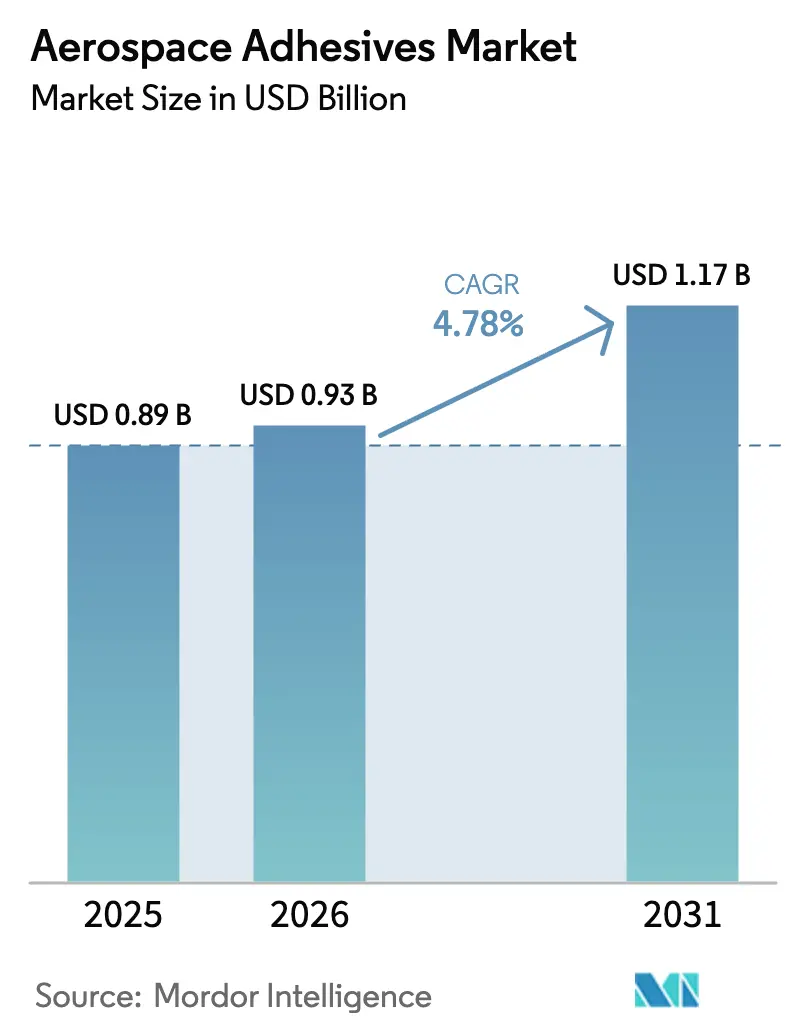
The Aerospace Adhesives Market size is projected to expand from USD 0.89 billion in 2025 and USD 0.93 billion in 2026 to USD 1.17 billion by 2031, registering a CAGR of 4.78% between 2026 to 2031. Key growth drivers include composite-intensive airframes, robotic bonding cells, and cryogenic-ready chemistries that support hydrogen propulsion. While solvent-borne systems maintain a significant revenue share, waterborne formulations are rapidly gaining ground, spurred by tightening VOC level caps from the California Air Resources Board and REACH. Structural grades align closely with original-equipment manufacturers’ consumption share, as they increasingly adopt bonded composite skins and wing boxes. North America, bolstered by Boeing’s 737 MAX and Lockheed Martin’s F-35 programs, dominates adhesive volumes. Yet, with the output of COMAC's C919 and Tata-Airbus's C295, the Asia-Pacific region is poised for the swiftest growth.
Key Report Takeaways
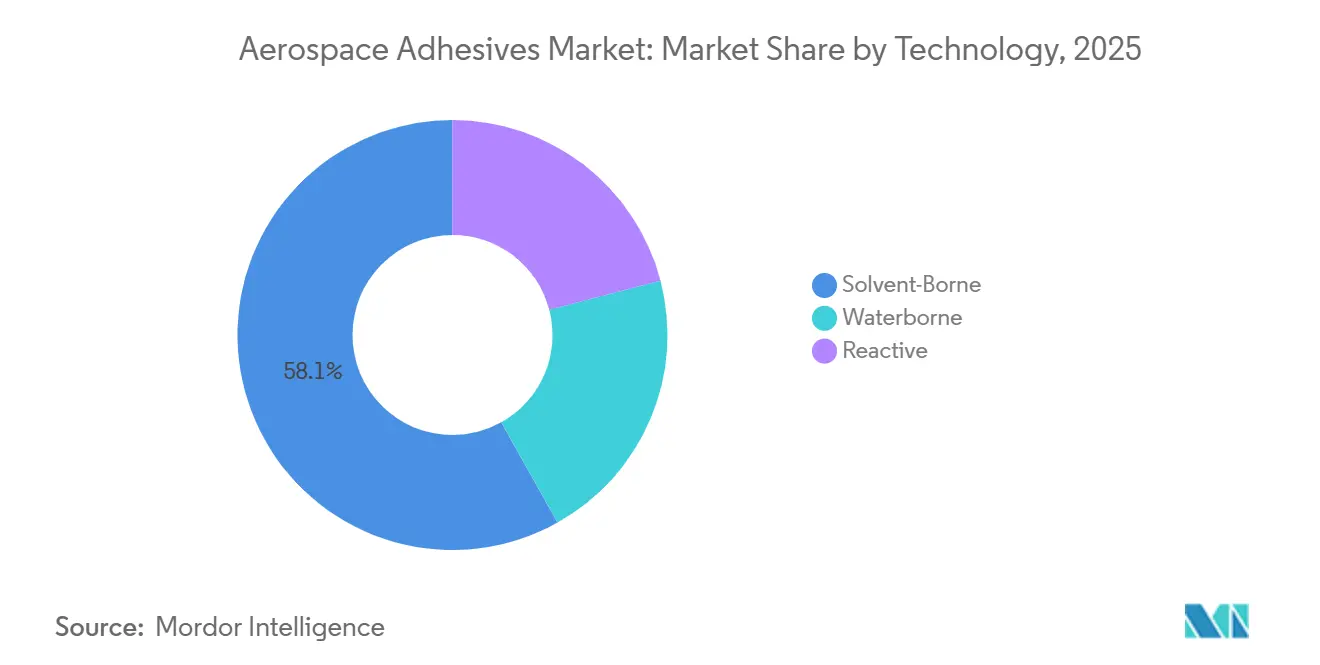
- By technology, solvent-borne formulations led with a 58.12% revenue share in 2025, while waterborne variants are projected to grow at a 4.98% CAGR through 2031.
- By resin type, epoxy captured 50.23% of 2025 sales and is forecast to advance at a 5.12% CAGR to 2031 on the strength of high-temperature composite applications.
- By function, structural adhesives accounted for 59.16% of demand in 2025 and are expected to expand at a 4.91% CAGR as automated robotic bonding lines proliferate.
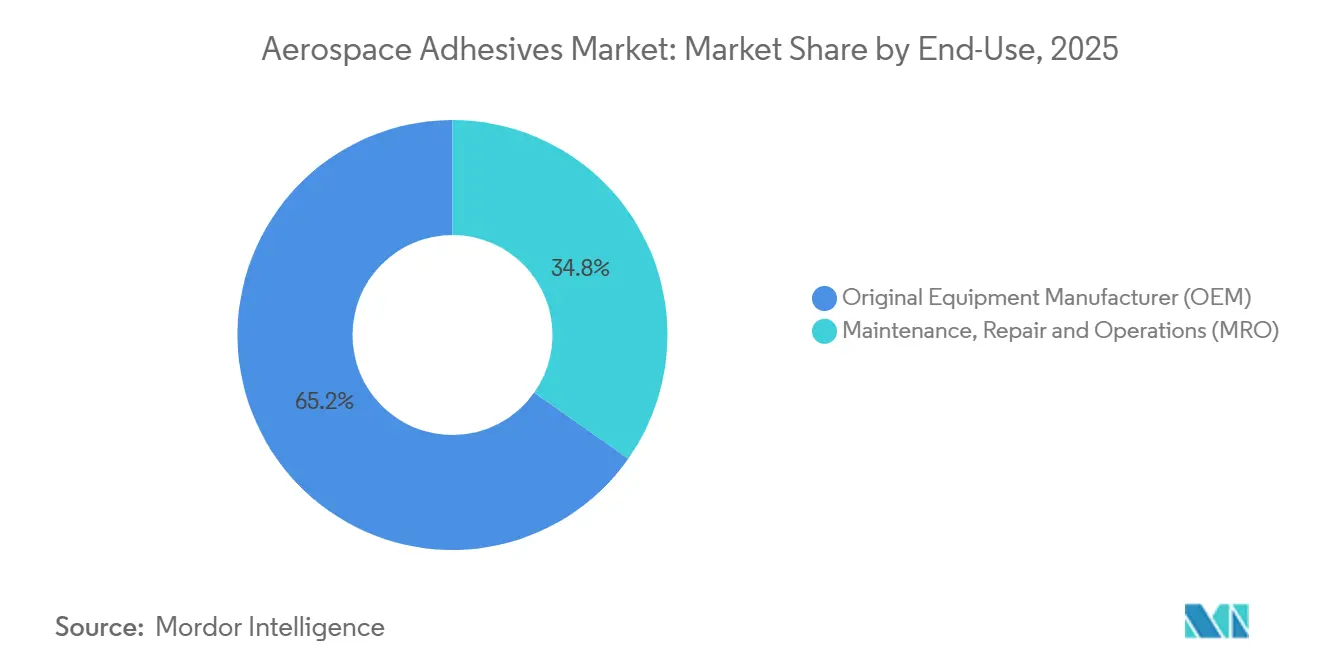
- By end-use, OEMs held 65.23% share in 2025, while the same channel will post the fastest 4.93% CAGR through 2031 because of new-build aircraft programs.
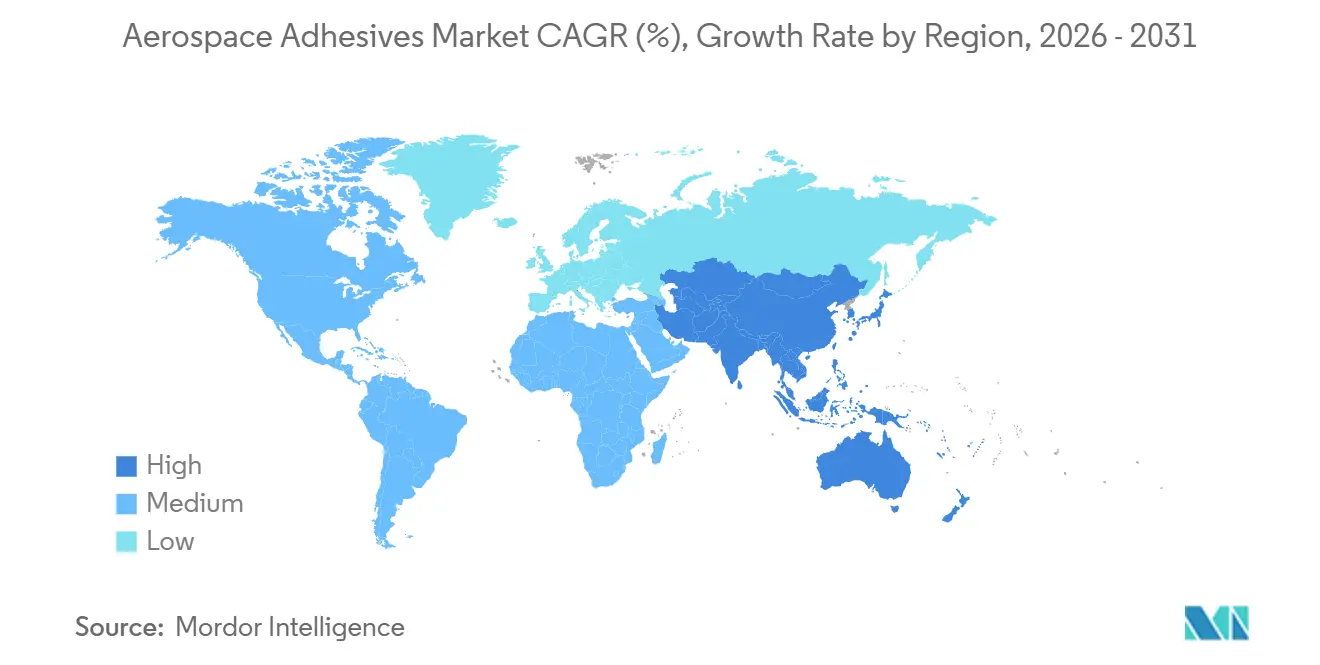
- By geography, North America generated 40.14% of 2025 revenue; Asia-Pacific is forecast to log the highest regional 5.21% CAGR between 2026 and 2031.
Note: Market size and forecast figures in this report are generated using Mordor Intelligence’s proprietary estimation framework, updated with the latest available data and insights as of January 2026.
Market Trends and Insights
Drivers Impact Analysis of Aerospace Adhesives Market*
| Drivers | (~) % Impact on CAGR Forecast | Geographic Relevance | Impact Timeline |
|---|---|---|---|
| Increasing penetration of composites in aircraft manufacturing | +1.2% | Global, with concentration in North America and Europe | Medium term (2-4 years) |
| Automated robotic bonding lines to meet Airbus and Boeing ramp-up | +0.9% | North America, Europe, APAC manufacturing hubs | Short term (≤ 2 years) |
| Expansion of national defense budgets (U.S., China, India) | +1.1% | North America, APAC (China, India, South Korea) | Long term (≥ 4 years) |
| Growth of commercial-space launch and in-orbit-service programs | +0.7% | North America (U.S.), emerging in Europe and APAC | Long term (≥ 4 years) |
| Cryogenic-ready adhesives for hydrogen-propelled aircraft | +0.5% | Europe (Airbus ZEROe), North America research and development clusters | Long term (≥ 4 years) |
| Source: Mordor Intelligence | |||
Increasing Penetration of Composites in Aircraft Manufacturing
Carbon-fiber-reinforced polymers now account for a significant portion of the structural weight in both the Boeing 787 and the Airbus A350. This shift has replaced thousands of mechanical fasteners with high-strength adhesive joints, ensuring the integrity of the laminate. NASA's AERoBOND program has confirmed that using barrier-ply film adhesives can reduce surface abrasion, leading to a decrease in fuselage assembly labor[1]. Similarly, COMAC's C919 wing box utilizes these film systems, achieving a reduction in wing mass compared to traditional aluminum riveting. This advancement bolsters COMAC's ambition of delivering its units by 2030. Epoxy-based structural grades lead the market, thanks to their compatibility with toughened prepreg cycles at cure profiles of 120 °C – 180 °C, and their ability to produce lap-shear strengths exceeding industry standards. While Asian suppliers are expanding their autoclave capacities, qualification delays have solidified the positions of Henkel's LOCTITE EA 9695 and Cytec's FM 300 series in the market.
Automated Robotic Bonding Lines to Meet Airbus and Boeing Ramp-Up
Airbus has earmarked a significant budget for automated cells that apply film and paste adhesives with high accuracy. This investment is pivotal for Airbus's ambition to ramp up production of the A320 family by late 2026. In 2024, Boeing's Fuselage Automated Upright Build line successfully cut the panel cycle time for the 737 MAX and achieved a notable reduction in scrap. Turnkey systems from Electroimpact and MTorres feature infrared pre-heat stations, elevating substrate temperatures to 60 °C, which bolsters wet-out and void control. Spirit AeroSystems reported a reduction in adhesive waste in 2025, translating to substantial cost savings across its Wichita and Prestwick sites. This was achieved using two-part reactive epoxies with open times of 20 to 45 minutes, perfectly aligning with robotic takt cycles.
Expansion of National Defense Budgets (U.S., China, India)
In 2024, the United States allocated a substantial budget for defense, designating a significant portion specifically for aircraft procurement. Each platform in this procurement utilizes adhesives. Meanwhile, India, in its fiscal 2026 budget, increased its defense allocation to support the Tejas Mk2 and AMCA fighters, which utilize film epoxies to bond composite radomes and wings. China officially reported a defense expenditure for 2024. However, external estimates suggest a significantly higher figure. Notably, China's J-20 stealth jet incorporates low-dielectric-loss adhesives under its radar-absorbent skins. Additionally, South Korea's KF-21 program mandates FST-compliant adhesives for 120 units, with a target completion year of 2032. These military contracts not only shield suppliers from the volatility of commercial price fluctuations but also ensure a steady long-term volume.
Growth of Commercial-Space Launch and In-Orbit-Service Programs
In 2024, SpaceX executed multiple Falcon 9 missions and ramped up Starship production, utilizing adhesives for TPS tiles and cryogenic insulation. Blue Origin's New Glenn rocket achieved its inaugural orbital flight in 2024, employing epoxy systems certified for -196 °C, tailored for carbon-fiber tanks. Virgin Galactic, resuming its tourism flights in 2025, mandated cabin adhesives compliant with ASTM E595 outgassing standards. Northrop Grumman's servicing craft in orbit employs adhesive docking collars, potentially extending satellite lifespans and deferring replacements. Due to the stringent space requirements for radiation tolerance and thermal cycling, margins are notably higher than aviation standards.
Restraints Impact Analysis of Aerospace Adhesives Market*
| Restraints | (~) % Impact on CAGR Forecast | Geographic Relevance | Impact Timeline |
|---|---|---|---|
| Volatility in epoxy and isocyanate feedstock supply chains | -1.3% | Global, with acute exposure in Asia-Pacific and Europe | Short term (≤ 2 years) |
| Stringent REACH/CARB VOC caps curbing solvent systems | -0.8% | Europe, North America, spill-over to APAC | Medium term (2-4 years) |
| Qualification bottlenecks for bio-based and recycled chemistries | -0.7% | Global, with early impact in EU and US | Long term (≥ 4 years) |
| Source: Mordor Intelligence | |||
Volatility in Epoxy and Isocyanate Feed-Stock Supply Chains
In 2024, volatility hit bisphenol-A and epichlorohydrin feedstocks as China, holding a significant share of global capacity, faced export quotas amid power rationing. This scenario led to price spikes, compelling European formulators to turn to sources in India and the Middle East. Toluene diisocyanate and methylene diphenyl diisocyanate experienced fluctuations. Major players like BASF, Covestro, and Wanhua declared force majeure, resulting in an extension of adhesive lead times. Meanwhile, fixed-price contracts with OEMs hindered Tier 1 suppliers from passing costs downstream, thereby compressing margins and heightening supply-chain risks.
Stringent REACH/CARB VOC Caps Curbing Solvent Systems
In 2025, the REACH update set a cap on VOCs in adhesives, making older solvent products non-compliant unless they were reformulated with higher solids or water carriers. In the same year, CARB slashed the permissible VOC limit for aerospace adhesives, leading to a wave of product withdrawals. Additionally, restrictions on nonylphenol and certain phthalates under SVHC have added to the regulatory challenges. Now, OEMs are proactively including "future-proof" clauses in their tenders, pushing for compliance by 2028. This shift is benefiting vertically integrated formulators who possess the capability to handle both reformulation and certification in-house.
*Our forecasts treat driver/restraint impacts as directional, not additive. The impact forecasts reflect baseline growth, mix effects, and variable interactions.
Aerospace Adhesives Market Segment Analysis
By Technology:
Waterborne Formulations Outpace Legacy Solvent SystemsSolvent-borne systems retained a 58.12% aerospace adhesives market share in 2025 because of rapid cure and process familiarity. However, their VOC emissions are increasingly at odds with tightening regulations. This has paved the way for waterborne chemistries, which are set to post a 4.98% CAGR through 2031. The market for waterborne aerospace adhesives is anticipated to grow, buoyed by gains in OEM panel assemblies and interior retrofits. Robotic bonding lines, utilizing reactive two-part epoxies and polyurethanes, benefit from open times and heightened initial tack, enhancing takt reliability. While Asia-Pacific has been slow to adopt, primarily due to a lack of investment in humidity-controlled rooms essential for waterborne curing, references in OEM procurement clauses to VOC ceilings are poised to spur accelerated capital spending.
Automation plays a pivotal role in minimizing application variability. Vision-guided robots, with an accuracy of ±5% of the target weight, apply waterborne pastes, ensuring more uniform bond lines compared to manual methods and significantly cutting down rework. Operators have noted reduced inventories, attributing it to the longer pot life of single-component waterborne products and their less stringent hazardous-material shipping classification. Consequently, suppliers lacking expertise in waterborne products face the risk of being sidelined from new-build programs.

By Resin Type:
Epoxy Dominates High-Performance ApplicationsEpoxy resins accounted for 50.23% of revenue in 2025, capturing the largest share by chemistry. With a 5.12% CAGR through 2031, epoxy's ascent is attributed to its elevated Tg, fatigue resistance, and seamless compatibility with carbon-fiber cure cycles, operating between 120 °C and 180 °C. Furthermore, epoxy's prominence extends to cryogenic tank prototypes, where its rubber-modified matrices maintain ductility even at a frigid -180 °C. While polyurethanes lag due to their lower modulus, limiting them to interior applications, hot-melt grades are carving a niche in sidewall panels, facilitating quicker line moves. Silicones, on the other hand, find their forte in nacelle firewalls and avionics bays, offering vibration damping at temperatures exceeding 200 °C, albeit at a premium price that restricts volume.
In response to REACH and CARB restrictions, epoxy suppliers are actively reducing residual amine and free monomer content. Highlighting the industry's innovative spirit, Hexcel secured a patent for a nano-silica-toughened epoxy, showcasing the delicate balance between toughness and low-viscosity film castability[2]. Looking ahead, resin vendors that integrate low-SVHC chemistry with advanced digital cure-kinetics modeling are poised to outpace traditional players, especially during pivotal platform refresh cycles.
By Function:
Structural Grades Drive Value CreationStructural products contributed 59.16% of demand in 2025. They are projected to expand at 4.91% CAGR on the back of composite fuselage, wing box, and nacelle integration. Baseline requirements include lap-shear strengths exceeding 30 MPa and 24-hour humidity durability. Meanwhile, emerging cryogenic-ready formulations, enhanced with nano-silica and rubber tougheners, are undergoing pressure tests for applications in Airbus ZEROe and reusable launch vehicles. Although non-structural grades are vital for seat tracks, insulation blankets, and quick repairs, they grapple with price pressures and faster reformulation cycles.
Changes in OEM processes further bolster the demand for structural products. The shift to single-piece barrel manufacturing has removed fastener rows, resulting in longer bonded seams for each aircraft. Additionally, robotic spar bonding lines are transitioning to two-part films that cure in under 90 minutes at 140 °C, allowing for wing movement within the same shift. Suppliers who position application engineers at OEM plants to optimize process windows are securing specifications for next-generation platforms.
By End-Use:
OEMs Capture the Largest and Fastest-Growing ShareOEMs consumed 65.23% of aerospace adhesives in 2025, and will expand 4.93% annually to 2031, keeping them the most lucrative customer class. The uptick in demand is largely attributed to the Airbus A321XLR, Boeing 777X, and COMAC C929, all of which are integrating wider bonded skin panels and liquid-hydrogen storage assemblies. Automated bonding lines are amplifying adhesive usage; the consistent bead geometry minimizes squeeze-out, enabling designers to expand the bond-line area for added margin. While aftermarket demand in MRO channels remains steady, it's not as brisk. This is due to older fleets opting for grandfathered solvent-borne kits and spot repairs over complete panel replacements.
However, the Asia-Pacific region stands out in MRO volume. The surge is driven by low-cost carriers emphasizing quick turnaround times. This urgency has led to a preference for depot-grade two-part epoxies, which cure at room temperature in just 30 minutes, allowing mechanics to release aircraft on the same day. Suppliers that provide pre-measured dual-cartridge packages, designed to eliminate scaling errors, are not only securing station approvals but also enhancing their presence in the aftermarket.
Geography Analysis
North America Aerospace Adhesives Market
North America produced 40.14% of the 2025 revenue. The robust demand is buoyed by Boeing's production of the 737 MAX and 787, alongside the F-35 and KC-46 defense programs. The region's early adoption of robotic bonding centers, combined with the use of VOC-compliant waterborne products, not only minimizes scrap but also garners sustainability credits. Furthermore, the co-location of OEMs and suppliers in states like Washington, South Carolina, Texas, and Wichita accelerates pilot-line validation, reduces logistics costs, and solidifies the region's dominant position.
APAC Aerospace Adhesives Market
Asia-Pacific is the fastest-growing region, forecast to post a 5.21% CAGR through 2031. The region's share of the aerospace adhesives market is set to increase, driven by COMAC's delivery of C919 jets and Tata-Airbus's ramping up of the C295 line. Japan and South Korea are also contributing, with Mitsubishi's SpaceJet making a comeback and KAI's KF-21 fighter gaining traction. While regional regulations on VOCs are currently more lenient, there's a move towards aligning with REACH standards, fueling investments in waterborne products. Additionally, a burgeoning MRO ecosystem in cities like Singapore, Kuala Lumpur, and Guangzhou bolsters the demand for adhesive retrofits.
EMEA and South America Aerospace Adhesives Market
Europe plays a crucial role, bolstered by Airbus facilities spread across France, Germany, the UK, and Spain. Research into hydrogen propulsion is channeling research and development funds into adhesive cryogenic testing. Meanwhile, the REACH legislation is hastening the phase-out of solvent-borne products. With tight supply chains and collaborative engineering efforts, the industry is witnessing accelerated recertification cycles. Emerging markets in the Middle East, South America, and Africa, though smaller, are gaining momentum, driven by fleet modernization and new composite-part fabrication centers. Suppliers eyeing joint ventures with local entities are strategically positioning themselves for early advantages as these regions ascend the aerospace value chain.
Value Chain Analysis
The value chain starts with upstream petrochemical and specialty-chemical inputs (notably epoxy and isocyanate feedstocks) and moves into formulation of film, paste, and liquid aerospace-qualified systems. Production is typically managed under AS9100-aligned quality systems with high traceability requirements. Products are then routed either directly to OEM and Tier 1 assembly sites or through qualified distributors that handle kitting, cold-chain or controlled storage where needed, with documentation supporting aerospace audits. Airbus-linked global supply consolidation through certified distribution has been visible, including a March 2026 worldwide supply contract awarded to Bodo Moller Chemie to support multiple Airbus plants under EN 9120-type distribution controls.
Midstream conversion and application are tightly coupled to airframe manufacturing process windows, and the shift toward automated dispensing and robotic bonding lines increases the need for consistent rheology, pot life, and cure profiles. As a result, application engineering and process-support services sit alongside the materials sale. Downstream demand divides between OEM new-build consumption and MRO, where MRO often uses pre-measured cartridges and repair kits, while OEM lines drive higher-volume structural grades and qualification-intensive changes such as VOC-driven reformulations and cryogenic-ready chemistries. Bottlenecks highlighted for 2026 include limited qualified capacity, uneven OEM production signals, and liquidity pressure across lower-tier suppliers, which has encouraged resilience tactics including dual sourcing, localized production, and deeper upstream partnerships. One example is Syensqo and Toray Composite Materials America entering a five-year strategic collaboration (April 2026) to secure critical composite and resin technology supply inputs that also feed structural adhesive ecosystems.
Competitive Landscape
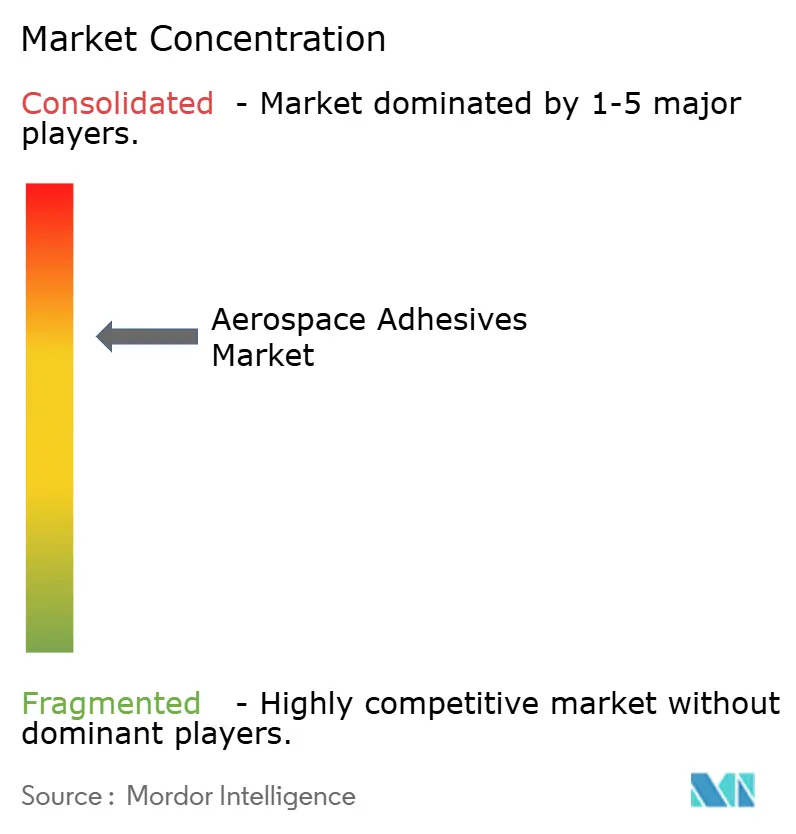
The aerospace adhesives market is moderately consolidated. The top five vendors' multi-site production, cradle-to-gate quality systems, and embedded engineering teams at OEM assembly lines create meaningful entry barriers. Specialty formulators are carving niches in low-outgassing, rapid-cure, and niche temperature windows. DELO and Dymax are leveraging UV-cure and dual-cure hybrids to shorten interior panel takt times. Competitive weaponry increasingly includes digital curve-simulation software that lets OEMs model bond-line stresses during load cases. Suppliers with robust regulatory intelligence and swift reformulation labs outperform peers as REACH, CARB, and EASA requirements evolve. Robotic automation reshuffles positioning as well. Vendors that integrate dispensing robots, inline calorimetry, and vision systems into a turnkey package capture process control data that OEMs crave for statistical quality control. Combined with sustainability reporting, this digital overlay differentiates offers beyond price per kilogram. The competitive field, therefore, tilts toward companies blending chemistry expertise with automation, data analytics, and regulatory agility.
Aerospace Adhesives Industry Leaders
-
Henkel AG & Co. KGaA
-
3M
-
PPG Industries Inc.
-
Huntsman International LLC.
-
H.B. Fuller Company
- *Disclaimer: Major Players sorted in no particular order
Aerospace Adhesives Market Companies Covered in this Report
- 3M
- Arkema
- Ashland
- Beacon Adhesives Inc.
- Chemetall GmbH (BASF)
- DELO Industrie Klebstoffe GmbH & Co. KGaA
- Dymax
- Flamemaster Corp.
- Gurit Services AG
- H.B. Fuller Company
- Henkel AG & Co. KGaA
- Hernon Manufacturing Inc
- Hexcel Corporation
- Huntsman International LLC.
- Hybond
- Hylomar Products
- IPS Corporation
- L&L Products
- Master Bond Inc.
- Parker Hannifin Corp
- Parson Adhesives Inc.
- Permabond LLC
- PPG Industries Inc.
- Sika AG
- Solvay
Market Opportunities and Future Outlook
Regulatory-driven reformulation and certification throughput are creating a clear whitespace for suppliers that can pair low-VOC chemistries with faster qualification support, particularly as OEM tenders add forward-looking compliance clauses tied to REACH and CARB VOC ceilings. Portfolio repositioning is already visible. In April 2026, Huntsman released FST-compliant structural adhesive grades (URALANE 5774-1 and 5779-1) for thermoplastic bonding applications, shifting product development toward evolving chemical and cabin safety requirements rather than legacy solvent-borne approaches.
Manufacturing and supply assurance also stand out as active opportunity areas as OEMs and Tier 1s reduce disruption exposure by consolidating approved sources and adding certified capacity near major build hubs. In 2026, Airbus awarded Bodo Moller Chemie a worldwide adhesive-systems supply contract to support international production facilities, reflecting ongoing pull for globally managed, audit-ready distribution and kitting models. Capacity and capability investments further reinforce the direction. H.B. Fuller announced a dedicated Aerospace Manufacturing Center of Excellence in Charlotte, North Carolina (May 2026, operations planned for early 2027) to consolidate aerospace-specific manufacturing, packaging, testing, and quality needs. Separately, Syensqo broke ground on an expansion at Havre de Grace, Maryland (July 2026), adding 30% capacity for structural adhesives, primers, and surfacing products to support higher-throughput programs and reduce lead-time risk for qualified materials.
Recent Industry Developments in Aerospace Adhesives Market
- July 2026: Syensqo broke ground on a manufacturing expansion at its Havre de Grace, Maryland site, adding 30% capacity for structural adhesives, primers, and surfacing products. The added output and aerospace-grade processing footprint strengthen supply assurance for commercial and defense programs that require long qualification cycles and tight traceability.
- December 2025: 3M launched the 3M Adhesive Mix Monitor, a real-time monitoring solution for two-part adhesive dispensing processes. By improving mix verification and process control at the point of application, it supports higher first-pass yield on safety-critical bonded joints, particularly in automated and semi-automated assembly environments.
- March 2024: PPG introduced PR-2940 epoxy syntactic paste adhesive and PR-2936 skin-bonding product for internal structural and fuselage applications. The additions expand PPG's addressable set across OEM build and MRO repair workflows where lightweight shimming, gap filling, and durable bonding performance are required.
Aerospace Adhesives Market Report Scope and Research Methodology
Market Definition and Coverage
For this methodology, the aerospace adhesives market covers qualified adhesive products used to bond parts and sub-assemblies in aircraft and spacecraft manufacturing and maintenance, where performance requirements (strength, fatigue, temperature, fluids, and smoke/toxicity where relevant) are aligned to aerospace standards.
Scope exclusions: We exclude general purpose industrial adhesives that are not sold, specified, or qualified for aerospace use, even if they are occasionally used in aviation workshops.
Segments Covered in This Report
- By Technology
- Waterborne
- Solvent-Borne
- Reactive
- By Resin Type
- Epoxy
- Polyurethane
- Silicone
- Others
- By Function Type
- Structural
- Non-Structural
- By End-Use
- Original Equipment Manufacturer (OEM)
- Maintenance, Repair and Operations (MRO)
- By Geography
- Asia-Pacific
- China
- Japan
- India
- South Korea
- Australia and New Zealand
- Rest of Asia-Pacific
- North America
- United States
- Canada
- Mexico
- Europe
- Germany
- United Kingdom
- France
- Italy
- Spain
- Rest of Europe
- South America
- Brazil
- Argentina
- Rest of South America
- Middle-East and Africa
- Saudi Arabia
- South Africa
- Rest of Middle-East and Africa
- Asia-Pacific
Data Sources, Market Sizing, and Validation
Desk Research
Desk work starts with mapping how demand is created and recorded in aerospace programs, then collecting the cleanest public signals that can be checked year after year. We use FAA and EASA releases for fleet and activity context, ICAO air transport indicators for utilization direction, and US Census and Eurostat trade statistics to understand cross-border chemical and formulated product flows that can influence supply.
To ground the material side, we also refer to sources such as NASA technical publications, NIST references where test methods matter, and peer-reviewed journals that discuss adhesive performance in composites and metal bonding. Company annual reports, investor decks, and reputable aerospace and chemicals press are used to validate production ramps, program cadence, and capacity or expansion announcements. Where needed, paid company financials and intelligence database and an aerospace and aviation database are used to normalize company exposure to aerospace-grade bonding materials and track aircraft platform activity. The sources listed here are illustrative, and many other public and internal references were also consulted for collection, cross-checking, and clarification.
Primary Interviews and Surveys
To make sure the model reflects how adhesives are actually purchased and consumed, we validate assumptions through expert interviews and structured surveys with raw material suppliers, formulators, distributors, aircraft and component OEM contacts, and MRO-facing stakeholders. Because the market is global, coverage is balanced across the major build and maintenance regions, and questions focus on qualification cycles, typical usage per aircraft area, and how pricing moves with specifications and mix shifts.
Distribution of primary research fieldwork respondents
| Company type | Respondent position | Region |
|---|---|---|
| Top tier: 29% | CXOs: 14% | APAC: 45% |
| Mid tier: 53% | Functional/Unit leaders: 29% | EMEA: 34% |
| Smaller Players: 18% | Managers: 57% | Americas: 21% |
Market-Sizing & Forecasting
Sizing starts from a top-down demand pool build, where aircraft production and maintenance activity are translated into adhesive consumption using program build rates, MRO event cadence, and typical usage patterns by bonding area. Because published aircraft delivery and fleet signals do not directly report adhesive volumes, conversion factors are built from interview inputs and technical literature, then adjusted for mix differences. For example, higher composite content can shift volumes between paste, film, and liquid systems.
Selective bottom-up checks are then used to keep totals realistic, including sampled supplier revenue splits for aerospace-grade adhesives, channel checks on qualification-driven purchasing, and ASP x volume approximations for a few common product families. Variables used in the model include commercial and defense aircraft delivery trends, in-service fleet size and utilization, share of composite structures in new platforms, typical replacement and rework rates during heavy checks, and pricing movement tied to resin cost and specification tightening. Forecasting uses scenario analysis supported by expert views on production ramp timing and maintenance normalization, so the final outlook follows realistic build and MRO pathways rather than a straight-line extension. Where bottom-up visibility is weaker, gaps are handled by applying conservative adoption and mix assumptions and then rechecking them against the demand pool and interview feedback.
Data Validation & Update Cycle
Outputs are validated through multiple passes, where computed market totals are compared with independent signals such as aircraft build schedules, major MRO throughput direction, and chemicals and materials commentary in public filings. We also run variance checks by region and end-use, and any sudden step changes are investigated back to a driver such as platform mix, pricing, or a change in qualification timing.
Before sign-off, the work is reviewed by another analyst to confirm that assumptions are consistent and that each step can be traced from inputs to totals. Reports are refreshed annually, and interim updates are triggered when material events occur, such as a major aircraft rate reset, supply constraints in key resin systems, or a regulatory change affecting qualified formulations. Right before delivery, a final pass is completed so clients receive the latest updated view.
Mordor Intelligence's Aerospace Adhesives Market Sizing Compared With Other Published Estimates
It is normal to see different market sizes for aerospace adhesives because studies may not be counting the same products, end uses, or timeframes, even when the titles look similar. Differences also come from how each study treats MRO versus OEM demand, and whether pricing is held constant or allowed to move with mix and specification changes.
The spread is usually driven by scope choices, such as adding sealants to adhesives, counting adjacent industrial bonding materials, or using a broader set of aircraft and space applications than what buyers typically budget for under aerospace-grade adhesives. Another common gap comes from how usage per aircraft is modeled. Some methods apply a single intensity factor to deliveries, while others link consumption to both build and heavy maintenance cycles and then update ASPs with currency timing and resin cost signals, an approach applied by Mordor Intelligence.
Benchmark comparison
| Source | Market Size | Gaps in Research Methodology |
|---|---|---|
| Mordor Intelligence | USD 0.93 B (2026) | |
| Global Research Publisher A | USD 1.39 B (2024) | Uses an earlier base year and a broader demand interpretation that can lift totals when aerospace delivery momentum is high, and the method is not clearly tied to a build-plus-maintenance consumption bridge for qualified adhesive formats. |
| Industry Analytics Firm B | USD 1.38 B (2024) | Employs a higher growth profile and mixes narrative base-year statements, which can overstate current sizing if ASP progression and platform mix are not reconciled to aircraft production and scheduled maintenance activity. |
Overall, the comparison shows that year selection and scope width explain most of the difference, followed by how tightly consumption is linked to real aircraft build and maintenance drivers. By keeping the inputs traceable to program activity, qualification-driven usage patterns, and realistic pricing movement, the methodology provides a balanced number that can be repeated and stress-tested as new aircraft and MRO signals come in.
Key Questions Answered in the Report
How large will the aerospace adhesives market be by 2031?
It is projected to reach USD 1.17 billion by 2031 on a 4.78% CAGR trajectory from USD 0.93 billion in 2026.
Which chemistry leads demand?
Epoxy accounted for 50.23% of 2025 revenue and is expected to maintain leadership thanks to high-temperature tolerance and composite compatibility.
What drives the fastest regional growth?
Asia-Pacific’s 5.21% CAGR stems from COMAC C919 production, India’s C295 program, and expanding regional MRO capacity.
How are VOC regulations shaping product portfolios?
REACH and CARB caps below 250 g/L and 120 g/L, respectively, are phasing out legacy solvent products and pushing suppliers toward waterborne and reactive chemistries.
What role does automation play in adhesive consumption?
Robotic bonding lines shorten cycle time, cut scrap, and standardize bead geometry, increasing structural adhesive usage per airframe.