
Aerosol Refrigerants Market Size and Share
Market Overview
| Study Period | 2020 - 2031 |
|---|---|
| Market Size (2026) | USD 1.4 Billion |
| Market Size (2031) | USD 1.69 Billion |
| Growth Rate (2026 - 2031) | 3.86 % |
| Fastest Growing Market | Asia Pacific |
| Largest Market | Asia Pacific |
| Market Concentration | Medium |
Major Players *Disclaimer: Major Players sorted in no particular order Image © Mordor Intelligence. Reuse requires attribution under CC BY 4.0. | |
Aerosol Refrigerants Market Analysis by Mordor Intelligence
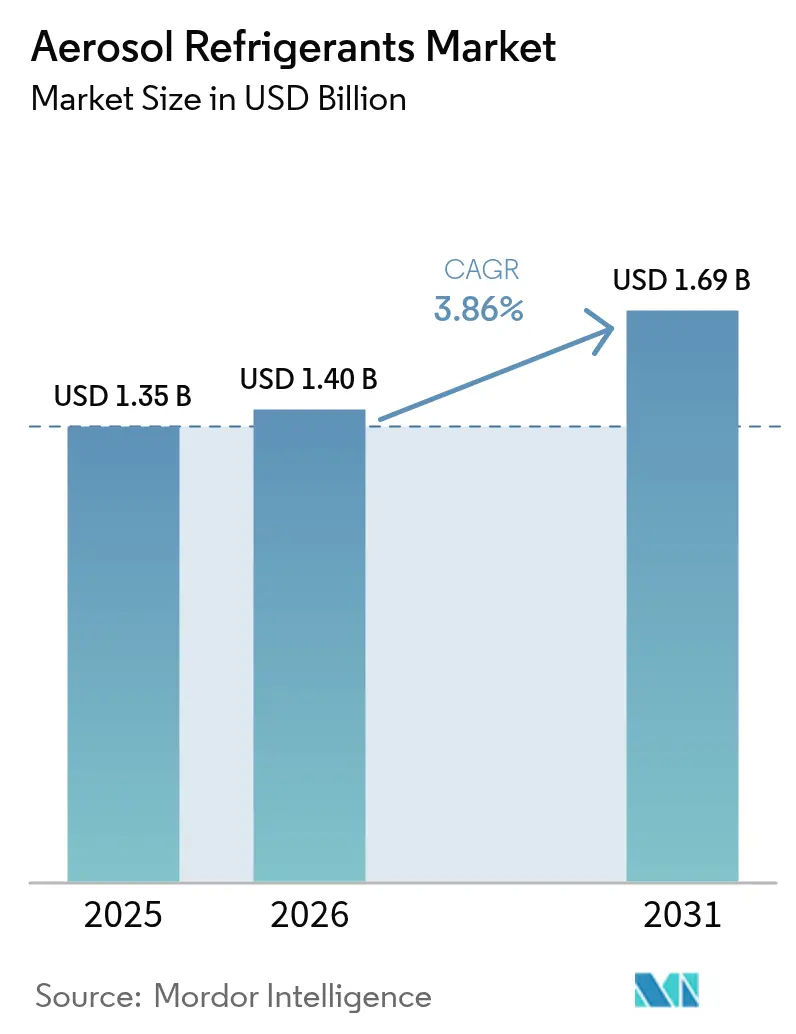
The Aerosol Refrigerants Market size is expected to grow from USD 1.35 billion in 2025 to USD 1.4 billion in 2026 and is forecast to reach USD 1.69 billion by 2031 at 3.86% CAGR over 2026-2031. This steady expansion reflects the sector’s migration away from high-GWP hydrofluorocarbons toward compliant propellants in response to the American Innovation and Manufacturing Act, European F-gas revisions and parallel phase-down rules across major economies. Demand is reinforced by stricter GWP caps that continue to raise legacy HFC prices, surging do-it-yourself (DIY) HVAC maintenance, the permanent build-out of ultra-cold pharmaceutical cold chains, and rising data-center cooling loads as artificial-intelligence workloads scale. Competitive activity remains moderate: incumbent producers are carving out low-GWP businesses, expanding cylinder capacity and partnering on immersion-cooling fluids to defend share while preparing for the A2L transition. Price volatility for R-454B and lingering safety-certification delays for A2L blends temper growth yet also widen openings for agile suppliers that can deliver compliant, small-pack aerosol formats into underserved regions.
Key Report Takeaways
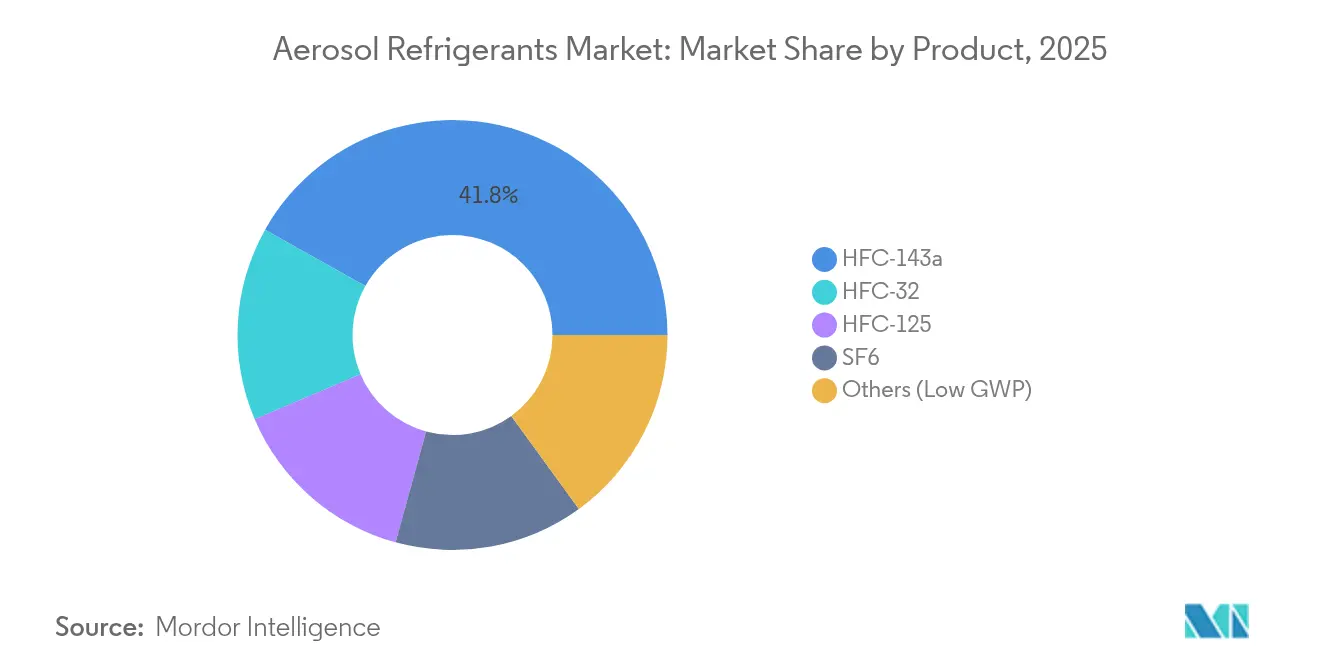
- By product, HFC-143a held a 41.85% aerosol refrigerants market share in 2025, whereas the Others (Low GWP) category is projected to grow the fastest at a 4.05% CAGR through 2031.
- By packaging form, aerosol cans (greater than or equal to 500 g) captured 58.30% of the aerosol refrigerants market size in 2025; others post the quickest expansion at a 4.62% CAGR to 2031.
- By application, refrigerators and freezers led with 31.88% revenue share in 2025, while specialty aerosol products advance at a 4.49% CAGR during the outlook period.
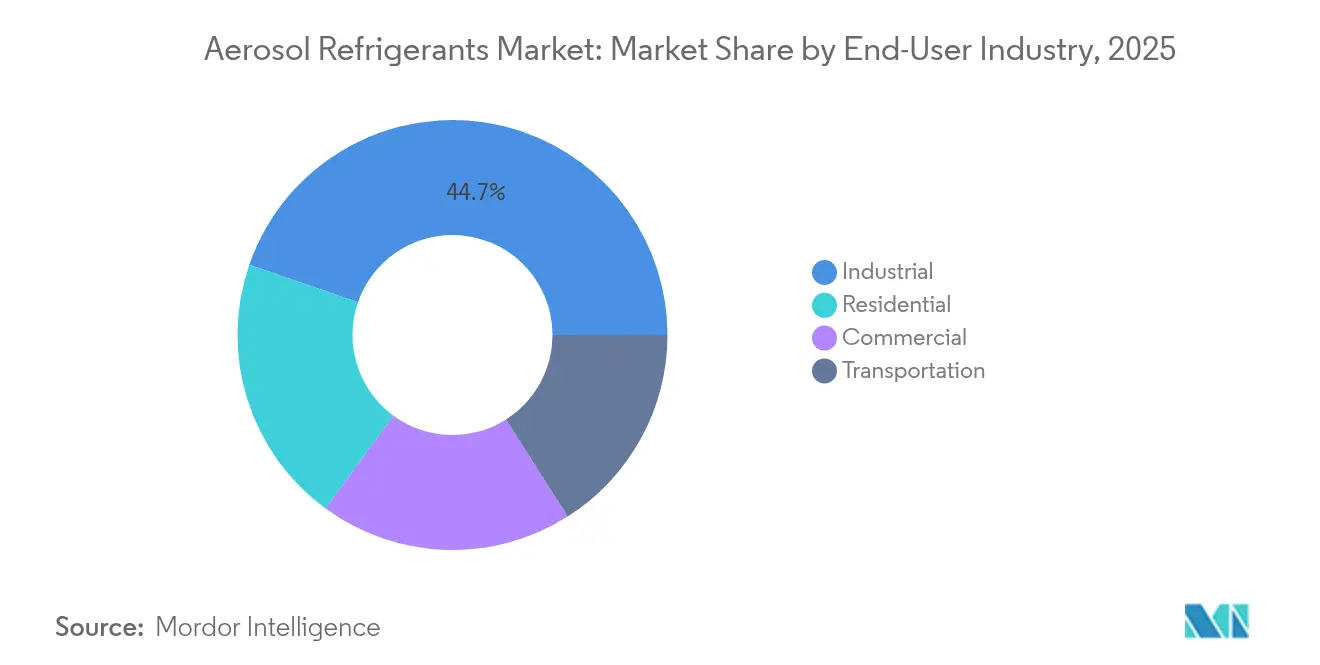
- By end-user industry, the industrial segment commanded 44.70% of the aerosol refrigerants market size in 2025, whereas commercial users record the highest projected CAGR at 4.41% through 2031.
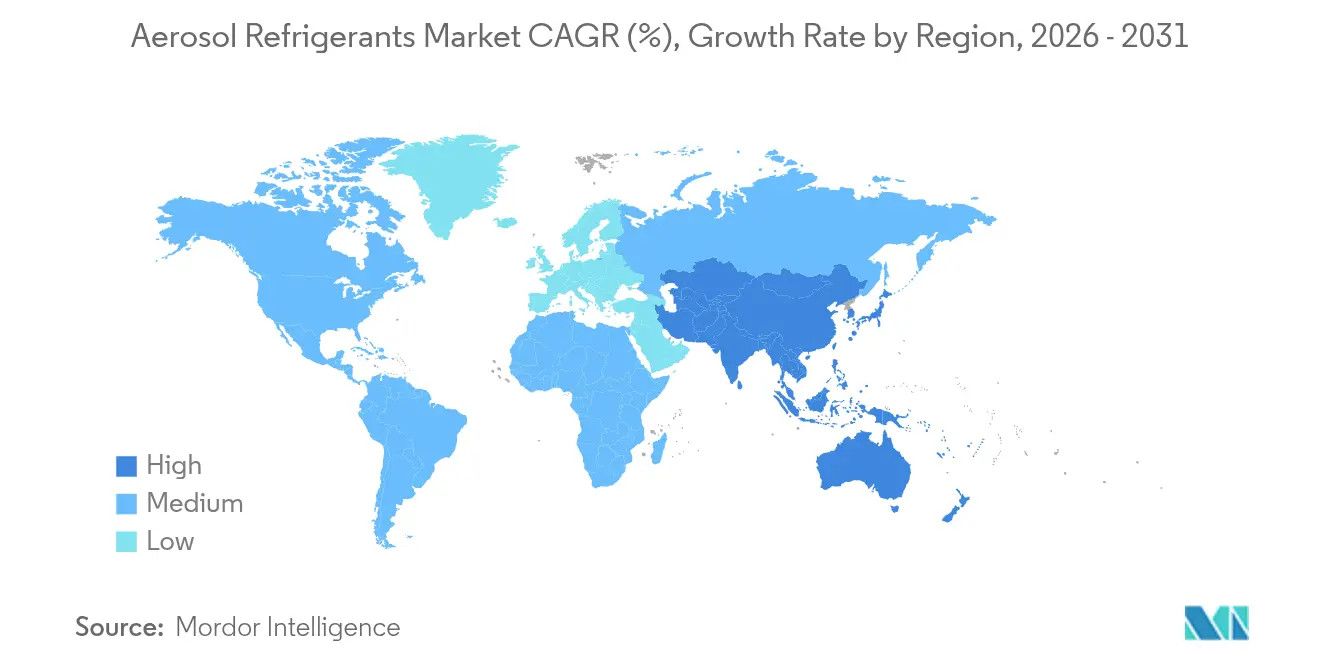
- By geography, Asia-Pacific controlled 42.95% of 2025 value; the region is also register the strongest CAGR of 4.21% over 2026-2031.
Note: Market size and forecast figures in this report are generated using Mordor Intelligence’s proprietary estimation framework, updated with the latest available data and insights as of 2026.
Global Aerosol Refrigerants Market Trends and Insights
Drivers Impact Analysis*
| Driver | (~) % Impact on CAGR Forecast | Geographic Relevance | Impact Timeline |
|---|---|---|---|
| Rapid HFC Phase-Down Policies in North America and Europe Spurring Low-GWP Aerosol Propellants | +1.2% | North America and Europe, spillover to APAC | Medium term (2-4 years) |
| Surging DIY HVAC Maintenance and Recharge-Kit Sales via E-Commerce | +0.8% | Global, concentrated in North America and Europe | Short term (≤ 2 years) |
| Rising Demand for Ultra-Cold Vaccine Logistics (Portable Aerosol Refrigerants) | +0.6% | Global, priority in developed markets | Medium term (2-4 years) |
| Expanding Refurbishment Cycle of Commercial HVAC In Hyperscale Data-Centres | +0.7% | Global, concentrated in North America and APAC | Long term (≥ 4 years) |
| Rising Residential AC Penetration in Tropical Emerging Economies | +0.9% | APAC core, spillover to Latin America and MEA | Long term (≥ 4 years) |
| Source: Mordor Intelligence | |||
Rapid HFC phase-down policies spur low-GWP propellants
Production-quota cuts of 40% in the United States by 2024 and 30% in the European Union by 2027 tighten legacy refrigerant supply, pushing R-454B cylinder prices to USD 700–800 versus USD 250–300 for R-32. California’s SB 1206 bans bulk HFCs over 750 GWP from 2033, while the revised EU F-gas regulation has lifted high-GWP spot prices by up to 1,000%. These cost gaps accelerate equipment retrofits and favor aerosol refrigerant manufacturers able to supply A2L alternatives on short notice[1].
Surging DIY HVAC maintenance supports e-commerce aerosol sales
Online retailers now offer compact recharge kits that let owners service split AC units without contractors. The trend gained traction through pandemic lockdowns and persists as R-22 and R-134a phase-outs raise service costs. Yet Section 608 of the U.S. Clean Air Act still requires certified recovery for most operations, limiting legitimate DIY use to minor top-ups and creating demand for sub-500 g aerosol cans clearly labeled for compliant uses.
Rising demand for ultra-cold vaccine logistics
Messenger-RNA vaccines, cell-based therapies and biologics all require -80 °C transport. Studies show hydrocarbon blends such as R-290/R-170 provide stable performance in cascade freezers, while Honeywell’s near-zero GWP Solstice Air propellant is already deployed in pressurized inhalers. Logistics providers therefore turn to portable aerosol refrigerants that offer instant, precise cooling and low environmental impact.
Expanding data-center refurbishment cycle
Hyperscale operators retrofitting for AI-chip heat loads are trialing two-phase immersion systems. Chemours and NTT DATA are testing Opteon 2P50 fluids, while Alliance Air is investing USD 121 million in Mexico to supply specialty cooling modules. Short maintenance windows favor aerosol propellants for interim top-offs or spot-cooling until full liquid-cooling retrofits complete.
Restraints Impact Analysis*
| Restraint | (~) % Impact on CAGR Forecast | Geographic Relevance | Impact Timeline |
|---|---|---|---|
| Escalating Feed-Stock Price Volatility | -0.9% | Global, concentrated in North America and Europe | Short term (≤ 2 years) |
| Safety and Flammability Concerns with A2L Blends Limiting Retrofit Adoption | -1.1% | Global, acute in North America and Europe | Medium term (2-4 years) |
| Scarcity of Certified Recovery and Recycling Infrastructure in Developing Nations | -0.7% | APAC, MEA, Latin America | Long term (≥ 4 years) |
| Source: Mordor Intelligence | |||
Escalating feed-stock price volatility constrains budgets
Honeywell applied a 42% surcharge on R-454B in 2024 amid fluoro-chemical shortages, sending contract prices as high as USD 2,000 per cylinder. Contractors facing unpredictable lead times restrict maintenance work to full-system replacements, which reduces short-term aerosol sales despite longer-term conversion benefits once new units arrive.
Safety and flammability concerns limit retrofit adoption
ASHRAE 15-2022 and UL 60335 revisions mandate leak detectors, charge-size caps and special tools for A2L handling. Consumers often conflate A2L with highly flammable A3, delaying acceptance. Multifamily-building codes in several U.S. states still require dedicated shafts for A2L linesets, inflating retrofit costs and slowing aerosol refrigerant uptake for older equipment[2].
*Our forecasts treat driver/restraint impacts as directional, not additive. The impact forecasts reflect baseline growth, mix effects, and variable interactions.
Segment Analysis
By Product: HFC-143a dominance amid low-GWP transition
HFC-143a retained 41.85% of the aerosol refrigerants market share in 2025 thanks to proven performance and entrenched supply networks. The EPA’s phasedown schedule nevertheless caps its growth, while low-GWP HFO and hydrocarbon blends post a 4.05% CAGR as OEMs certify replacements. Chemours’ Opteon YF retrofit kits and the EPA’s most-recent Significant New Alternatives Policy (SNAP) listings position R-454C, R-455A and R-516A for swift uptake in refrigeration and mobile-air-conditioning segments. The aerosol refrigerants market size attributable to the Others (Low GWP) segment is therefore set to expand steadily as regulations tighten.
Continued HFC-143a availability ensures a controlled exit rather than abrupt discontinuation, giving industrial users time to adapt. Natural refrigerant uptake remains selective because propane and isobutane raise charge-limit and ventilation concerns inside pressurized cans.

By Packaging Form: Aerosol cans lead amid cylinder constraints
Aerosol cans of greater than or equal to 500 g held 58.30% value share in 2025, driven by DIY maintenance and their exemption from the strictest transport rules that govern larger cylinders. Persistent shortages of A2L-compliant cylinders further push technicians toward multi-can service kits. Conversely, new fabrication lines for small-diameter steel cylinders are coming online in the United States and Europe, promising to ease supply tightness by 2026.
Smaller format growth reflects consumer comfort with single-use containers and the need for precise, low-weight charges in mini-split systems. Enterprises, however, still prefer 1–5 kg cylinders for workshop efficiency once availability stabilizes.
By Application: Refrigerator servicing leads while specialty products surge
Refrigerators and freezers accounted for 31.88% of 2025 revenue, anchored by global appliance proliferation and ongoing maintenance demand. The specialty aerosol products niche, which includes ultra-cold vaccine shippers and pressurized respiratory devices, shows the fastest 4.49% CAGR as pharmaceutical cold-chain infrastructure becomes permanent. Portable -80 °C solutions rely on advanced propellants that balance low GWP with high latent-heat capacity, an area where the aerosol refrigerants industry is channeling R&D investments.
Heat-pump retrofits and data-center chillers add further upside. Governments promoting building electrification push legacy boiler replacements toward low-GWP heat-pump systems that still need interim service with aerosol propellants until sealed-system volumes dominate.
By End-User Industry: Industrial dominance amid commercial uptake
Industrial facilities held 44.70% of spending in 2025 because downtime risk in process cooling justifies premium propellant pricing and rapid-response service. Commercial buildings—from offices to supermarkets—are the fastest-growing customer class at 4.41% CAGR, propelled by global urban real-estate development and post-pandemic hospitality recovery. Residential units continue to scale in tropical nations, while the transportation segment pivots to R-1234yf retrofits for vehicle AC systems, adding incremental aerosol demand.
Geography Analysis
Asia-Pacific presently hosts the world’s largest installed base of room-air conditioners, and policy extensions for Article 5 countries allow manufacturers to ship R-32 and transitional A2L blends until late decade. China shipped 185 million units in 2024, up 29.1% year-on-year, underscoring local demand for maintenance propellants. India’s rising middle class is projected to take household AC penetration to 50% by 2037, creating a vast aftermarket for compliant aerosol can refills.
Emerging ASEAN economies—from Vietnam to Indonesia—present similar trajectories. Their hot-humid climates, young population profiles and growing e-commerce ecosystems combine to accelerate propellant sales. Japan and South Korea, meanwhile, deliver steady retrofit demand as white-goods makers switch to R-600a and R-1234yf yet still service installed HFC fleets.
In North America, the AIM Act’s production caps push contractors toward reclaim or low-GWP substitutes, and California’s SB 1206 GWP threshold of 750 in 2033 intensifies early adoption. DIY maintenance culture, aided by next-day online deliveries, sustains high turnover of 340 g to 680 g cans.
Europe’s aerosol refrigerants market faces the steepest price escalations for legacy HFCs—up to 1,000% since the first F-gas baseline year—which incentivizes low-GWP supply chains. Strict A2L building-code hurdles damp immediate uptake but drive innovation in packaging safety features such as pressure-relief membranes and tamper-evident valves.
South America benefits from Brazil’s 5.9 million-unit air-conditioner output, now only behind China. Local content rules encourage domestic propellant filling operations that feed both OEM lines and aftermarket. In the Middle East and Africa, 47% of air conditioners still utilise R-22, opening a sizeable replacement and retrofit pool once recovery and training infrastructure expands.
Regulatory Landscape
Aerosol refrigerants are regulated primarily through HFC phasedown frameworks that constrain the availability and permitted uses of higher-GWP gases, which accelerates substitution toward lower-GWP HFO and blend chemistries. In the United States, the EPA implements the AIM Act through production and consumption allowances, including calendar year 2026 allowances that cap total production at 229,521,263 MTEVe and consumption at 181,522,990 MTEVe, tightening supply conditions for legacy HFCs used across servicing channels.
On May 21, 2026, the US EPA finalized revisions to the 2023 Technology Transitions Rule, adjusting HFC requirements and extending certain compliance deadlines for specific refrigeration and air-conditioning equipment categories, with the updated rule effective July 27, 2026. In Europe, Regulation (EU) 2024/573 on fluorinated greenhouse gases entered into force on March 11, 2024, and includes servicing restrictions such as a ban on using F-gases with GWP of 2,500 or more for maintenance or servicing of air-conditioning equipment and heat pumps from January 1, 2026; the framework is supported by quota and reporting systems tied to the EU F-gas Portal and a mandate for the European Commission to set minimum certification and training requirements by March 12, 2026.
Value Chain Analysis
The value chain starts with upstream feedstocks and fluorochemical synthesis into HFCs, HFOs, and proprietary low-GWP blends, led by large chemical producers (for example, Honeywell/Solstice, Chemours, Arkema, Daikin, Solvay, and regional manufacturers). Midstream activities include blending, purification, and filling into aerosol cans and small cylinders, where compliance-driven packaging specifications (pressure ratings, valve design, labeling, and traceability) increase the role of container and packaging suppliers such as Worthington Enterprises, along with certified filling and distribution partners.
Downstream, distribution typically runs through HVACR wholesalers, e-commerce channels for small-format recharge kits, and service contractors, with closer linkage to reclamation and reuse networks as quotas tighten. Recovery and reclamation specialists such as A-Gas are increasingly embedded in supply through recovery, reclamation, and redistribution of refrigerants and blends to support installed-base servicing needs under phasedown constraints. Capacity localization and technology transfer also affect supply resilience, including announced investments such as SRF Limiteds plan to build a 30,000 tpa HFO manufacturing facility in Odisha, India, and collaboration models that combine IP owners and recovery infrastructure to widen access to lower-GWP blends.
Competitive Landscape
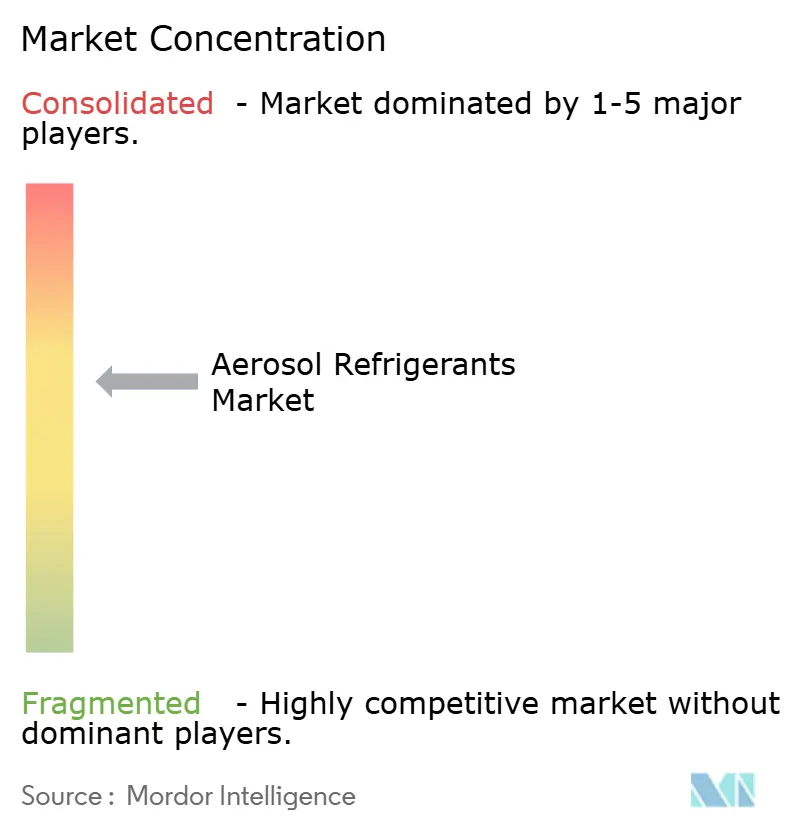
The aerosol refrigerants market exhibits moderate concentration: the top five suppliers—Honeywell, Solvay, Daikin, Arkema and SINOCHEM LANTIAN —controlled just over 60% of 2024 revenues. Honeywell is spinning off its Solstice portfolio into Solstice Advanced Materials by late 2025, carving out a pure-play low-GWP entity poised to accelerate investments in A2L blends and medical propellants. Chemours signed a manufacturing pact with Navin Fluorine to scale Opteon immersion-cooling fluids and is piloting 2P50 with NTT DATA in Japan, signalling a move beyond traditional aerosol channels into data-center thermal management.
Cylinder shortages in 2024 exposed supply-chain fragility; Worthington Enterprises and other container specialists are now expanding seamless-steel capacity to meet stricter A2L pressure-ratings. Hudson Technologies’ partnership with LG Electronics highlights a reclaimed-refrigerant strategy aimed at circularity and quota relief. Smaller challengers target gap niches such as portable ultra-cold shippers and single-dose respiratory propellants, leveraging low fixed-asset footprints.
Technology investment emphasises flammability-mitigation hardware—integrated leak detection, QR-code-linked training modules and child-resistant actuators—all of which reinforce incumbents’ ability to sell premium-priced, standards-ready aerosol cans. Market positioning therefore hinges on combined mastery of regulations, packaging innovation and feed-stock security rather than sheer production scale.
Aerosol Refrigerants Industry Leaders
-
Honeywell International Inc.
-
DAIKIN INDUSTRIES, Ltd.
-
Solvay
-
Arkema
-
SINOCHEM LANTIAN CO., LTD.
- *Disclaimer: Major Players sorted in no particular order
Market Opportunities and Future Outlook
Regulatory-driven substitution continues to create room for low-GWP aerosol formats that simplify compliance and training at the point of use, particularly where legacy refrigerants face tighter controls, quotas, and higher spot pricing. The May 21, 2026 US EPA revisions to the Technology Transitions Rule (effective July 27, 2026) introduced additional flexibility through adjusted requirements and extended compliance timelines for certain HVAC and refrigeration categories. At the same time, the broader AIM Act phasedown continues to reduce overall HFC availability, supporting opportunities for suppliers that can provide approved lower-GWP blends, clear labeling, and standards-aligned packaging for contractor and retail channels.
New supply and localization initiatives also improve the case for expanding low-GWP aerosol portfolios and regional filling footprints. In India, announcements around next-generation refrigerants, including SRF Limiteds plan for a 30,000 tpa HFO facility in Odisha and CSIR-IICTs July 2026 announcement of an indigenous HFO-1234yf manufacturing process ready for transfer, point toward lower import dependence and faster availability of low-GWP molecules for blends and specialty uses. Parallel moves into adjacent high-value end uses, including Honeywells work with Lupin using Solstice Air propellant for next-generation pMDIs, reinforce demand for high-purity, low-GWP propellants where aerosol delivery and stringent specifications intersect.
Recent Industry Developments
- May 2026: The US EPA finalized revisions to its HFC Technology Transitions requirements, adjusting certain sector rules and extending select compliance deadlines, with the updated rule taking effect on July 27, 2026. The change altered near-term compliance pathways for parts of HVAC and refrigeration, influencing how quickly lower-GWP alternatives replace legacy refrigerants in servicing-heavy applications.
- May 2025: Arkema announced a commercial arrangement with Honeywell to expand access to lower-GWP HFO blend refrigerants marketed under Arkemas Forane brand. The tie-up broadened product coverage for customers navigating HFC phasedown constraints and supported faster commercialization of compliant blends through established sales channels.
- May 2024: Honeywell implemented a surcharge on R-454B amid reported fluorochemical supply tightness, contributing to elevated contractor costs and price volatility for A2L transition refrigerants. The move highlighted the importance of feedstock security and inventory strategy for aerosol and small-pack suppliers serving maintenance-driven demand.
Research Methodology Framework and Report Scope
Market Definition and Coverage
This market covers the value of refrigerant products sold in aerosol-style containers and small service cylinders that are used for charging, topping up, and maintenance of cooling equipment across end users.
Scope exclusions: Bulk refrigerant gases sold in drums, ISO tanks, and pipeline delivery are excluded since they are not supplied in aerosol or small portable formats.
Segmentation Overview
- By Product
- HFC-143a
- HFC-32
- HFC-125
- SF6
- Others (Low GWP)
- By Packaging Form
- Aerosol Can (greater than or equal to 500 g)
- Small Cylinder (1-5 kg)
- Others
- By Application
- Refrigerators and Freezers
- Air Conditioners
- Chillers
- Heat Pumps
- Specialty Aerosol Products
- By End-User Industry
- Residential
- Commercial
- Industrial
- Transportation
- By Geography
- Asia-Pacific
- China
- India
- Japan
- South Korea
- Rest of Asia-Pacific
- North America
- United States
- Canada
- Mexico
- Europe
- Germany
- United Kingdom
- France
- Italy
- Russia
- Rest of Europe
- South America
- Brazil
- Argentina
- Rest of South America
- Middle East and Africa
- Saudi Arabia
- South Africa
- Rest of Middle East and Africa
- Asia-Pacific
Data Sources, Market Sizing, and Validation
Desk Research
Desk work starts by mapping the demand pool for servicing and small-format recharge across major cooling applications, and then aligning it with refrigerant transition rules that change what can be sold. We typically refer to public programs and datasets such as the US EPA SNAP listings, the EU F-gas regulatory publications, UN Comtrade trade statistics for relevant HS codes, and IEA cooling and energy outlook material to understand macro direction.
To keep pricing and volume assumptions grounded, we also review customs and port data summaries, safety and handling standards notes from publicly available standards bodies, and peer-reviewed articles on refrigerant blends and leakage behavior in servicing. Company annual reports, product brochures, and investor presentations are used to confirm packaging formats (aerosol can versus small cylinder) and typical application coverage. For cross-checking supplier footprint, news and financials databases, patent databases, and shipment-level import and export databases are used selectively where they clarify capacity, channel presence, or product introductions. The sources listed here are illustrative rather than exhaustive, and many other public references were also used for data collection, validation, and clarification during the study.
Primary Interviews and Surveys
Primary work focuses on validating how aerosol refrigerants move through HVACR service channels, what packaging sizes are actually preferred in the field, and how refrigerant type mix is shifting due to compliance and safety constraints. We spoke with a mix of manufacturers, distributors, service technicians, and large end users across APAC, EMEA, and the Americas. The respondent input was used to tighten assumptions on replacement cycles, refill frequency, and average selling price movement by container type.
Distribution of primary research fieldwork respondents
| Company type | Respondent position | Region |
|---|---|---|
| Top tier: 26% | CXOs: 15% | APAC: 53% |
| Mid tier: 59% | Functional/Unit leaders: 41% | EMEA: 29% |
| Smaller Players: 15% | Managers: 44% | Americas: 18% |
Market-Sizing & Forecasting
Sizing is built using top-down and bottom-up logic, where application-level servicing activity is first reconstructed and then translated into small-format refrigerant demand. In practice, we start with cooling equipment installed base signals and service intensity by application (refrigerators and freezers, air conditioners, chillers, heat pumps, and specialty aerosol uses), and then apply container mix splits for aerosol cans versus small cylinders.
A few inputs that meaningfully move the model include the pace of refrigerant transition to lower-GWP options, regulatory phase-down timing, typical recharge and leakage patterns in servicing, and price spreads across the listed product chemistries. Because packaging matters in this market, we also track average fill weight, compliance labeling impacts, and distribution markups by channel to keep average selling prices realistic. Where local gaps exist, missing points are bridged using regional proxies from similar HVACR service markets, and then tested during expert calls.
Forecasting uses scenario analysis tied to policy timelines and adoption of alternative blends, and the year-by-year path is checked against expected HVACR servicing volumes and price normalization. Results are corroborated with selective bottom-up approximations such as sampled price points by container type and limited supplier and distributor roll-ups, which are then used to adjust the totals when the two views drift.
Data Validation & Update Cycle
Validation is done by comparing the modeled totals against independent signals like regional cooling equipment service activity, trade flow direction for small-format containers, and observed pricing bands for common refrigerant types. When a region shows an outlier jump, the assumptions are re-checked in steps, starting with unit demand, then packaging mix, and then price build-ups, before the final number is signed off.
Each report goes through multi-step analyst review so calculation errors, currency timing mismatches, and double counting across formats are caught early. We refresh the study annually, and interim updates are made when material events occur, such as major regulatory changes or sharp feedstock-driven price swings. Right before delivery, the model is re-opened for a fresh pass so clients get the most current view available.
Mordor Intelligence's Aerosol Refrigerants Market Sizing Compared With Other Published Estimates
Published market values for aerosol refrigerants can look different from one source to another because the market can be defined in more than one practical way, and not every estimate uses the same year, currency timing, or pricing build-up. The year chosen as the starting point, the container formats included, and how refrigerant transitions are treated in forecasts usually explain most of the spread.
Bulk refrigerant sales in drums or tanker deliveries sit outside Mordor Intelligence's scope here, so the total stays tied to aerosol cans and small portable cylinders used for service and recharge, which some publications blend with wider refrigerant supply. Differences also come from whether the model anchors on equipment servicing activity by application versus using a broad growth rate, and whether ASP changes are refreshed with field checks by region or left as a flat escalation.
Benchmark comparison
| Source | Market Size | Gaps in Research Methodology |
|---|---|---|
| Mordor Intelligence | USD 1.40 B (2026) | |
| Industry Publisher A | USD 1.30 B (2025) | Uses an earlier base year and does not clearly separate aerosol and small-cylinder formats from broader refrigerant sales in some country roll-ups, which can shift the starting value. |
| Global Advisory B | USD 1.31 B (2025) | Relies on a different forecast window and segment structure that leans on general CAGR projection, with limited visibility on container fill-weight assumptions and region-level ASP refresh timing. |
Across the table, the main takeaway is that the spread is mostly driven by format coverage and how demand is anchored, not by a single arithmetic issue. We keep the demand pool connected to servicing activity and then check container mix and pricing with field inputs, which makes the steps easier to explain and rerun when conditions change.
Key Questions Answered in the Report
What is the current size of the aerosol refrigerants market and its expected growth?
The aerosol refrigerants market size was USD 1.4 billion in 2026 and is projected to reach USD 1.69 billion by 2031 at a 3.86% CAGR.
Which product type dominates global sales?
HFC-143a remains the leading product with 41.85% revenue share in 2025, although low-GWP blends are expanding fastest.
Why are aerosol cans more popular than small cylinders?
Cans of greater than or equal to 500 g avoid certain transport restrictions, align with DIY trends and mitigate current shortages of A2L-rated cylinders.
How are regulations influencing the market?
The AIM Act, EU F-gas rules and similar regional legislation are capping high-GWP production quotas, lifting prices and accelerating adoption of low-GWP aerosol propellants.
Which regions offer the highest growth prospects?
Asia-Pacific leads global demand and shows the strongest CAGR due to rising residential AC penetration in India and Southeast Asia.