
Adhesive Films Market Size and Share
Market Overview
| Study Period | 2021 - 2031 |
|---|---|
| Market Size (2026) | USD 39.92 Billion |
| Market Size (2031) | USD 50.78 Billion |
| Growth Rate (2026 - 2031) | 4.93 % |
| Fastest Growing Market | Middle East and Africa |
| Largest Market | Asia Pacific |
| Market Concentration | Medium |
Major Players *Disclaimer: Major Players sorted in no particular order Image © Mordor Intelligence. Reuse requires attribution under CC BY 4.0. | |
Adhesive Films Market Analysis by Mordor Intelligence
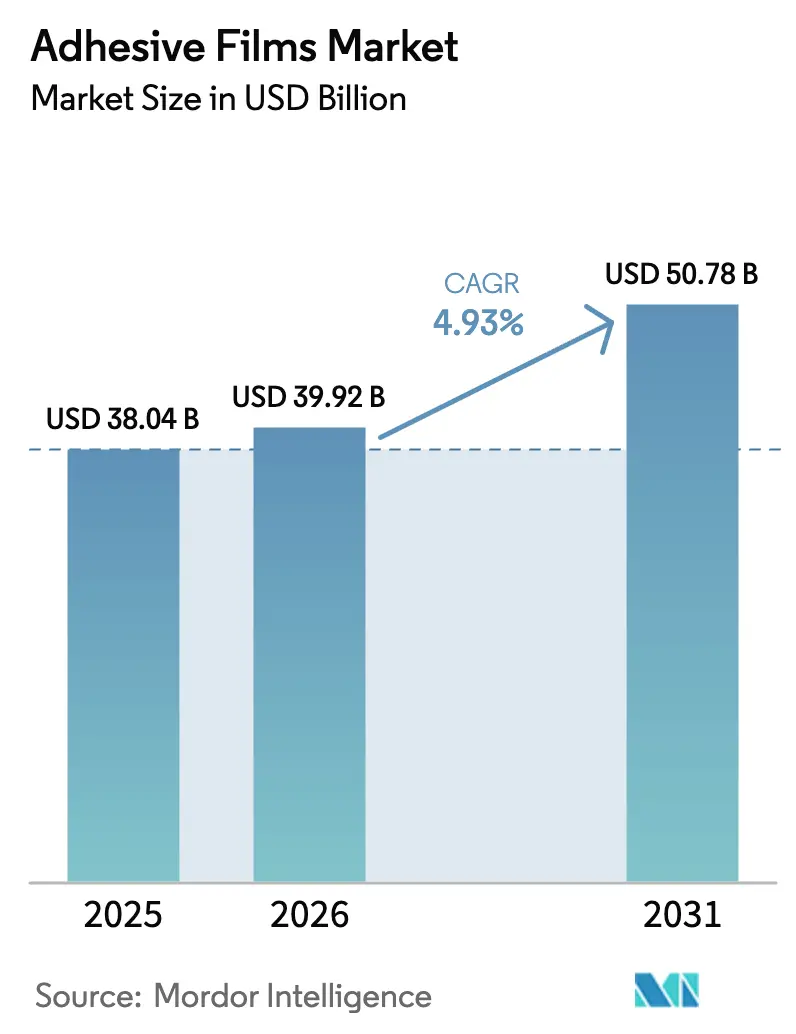
The Adhesive Films Market size is expected to grow from USD 38.04 billion in 2025 to USD 39.92 billion in 2026 and is forecast to reach USD 50.78 billion by 2031 at 4.93% CAGR over 2026-2031. Current growth rests on three pillars: surging electric-vehicle battery builds that demand sub-50-micron bonding layers, accelerating e-commerce parcel volumes that favor lighter yet tougher packaging films, and quickening product-design cycles in flexible electronics that reward ultra-thin optically clear adhesives. Competitive dynamics now hinge on precision-coating capabilities, sustainability credentials, and responsiveness to resin-price swings, all of which shape procurement decisions across automotive, electronics, and packaging supply chains. Market leaders continue to widen the technology gap through investments in water-based chemistries, ultraviolet curing, and high-filler thermally conductive films, while regional specialists leverage fast prototyping and short-run service levels to win niche projects.
Key Report Takeaways
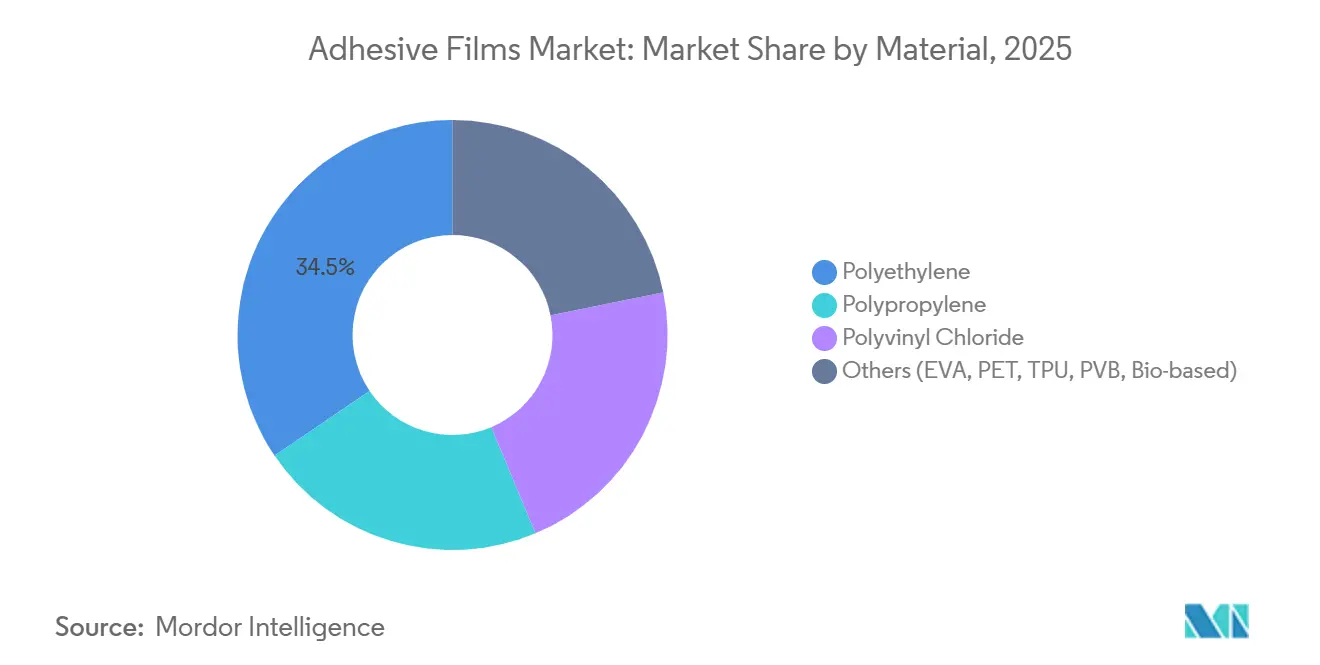
- By material, polyethylene captured 34.47% of adhesive films market share in 2025. Bio-based and specialty polymer blends are projected to expand at a 6.31% CAGR through 2031.
- Pressure-sensitive technology held 46.38% revenue share in 2025. Radiation and ultraviolet-cured films are forecast to be the fastest-growing technology at a 6.42% CAGR to 2031.
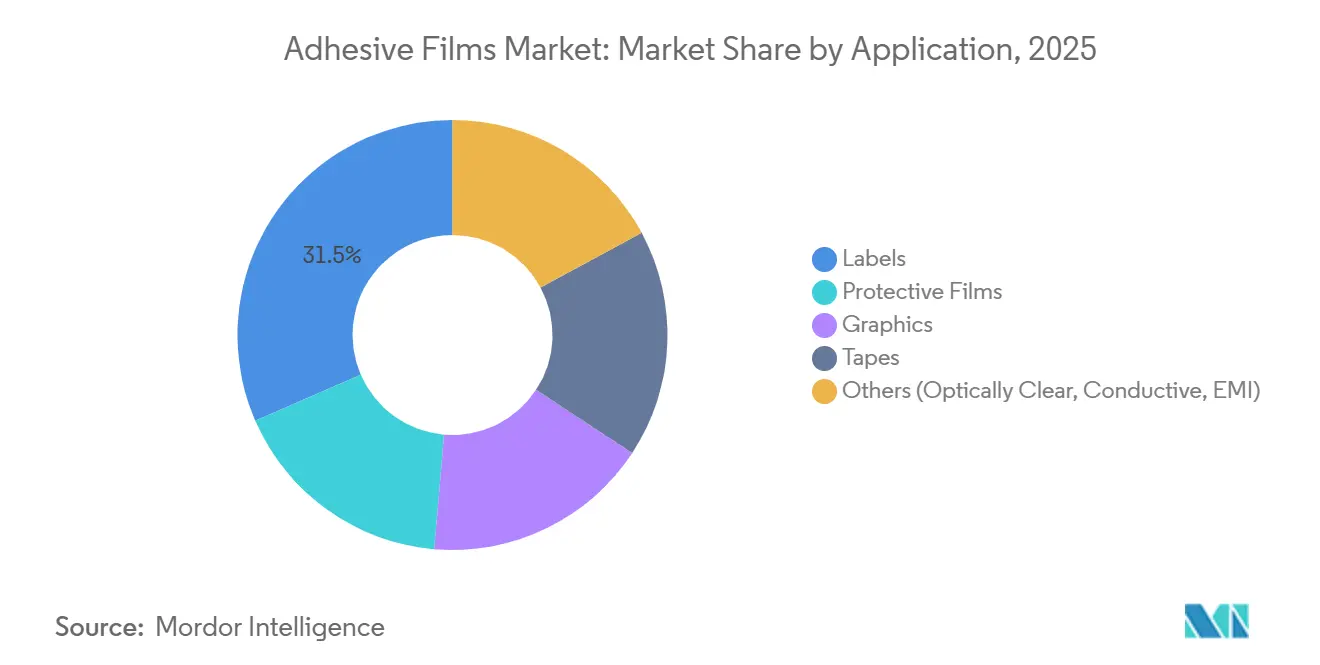
- Labels accounted for 31.52% of application revenue in 2025. Optically clear, conductive, and electromagnetic-interference-shielding films are set to advance at a 6.27% CAGR through 2031.
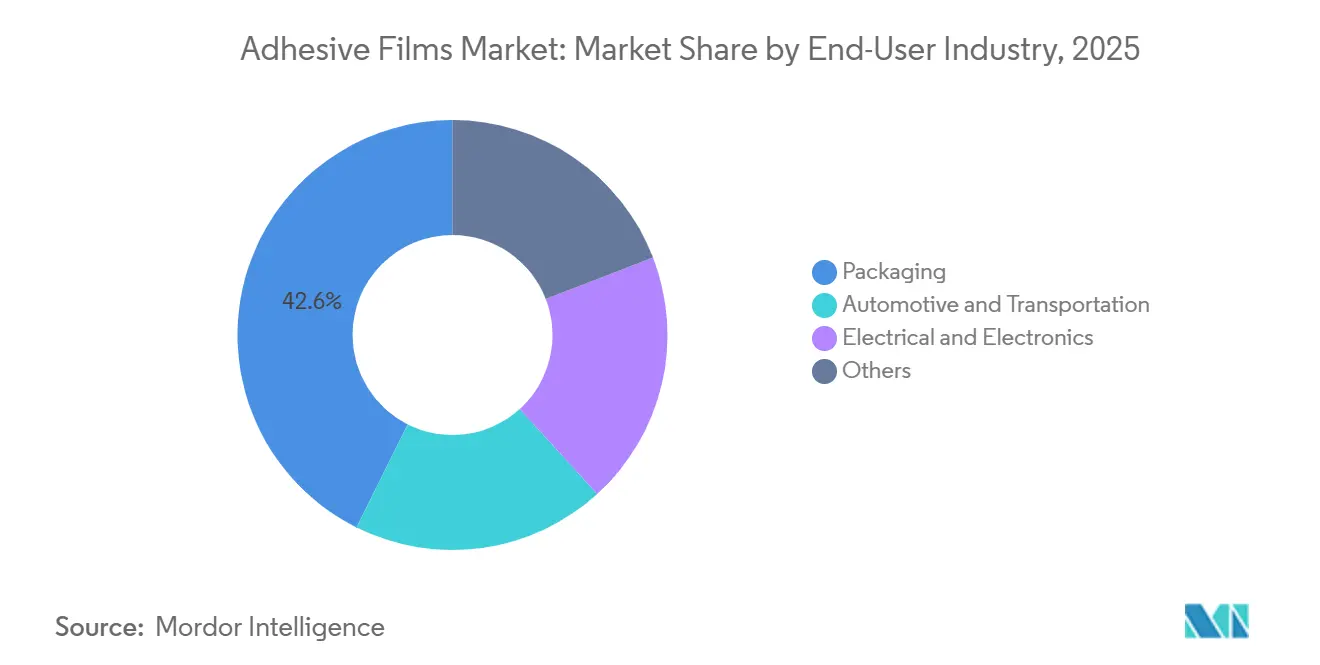
- Packaging represented 42.63% of demand in 2025. Electrical and electronics end-users are expected to grow at a 6.24% CAGR through 2031.
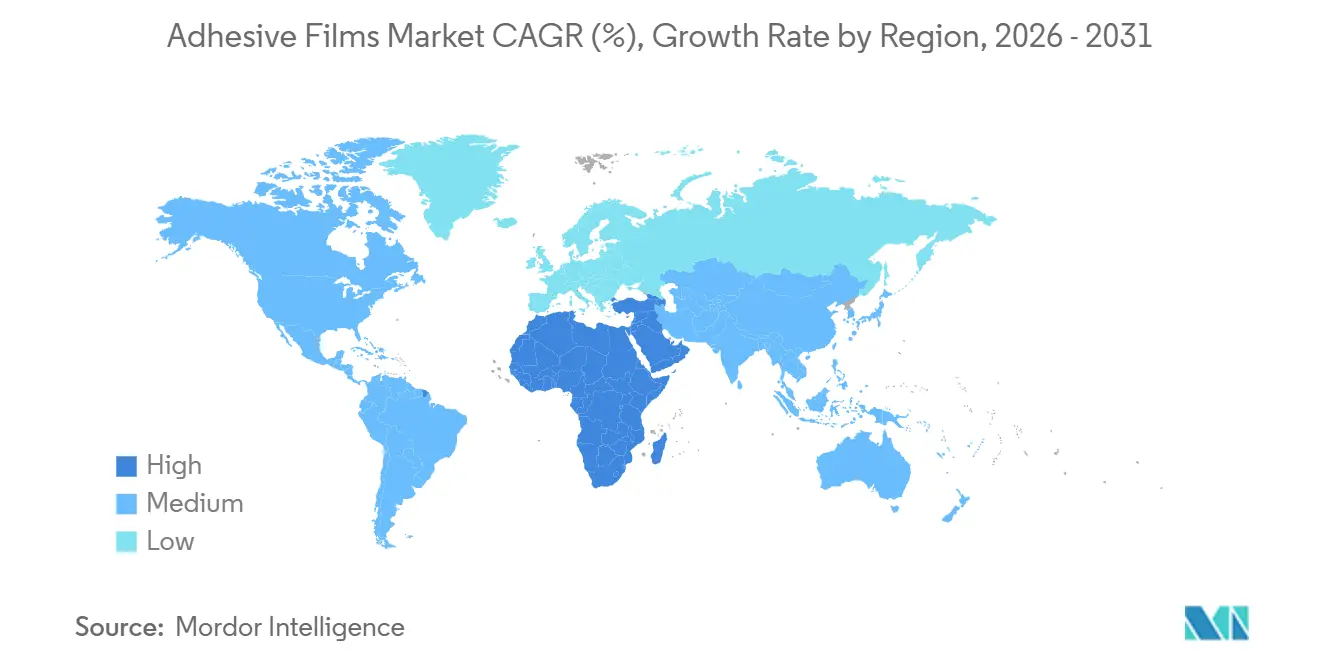
- Asia-Pacific contributed 48.36% of global revenue in 2025. The Middle East and Africa are projected to deliver the fastest regional CAGR at 5.93% through 2031.
Note: Market size and forecast figures in this report are generated using Mordor Intelligence’s proprietary estimation framework, updated with the latest available data and insights as of January 2026.
Market Trends and Insights
Drivers Impact Analysis of Adhesive Films Market*
| Drivers | (~) % Impact on CAGR Forecast | Geographic Relevance | Impact Timeline |
|---|---|---|---|
| EV/Battery Thermal-Management Demand | +0.8% | China, EU, North America | Medium term (2-4 years) |
| E-commerce Packaging Boom | +0.6% | APAC, North America | Short term (≤ 2 years) |
| Miniaturization in Flexible and Wearable Electronics | +0.7% | APAC core, spill-over to North America | Medium term (2-4 years) |
| Shift to Water-based/Solvent-free Chemistries | +0.5% | North America, EU | Long term (≥ 4 years) |
| Infrastructure Spend on Smart Construction Facades | +0.4% | Middle East, China, select EU markets | Long term (≥ 4 years) |
| Source: Mordor Intelligence | |||
EV/Battery Thermal-Management Demand
Vehicle manufacturers moving from module-to-pack to cell-to-pack architectures need films that deliver both electrical isolation and thermal conductivity above 3 W/m-K. Henkel posted an 18% jump in revenue from thermally conductive adhesive films during 2024, aided by solutions that replace gap pads and eliminate one-third of assembly steps. H.B. Fuller’s EV THERM series, launched in 2024, laminates in a single pass and carries ceramic filler loadings above 70 wt%. Patent applications for adhesive-based runaway barriers rose 22% year on year in 2024, underscoring the strategic importance of fire-mitigation films. Lithium-iron-phosphate packs require more cells per vehicle, lifting film consumption by roughly 25-35% per car. New standards such as UL 2580 now call for 1,000-hour thermal-aging tests at 85 °C, accelerating the shift from acrylic to silicone or polyurethane chemistries.
E-commerce Packaging Boom
Parcel throughput per square meter jumped 15% versus 2024, compelling fulfillment operators to specify thinner gauges-now 35 microns instead of 50 microns-while still passing 1.2-meter drop tests. The EU Packaging and Packaging Waste Regulation demands 70% recyclability by 2030, encouraging mono-material polyethylene constructions bonded with water-based adhesives[1]. H.B. Fuller reported double-digit growth in water-based packaging adhesives in 2024 as brand owners chased volatile-organic-compound limits below 250 g/L. Rising product return rates sustain demand for re-sealable adhesive films that maintain tack after multiple openings. Meanwhile, the average parcel weight fell from 2.8 kg in 2020 to 2.3 kg in 2025, magnifying cost savings from lightweight films.
Miniaturization in Flexible and Wearable Electronics
Printed-sensor production is on track to top USD 15.3 billion by 2030, with adhesive films acting as both substrate and encapsulant. Samsung Display and LG Display now employ optically clear films under 25 microns that must match panel refractive index within 0.02 and stay below 1% haze[2]. LINTEC’s 2024 dicing tapes enable 10-micron die separation without chipping, a prerequisite for chiplet packaging. Wearable health monitors integrate conductive adhesive films that double as electrodes, trimming component count and bill-of-materials cost by USD 0.40-0.60 per unit. Compliance with IEC 62368-1 drives uptake of halogen-free flame retardants, lifting raw-material spend by 8-12% yet unlocking premium OEM demand.
Shift to Water-based/Solvent-free Chemistries
U.S. EPA rules cap volatile-organic-compound content at 250 g/L for flexible-packaging adhesives, a limit that solvent-based systems overshoot by up to 50%. Henkel earmarked EUR 150 million in 2024 to enlarge water-based output in Düsseldorf and Bridgewater. Europe’s planned PFAS ban will outlaw fluorinated release liners by 2026, stoking reformulation toward silicone-based alternatives that still lag on release-force consistency. Water-based pressure-sensitives need 20-30% longer drying time, slowing uptake among label press lines running 200 m/min. Hot-melt faces open-time limits, but their zero-VOC profile secures a share in carton and case sealing.
Restraints Impact Analysis of Adhesive Films Market*
| Restraints | (~) % Impact on CAGR Forecast | Geographic Relevance | Impact Timeline |
|---|---|---|---|
| Raw-Material Price Volatility | -0.6% | North America, Europe | Short term (≤ 2 years) |
| Complex End-of-life Recycling of Multi-layer Films | -0.4% | EU, North America | Medium term (2-4 years) |
| Stricter PFAS and VOC Regulations | -0.5% | North America, EU, emerging in APAC | Medium term (2-4 years) |
| Source: Mordor Intelligence | |||
Raw-Material Price Volatility
Polyethylene resin added 8 cents/lb during the first two months of 2025, while polypropylene climbed 4 cents/lb, slicing 200-300 basis points off converter margin. The U.S. Producer Price Index for plastic resins hit 275.323 in March 2025, up 2.5% quarter on quarter. Smaller converters lacking hedging tools face a 6-9-month delay before passing costs to customers, pushing many sub-USD 50 million firms toward consolidation. Structural oversupply keeps global cracker utilization near 80%, yet unplanned outages and geopolitical shocks still jolt spot prices.
Stricter PFAS and VOC Regulations
The EU Packaging and Packaging Waste Regulation compels 70% recyclability by 2030, threatening 15-20% of current multilayer film capacity. Proposed REACH Annex XV PFAS limits will remove fluorinated release liners that account for about half of silicone-free liner stocks. U.S. EPA formaldehyde limits below 0.09 ppm for composite wood products also affect laminating adhesives in furniture supply chains. Only 14% of plastic packaging is collected for recycling worldwide, and the rate falls below 5% for multilayer flexible films, reflecting delamination challenges.
*Our forecasts treat driver/restraint impacts as directional, not additive. The impact forecasts reflect baseline growth, mix effects, and variable interactions.
Adhesive Films Market Segment Analysis
By Material:
Bio-based Blends Narrow Cost GapPolyethylene delivered 34.47% of 2025 revenue thanks to its cost advantage at USD 1.20-1.40 per kg and compatibility with widespread blown-film assets. Specialty and bio-based polymers are forecast to post a 6.31% CAGR, topping the overall adhesive films market by 140 basis points as automotive and electronics buyers embed carbon-reduction targets in supplier contracts. Polypropylene ranks second by volume on the strength of its clarity and moisture barrier, but its 4.5% growth trails specialty blends that promise better heat stability.
In niche arenas, thermoplastic polyurethane commands USD 8-12 per kg, justified by elasticity and abrasion resistance valued in paint-protection and wound-care films. Polyvinyl butyral is spreading from windshield interlayers to smart-glass façades, a segment that could reach 20 million m² annually by 2030. Compostable options such as polylactic acid remain under 2% share because heat-deflection temperatures below 60 °C prevent use in most hot-melt or thermal-lamination lines.

By Adhesive Technology:
UV-Cured Films Gain MomentumRadiation and ultraviolet-cured products are projected to grow at 6.42% CAGR, the fastest within the adhesive films market, spurred by electronics assemblers that cannot afford 10-15 second dwell times typical of hot-melts. Pressure-sensitives retained 46.38% share in 2025 owing to their plug-and-play integration on high-speed labelers. However, water-based versions require longer oven zones, posing a hurdle for converters running at 300 m/min.
Hot-melts have won incremental packaging share because they emit zero VOCs, yet their short open window restricts intricate pouch assembly. Solvent systems are tethered to sub-3% growth as EPA’s 250 g/L cap sparks migration to water-based formulations. Ultraviolet-cured pressure-sensitives now offer instant tack and 24-hour post-cure strength, but USD 200,000-plus lamp lines deter smaller shops.
By Application:
Specialty Films Move Up the Value LadderOptically clear, conductive, and electromagnetic-interference-shielding films are forecast to climb at a 6.27% CAGR, outperforming labels, which still held 31.52% of 2025 revenue. Automotive paint-protection demand lifted protective films in line with the overall adhesive films market, thanks to XPEL’s direct-to-installer model that expands aftermarket reach.
Graphics films face substitution pressure from direct-to-substrate digital printing, causing flat growth at Avery Dennison’s graphic division. Conductive adhesive films, priced as high as USD 100 per m², enable touch sensors and shield 5G handsets from interference, trading at 10-20 times the value of commodity tapes. Optically clear adhesive output is dominated by a handful of Japanese and Korean firms that consistently meet haze below 1% and refractive-index tolerance within 0.02.
By End-User Industry:
Electronics AcceleratesPackaging absorbed 42.63% of demand in 2025, yet electronics is set to register the quickest 6.24% CAGR as films migrate from passive covers to functional layers such as antennas and heat spreaders. Automotive builds continue to consume large square meterage for battery thermal interfaces, interior trim, and noise-damping, rising 5.8% in 2024 on 14 million electric-vehicle units.
Mono-material polyethylene pouches bonded with water-based adhesives are winning in e-commerce, while multilayer barrier films for shelf-stable food face recyclability headwinds. Electronics demand is heavily Asia-Pacific-centric, challenging North American and European suppliers to shorten lead times or invest in local compounding. Construction and medical applications offer steady volume but remain fragmented across small job sizes.
Geography Analysis
APAC Adhesive Films Market
Asia-Pacific generated 48.36% of global revenue in 2025 and should extend at a 5.1% CAGR through 2031, propelled by its 60% share of semiconductor packaging capacity and dominance in smartphone assembly. China exported USD 1.75 billion of self-adhesive tape in 2023, confirming its price-setting status. Japan and South Korea stay at the innovation frontier for foldable OLED bonding films, while Southeast Asia attracts incremental lines as supply chains diversify.
North America and Europe Adhesive Films Market
North America and Europe together controlled a significant revenue share but will trail the Asia-Pacific by nearly 1 percentage point in CAGR. Resin price oscillations of 5-8 cents/lb in early 2025 squeezed margins and forced consolidation among mid-tier extruders. The EU’s recyclability mandate is triggering fresh capital for mono-material lines, including Henkel’s EUR 150 million water-based expansion. The United States remains the largest country market, supported by e-commerce parcel growth of 12% in 2024 and persistent automotive demand of roughly 225 million m² annually.
MEA and South America Adhesive Films Market
Middle East and Africa, though smaller, is forecast to grow fastest at 5.93% CAGR, helped by Saudi Arabia’s USD 1.1 trillion Vision 2030 build-out. Egypt’s flexible-packaging plants feed North African food brands, while United Arab Emirates construction projects lift demand for façade and interior laminate films. South America lags, with Brazil and Argentina constrained by import tariffs and limited domestic capacity for high-performance bases, keeping the region focused on commodity tapes and labels.
Regulatory Landscape
Compliance requirements are tightening around packaging recyclability, chemical content, and food-contact safety, reshaping adhesive film formulations and the documentation behind them. In the European Union, the Packaging and Packaging Waste Regulation (PPWR) 2025/40 enters general application from August 2026, pushing design-for-recycling and traceability for packaging components while increasing pressure to substantiate PFAS status across backings, coatings, and release systems.
Chemical and food-contact rules add further constraints for specialty and UV-cured adhesive films. The EU updated plastics food-contact provisions via Commission Regulation (EU) 2026/245 (February 2026), authorizing specific comonomer use in thin polyamide films under defined migration limits. In the United States, the FDA revised 21 CFR 175.300 (July 2026) to tighten migration thresholds for certain UV-curable components, which is already driving photoinitiator and monomer selection changes for food-contact lamination and label constructions.
Value Chain Analysis
The adhesive films value chain starts with upstream polymer and tackifier suppliers (PE, PP, PVC, specialty polymers, and adhesive raw materials). It then moves through film extrusion and precision coating or lamination, and into converting steps such as slitting, die-cutting, and liner handling, before distribution and application-specific integration at packaging converters, label printers, electronics assemblers, and automotive tier suppliers. Process inputs, especially coating and curing lines for water-based and UV systems, shape throughput, defect rates, and the ability to meet thin-gauge, low-haze, or thermally conductive specifications.
Two operational themes are influencing how value is captured across the chain: regulatory interpretation and supply chain resilience. In Europe, Afera engagement around PPWR has included clarifications, including the April 2026 confirmation that certain adhesive process films used in manufacturing are not classified as packaging, reducing compliance overhead for industrial process applications. On manufacturing footprints, announced rationalizations such as UPM Adhesive Materials plans to discontinue label materials production in Nancy, France (September 2025) point to continued capacity optimization, while converters and brand owners increasingly request product carbon footprint data and materials traceability, raising the role of associations and shared tools in standardizing reporting across suppliers.
Competitive Landscape
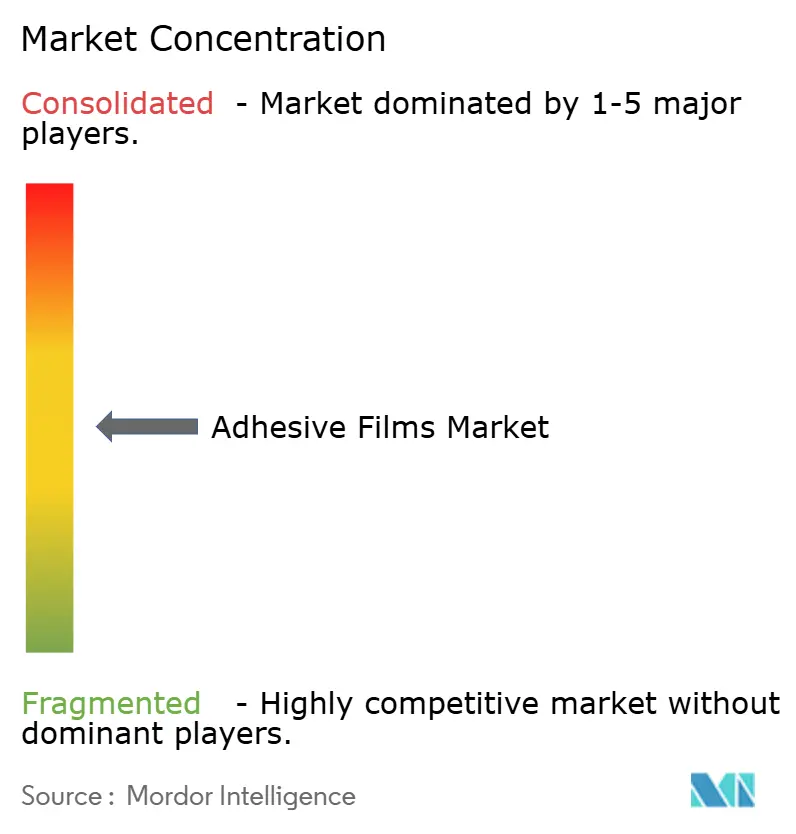
The global adhesive films market is moderately consolidated. Competitive fronts are split between scale-driven commodity labels and science-intensive specialty films. Patent filings for lithium-ion cell encapsulation rose 22% in 2024, spotlighting a scramble for intellectual property that will define battery assembly standards through the decade. Emerging leaders in the market are exploiting white spaces by combining die-cut customization with sub-24-hour delivery for order sizes below 10,000 m², service levels that global conglomerates struggle to match. Leading groups defend legacy labels while investing in optically clear and thermally conductive lines whose unit economics yield three to five times the gross profit of commodity packaging films. Technological thrusts include ultraviolet-cured tackifiers that cut ovens, digital presses that run adhesive-backed media on demand, and hyperspectral inspection that detects defects under 10 microns, outperforming manual checks.
Adhesive Films Industry Leaders
-
3M
-
Avery Dennison Corporation
-
Henkel AG & Co. KGaA
-
Nitto Denko Corporation
-
LINTEC Corporation
- *Disclaimer: Major Players sorted in no particular order
Adhesive Films Market Companies Covered in this Report
- 3M
- Adhesive Films, Inc.
- Arkema
- Avery Dennison Corporation
- Berry Global Inc.
- DuPont
- Eastman Chemical Company
- Grafix Plastics
- H.B. Fuller Company
- Henkel AG & Co. KGaA
- Huntsman International LLC
- LINTEC Corporation
- L&L Products
- Nitto Denko Corporation
- Scapa
- Sika AG
- tesa Tapes (India) Private Limited
- Toray Advanced Composites
- XPEL
Market Opportunities and Future Outlook
Near-term whitespace is concentrating on redesigning structures to meet recyclability and chemical constraints while holding performance across packaging, electronics, and EV battery assembly. PPWR is pushing more mono-material packaging and stronger traceability requirements, expanding the addressable need for water-based and solvent-free adhesive film systems that support recyclable polyethylene structures and lower VOC profiles. This dynamic reinforces investment in water-based capability, including Henkel's EUR 150 million 2024 expansion of water-based output in Germany and the United States. At the same time, tighter food-contact scrutiny of UV-curable components, including the July 2026 FDA update to 21 CFR 175.300, is supporting demand for compliant UV-curable adhesive film chemistries and validated migration performance for labels and flexible packaging.
Regionalization and specialty upgrades are also creating openings for suppliers with precision coating and application-specific portfolios. UPM Adhesive Materials capacity expansion in Johor Bahru, Malaysia, with a new coating line targeted for mid-2026 operation, and tesa's Offenburg, Germany site expansion milestone in May 2026, show active moves to add capacity closer to growing end-use hubs and industrial tape demand. Portfolio expansion through consolidation is supporting higher-value film applications as well, including Covestro's June 2025 agreement to acquire Pontacol to broaden specialty adhesive films capacity and offerings in Europe. On the R&D side, hydrophobic pressure-sensitive films produced via initiated chemical vapor deposition and microencapsulated adhesive systems are pointing to differentiation paths for electronics and automotive assembly where moisture resistance and process control are critical.
Recent Industry Developments in Adhesive Films Market
- July 2026: Ahlstrom launched MaxLiner, a high-transparency release paper produced at its Jacarei plant in Brazil. The added local supply of release liners supports pressure-sensitive adhesive labeling ecosystems and reduces reliance on imported liner materials for regional converters.
- March 2026: Avery Dennison and BASF collaborated to introduce acrylates made using renewable electricity, including butyl acrylate RE and 2-ethylhexyl acrylate RE. Access to lower-footprint monomers supports PSA adhesive film and labelstock decarbonization efforts while maintaining drop-in compatibility for established formulations.
- June 2024: Henkel allocated EUR 150 million to expand water-based adhesive capability in Germany and the United States. The investment strengthens supply for converters shifting away from solvent-based systems to meet VOC and emerging PFAS-related constraints in packaging and related applications.
Adhesive Films Market Report Scope and Research Methodology
Market Definition and Coverage
This market covers adhesive films sold as film-based bonding solutions that are coated or formulated to stick to surfaces using pressure, heat, water, solvents, or radiation curing, and then used across industrial and consumer end uses.
Scope exclusions: We exclude liquid-only adhesives, bulk sealants, and coating systems that are not supplied and used in film form.
Segments Covered in This Report
- By Material
- Polyethylene
- Polypropylene
- Polyvinyl Chloride
- Others (EVA, PET, TPU, PVB, Bio-based)
- By Adhesive Technology
- Pressure-Sensitive (PSA)
- Hot-Melt
- Water-based
- Solvent-based
- Radiation/UV-cured
- By Application
- Protective Films
- Graphics
- Labels
- Tapes
- Others (Optically Clear, Conductive, EMI)
- By End-User Industry
- Packaging
- Automotive and Transportation
- Electrical and Electronics
- Others
- By Geography
- Asia-Pacific
- China
- India
- Japan
- South Korea
- Malaysia
- Thailand
- Indonesia
- Vietnam
- Rest of Asia-Pacific
- North America
- United States
- Canada
- Mexico
- Europe
- Germany
- United Kingdom
- France
- Italy
- Spain
- NORDIC Countries
- Turkey
- Russia
- Rest of Europe
- South America
- Brazil
- Argentina
- Rest of South America
- Middle-East and Africa
- Saudi Arabia
- Qatar
- United Arab Emirates
- Nigeria
- Egypt
- South Africa
- Rest of Middle-East and Africa
- Asia-Pacific
Data Sources, Market Sizing, and Validation
Desk Research
Desk research starts with building the market boundary and the demand drivers that pull adhesive films into end uses. We reference public sources such as UN Comtrade trade statistics, US International Trade Commission data, Eurostat industrial indicators, and national statistics offices for packaging output, vehicle production, and electronics manufacturing signals.
To connect supply and demand, we also review patent databases to understand technology shifts in pressure-sensitive and hot-melt systems, and we scan peer-reviewed journals for material substitution trends (including polypropylene and polyethylene film usage in laminates). Annual reports, investor decks, and press releases help validate capacity additions, product focus, and pricing commentary, while a paid subscription for company financials and an import-export shipment-level database are used selectively to cross-check directionally where public data is thin. These sources are illustrative only, and other public references were also used for data collection, validation, and clarification during the study.
Primary Interviews and Surveys
Primary work is used to confirm what is actually counted as adhesive films in buying and selling discussions, and to stress-test the volume and pricing assumptions used in the model. We spoke with a mix of film converters, adhesive formulators, distributors, and large end users across packaging, automotive and transportation, and electronics. Coverage was balanced across APAC, EMEA, and the Americas to reflect different sourcing patterns and application mix.
Distribution of primary research fieldwork respondents
| Company type | Respondent position | Region |
|---|---|---|
| Top tier: 34% | CXOs: 16% | APAC: 42% |
| Mid tier: 50% | Functional/Unit leaders: 40% | EMEA: 34% |
| Smaller Players: 16% | Managers: 44% | Americas: 24% |
Market-Sizing & Forecasting
Market sizing is built using top-down and bottom-up logic, but the core build starts from a top-down view of film and adhesive demand pools that can be reconstructed from packaging activity, vehicle output, and electronics manufacturing, then filtered by typical adhesive film penetration and usage intensity. After that total is obtained, we corroborate it using selective bottom-up checks such as sampled supplier revenue splits, channel checks for major application areas (labels, tapes, graphics, protective films), and a simple volume-times-average selling price build for a few anchor countries.
Key inputs used in the model include packaging production growth, automotive build rates, electronics output trends, resin and film material mix shifts (polyethylene, polypropylene, and PVC), and observed pricing movement by adhesive technology (pressure-sensitive, hot-melt, water-based, solvent-based, and radiation-cured). For the forecast, scenario analysis is used so that base-case adoption and pricing progression can be adjusted when expert feedback signals a faster or slower shift in end-use demand. Where bottom-up inputs are incomplete for smaller countries, gaps are handled using regional benchmarks tied back to trade flows and industrial activity, and then reviewed before final roll-up.
Data Validation & Update Cycle
Validation is done through several checks so that the totals match real-world signals and not just model math. We compare outputs against independent indicators like trade movement for relevant film and adhesive categories, regional manufacturing trends, and the implied per-unit consumption in packaging and labels, then re-check outliers where growth or pricing looks unusual.
Before sign-off, the model is reviewed in steps, with assumptions revisited when interview feedback conflicts with desk findings. The report is refreshed annually, and interim updates are triggered when large capacity changes, policy shifts, or abrupt raw material price swings materially alter the outlook. Right before delivery, a final pass is done so the numbers reflect the latest available data.
Mordor Intelligence's Adhesive Films Market Size Versus Other Published Estimates
Published market sizes for adhesive films can vary a lot, even when the topic name looks identical. The spread usually comes from how the scope is drawn, how pricing is treated across technologies, and whether the sizing is tied back to end-use activity or broader materials baskets.
By tracking technology-specific pricing and application-level demand signals, Mordor Intelligence keeps adhesive films counted only when they are used as film-form bonding solutions within packaging, automotive and transportation, electronics, and related applications, which can diverge from estimates that fold in adjacent tapes, liquid adhesives, or wider converted film value.
Benchmark comparison
| Source | Market Size | Gaps in Research Methodology |
|---|---|---|
| Mordor Intelligence | USD 39.92 B (2026) | |
| Global Consultancy A | USD 89.50 B (2024) | Uses a broader market envelope that appears to capture a wider converted-film and adhesive value chain, which lifts totals versus a film-only bonding scope, and it also anchors on an earlier year that can reflect different pricing cycles. |
| Industry Publisher B | USD 89.89 B (2024) | The definition is described at a high level with limited visibility into what is excluded, so adjacent products like tapes or non-film adhesive formats can be blended in, and regional weighting assumptions may not be fully tied back to end-use production indicators. |
Overall, the table shows that the biggest differences come from scope boundaries and what value is being counted, followed by base-year timing and pricing logic. When the market is tied to clear application demand pools and checked against trade and production signals, the resulting size is easier to trace and update consistently as conditions change.
Key Questions Answered in the Report
What is the current value of the adhesive films market?
The adhesive films market size stood at USD 39.92 billion in 2026 and is projected to reach USD 50.78 billion by 2031.
Which material leads demand in adhesive film production?
Polyethylene leads, accounting for 34.47% of global revenue in 2025 due to its low cost and broad processing compatibility.
Which application segment is expected to grow fastest?
Optically clear, conductive, and electromagnetic-interference-shielding films are forecast to advance at a 6.27% CAGR through 2031.
Why are ultraviolet-cured adhesive films gaining traction?
UV-cured films offer instant bonding without lengthy oven cycles, aligning with high-speed electronics lines and zero-VOC sustainability targets.
Which region will register the highest growth rate to 2031?
Middle East and Africa should post the quickest regional CAGR at 5.93%, buoyed by Saudi Vision 2030 infrastructure spending and packaging expansion in Egypt.