
Acute Bacterial Skin And Skin Structure Infection Market Size and Share
Market Overview
| Study Period | 2020 - 2031 |
|---|---|
| Forecast Data Period | 2026 - 2031 |
| Historical Data Period | 2020 - 2024 |
| Growth Rate | 8.12 % |
| Fastest Growing Market | North America |
| Largest Market | Asia-Pacific |
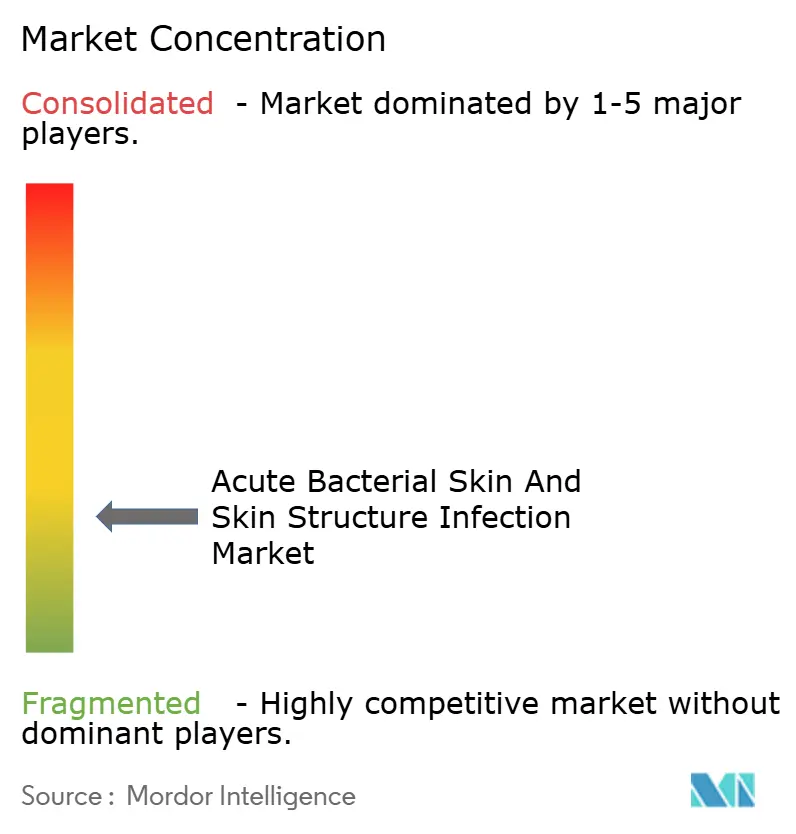
| Market Concentration | Low |
Major Players *Disclaimer: Major Players sorted in no particular order Image © Mordor Intelligence. Reuse requires attribution under CC BY 4.0. | |
Acute Bacterial Skin And Skin Structure Infection Market Analysis by Mordor Intelligence
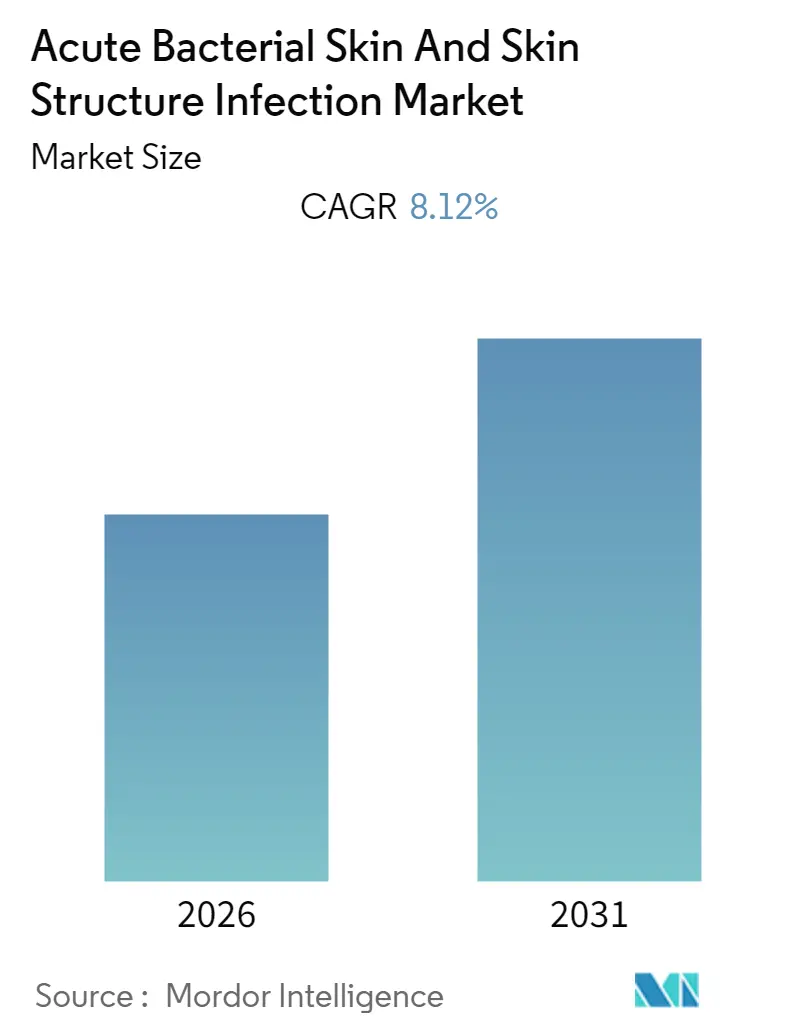
The Acute Bacterial Skin And Skin Structure Infection Market size is expected to grow from USD 3.16 billion in 2025 to USD 3.42 billion in 2026 and is forecast to reach USD 5.05 billion by 2031 at 8.12% CAGR over 2026-2031.
COVID-19 impacted the global supply chain of pharmaceuticals, affecting the acute bacterial skin and skin structure infection (ABSSSI) market. In the early phases of the pandemic, the market saw a significant sales decline due to stringent lockdowns, supply chain restrictions, and manufacturing halts. However, according to the study published in Acta Medica Indonesia in January 2021, bacterial skin and skin structure infections are worsened in COVID-19 patients and lead to prolonged hospitalization, thereby boosting the market. According to a study published in the Journal of Infectious Diseases in Clinical Practice, many high-risk COVID-19 individuals are also more likely to experience severe bacterial infections, frequently requiring hospitalization. Thus, during the initial stages of the pandemic, there was a slight decline in the market's growth. The high risk of ABSSSI in COVID-19 patients led to increased adoption of therapeutics.
The rising prevalence and awareness of acute bacterial skin and skin structure infection, as well as increased R&D activities by pharmaceutical and biopharmaceutical companies to supply new products and novel treatments, contribute to the market's growth.
Two of the most common bacteria that cause acute bacterial skin and skin structure infections are Streptococcus pyogenes and Staphylococcus aureus, including methicillin-resistant S. aureus. Gram-negative bacteria, other Streptococcus species, and Enterococcus faecalis are less common causes. According to a study published in the Infection and Drug Resistance Journal in April 2022, a crucial emerging concept in the treatment of acute bacterial skin and skin structure infections was the availability of various approved agents with anti-MRSA activity. The availability of anti-MRSA drugs in the management of ABSSSI is expected to drive the market.
However, growing pipeline development activity and rising R&D expenditure by pharmaceutical and biotechnology companies, along with the approval of drugs, are anticipated to drive the market over the forecast period. For instance, as per clinicaltrials.gov, in May 2021, Ceftobiprole Medocarial under Phase III trials proved an effective treatment option for acute bacterial skin and skin structure infections. China National Medical Products Administration (NMPA) approved Zai Lab Ltd's new drug application for NUZYRA (omadacycline), a novel antibiotic with both oral and intravenous (IV) formulations, for the treatment of community-acquired bacterial pneumonia (CABP) and acute bacterial skin and skin structure infections (ABSSSI).
Growing product launches and various activities by key market players, such as mergers and acquisitions, collaborations, and partnerships, are anticipated to drive the market. For instance, in July 2021, Melinta Therapeutics launched KIMYRSA (oritavancin), a lipoglycopeptide antibiotic that delivers a complete course of therapy for acute bacterial skin and skin structure infections (ABSSSI) in a single, one hour, 1,200 mg infusion.
Thus, the rising prevalence of ABSSSI, increasing strategies by key players, and rising R&D of therapeutics of ABSSSI are expected to boost the market over the forecast period. However, stringent regulatory policies by government bodies and patent expiration are expected to hinder the market in the future.
Note: Market size and forecast figures in this report are generated using Mordor Intelligence’s proprietary estimation framework, updated with the latest available data and insights as of 2026.
Global Acute Bacterial Skin And Skin Structure Infection Market Trends and Insights
Hospital-acquired ABSSI is Expected to Hold Significant Market Share During the Forecast Period
Infections acquired in a healthcare setting are known as hospital-associated infections (HCAIs). They may cause (or prolong) stays in acute care hospitals, increase medical and economic burdens, and cause morbidity and mortality. According to a study published in the Journal of Antimicrobial Chemotherapy in November 2021, adult inpatients in the National Health Service hospitals in England have 834,000 hospital-acquired infections (HCAIs) each year, accounting for 7.1 million occupied hospital bed days (21% of total annual bed days) and a EUR 2.7 billion (USD 2.8 billion) economic burden. Such a huge burden of hospital-acquired infections is expected to drive the segment's growth due to the rising adoption of ABSSSI therapies for these infections.
According to the same source, the prevalence of HCAI is estimated to be 6.0%. The most common infections were skin and soft tissue infections (SSTIs), which included surgical site infections (SSIs). Patients in intensive care units had the highest rate of hospital-acquired ABSSSI. Thus, growing prevalence of hospital-acquired infection is expected to boost the segment.
According to a study published in the International Journal of Antimicrobial Agents in August 2022, almost 10% of all hospital admissions in the United States and around 15% of all infections treated in European hospitals are due to ABSSSIs. Such a huge prevalence of hospital-based ABSSSI is expected to drive the segment due to the increased adoption of treatments for ABSSSI.
Therefore, as the high burden of hospital-acquired ABSSSI is expected to drive the market over the forecast period
North America Holds a Significant Share in the Market and is Expected to Continue the Same During the Forecast Period
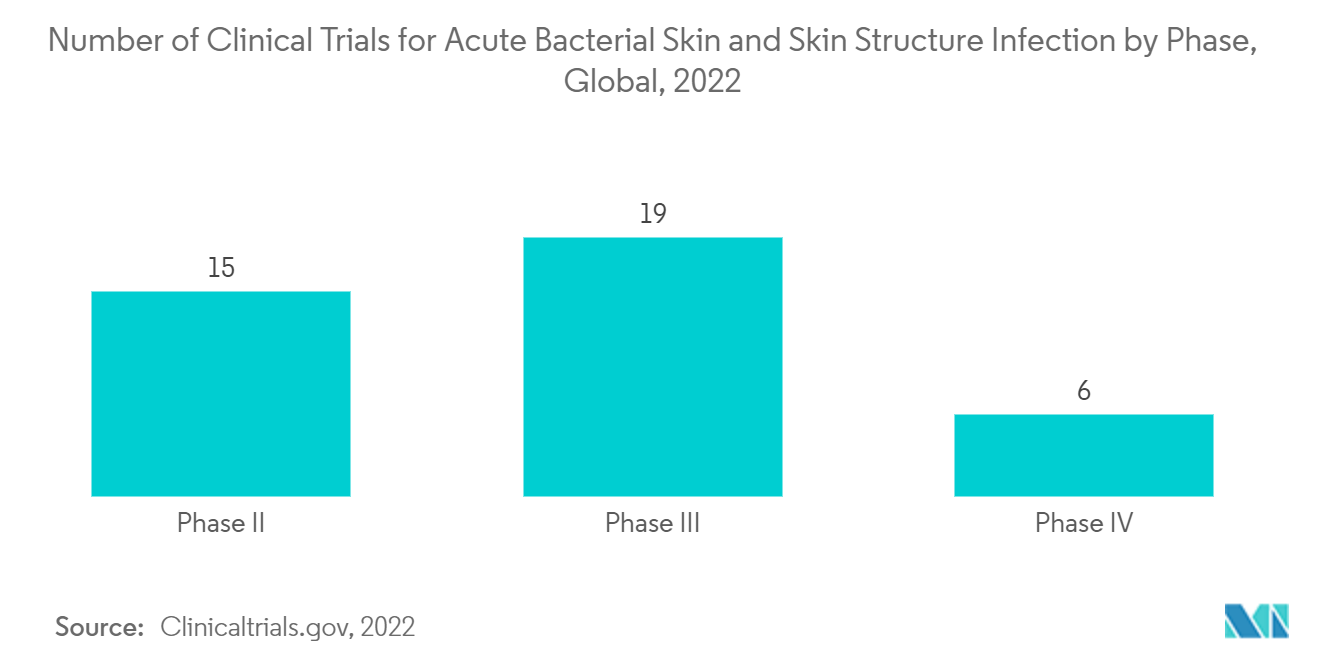
North America may continue to hold a significant share in the acute bacterial skin and skin structure infection market during the forecast period due to extensive R&D activity, R&D spending, product pipeline, and novel product launches.
The growing product pipeline and product approval by regulatory authorities are expected to boost the market over the forecast period. For instance, in July 2021, the US FDA approved AbbVie's DALVANCE (dalbavancin) to treat acute bacterial skin and skin structure infections (ABSSSI) in pediatric patients from birth. DALVANCE is a single dose option administered as a 30-minute intravenous (IV) infusion for the treatment of ABSSSI caused by designated susceptible Gram-positive bacteria in pediatric patients, including infections caused by methicillin-resistant Staphylococcus aureus (MRSA). Such launches are expected to drive the market in the region.
In January 2022, Paladin Labs Inc., a subsidiary of Endo International PLC, launched Xydalba (dalbavancin for injection), a 30-minute intravenous (IV) therapy in Canada for acute bacterial skin and skin structure infections (ABSSSI) that can be administered as a single- or two-dose regimen.
Thus, all such factors are expected to boost the market in North America over the forecast period.
Regulatory Landscape
Regulatory requirements for ABSSSI therapies continue to be shaped by harmonized clinical-trial design expectations from major regulators such as the US FDA and the EMA. The FDA guidance for ABSSSI drug development anchors eligibility and endpoints around infection categories (cellulitis/erysipelas, wound infection, major cutaneous abscess) and trial enrollment conventions such as a minimum lesion surface area of about 75 cm2, while the EMA bacterial infections guideline (Revision 3) outlines acceptable ABSSSI infection types and emphasizes non-inferiority designs with an established non-inferiority margin (for example, -10% for primary outcome analysis in the ITT population). In parallel, the EMA pediatric addendum reinforces pediatric data expectations and the use of efficacy extrapolation where appropriate, influencing development plans for products seeking broader labeling.
Regulatory actions underline continued agency engagement in ABSSSI space across regions. In April 2024 Basilea Pharmaceutica received US FDA approval for ZEVTERA (ceftobiprole medocaril sodium), including an ABSSSI indication in adults, while China’s NMPA expanded local access dynamics with approvals relevant to ABSSSI, including Zai Lab’s NUZYRA (omadacycline) NDA for ABSSSI and, in December 2025, NMPA approval of delafloxacin meglumine from Beijing Aosaikang Pharmaceutical Co. These actions reinforce the importance of region-specific dossiers and resistance-focused evidence packages for agents positioned against pathogens such as MRSA.
Competitive Landscape
The acute bacterial skin and skin structure infection market is moderately competitive. The market comprises many small and large market players. However, with technological advancements and product innovations, mid-size to smaller companies are increasing their market presence by introducing new products at lower prices. Some of the market players are Glenmark Pharmaceuticals Ltd, Melinta Therapeutics Inc., Sandoz Inc. (a subsidiary of Novartis), Paratek Pharmaceuticals Inc., AbbVie Inc. (Allergan PLC), Merck & Co. Inc., Pfizer Inc., Melinta Therapeutics Inc.
Acute Bacterial Skin And Skin Structure Infection Industry Leaders
-
Paratek Pharmaceuticals, Inc.,
-
Melinta Therapeutics, Inc.,
-
Merck & Co., Inc.,
-
Pfizer Inc
-
AbbVie Inc
- *Disclaimer: Major Players sorted in no particular order
Market Opportunities and Future Outlook
Policy and public-sector antimicrobial resistance (AMR) initiatives are creating concrete commercialization and partnering whitespace for ABSSSI-focused anti-infectives, especially for products positioned against drug-resistant pathogens or designed to reduce inpatient burden. In the United States, the PASTEUR Act advanced again in 2026, with H.R. 7352 (PASTEUR Act of 2026) introduced in February 2026 and a Senate reintroduction highlighted in June 2026, keeping a subscription-style incentive model active in the policy agenda and supporting continued interest in novel antibiotic development economics beyond unit sales. On the surveillance and stewardship side, the CDC marked the 10th anniversary of the AR Solutions Initiative and the AR Laboratory Network in February 2026, reinforcing the infrastructure used by hospitals and public health bodies to detect and respond to resistant threats, which shapes how new ABSSSI agents are evaluated and deployed.
Clinical and care-pathway shifts also support differentiated ABSSSI product strategies, including long-acting IV options that enable outpatient administration or earlier discharge compared with traditional multi-day inpatient regimens. Evidence of ongoing innovation includes Phase 2 results reported in January 2025 for rifaquizinone (TNP-2092), which demonstrated safety and early clinical response performance versus vancomycin in ABSSSI patients, including MRSA and fluoroquinolone-resistant Staphylococcus aureus. Alongside this, continued public funding mechanisms have been used to sustain late-stage antibacterial development, including HHS/BARDA support cited for Basilea’s Phase 3 work that includes ABSSSI, which can lower development risk for companies pursuing ABSSSI labels or resistance-focused claims.
Recent Industry Developments
- April 2026: Paratek Pharmaceuticals presented pooled safety data from Phase 3 ABSSSI studies (OASIS-1 and OASIS-2) and related CABP studies for NUZYRA (omadacycline) at ESCMID Global 2026. The visibility of consolidated clinical evidence supports prescribing confidence and can reinforce NUZYRA positioning across acute bacterial indications in hospital and outpatient settings.
- March 2026: Paratek Pharmaceuticals completed its combination with Radius Health, expanding into a multi-product specialty commercial platform that includes NUZYRA alongside XHANCE and TYMLOS. The broader portfolio and integrated commercial infrastructure strengthens antibiotic detailing and contracting capabilities relevant to ABSSSI treatment channels.
- November 2024: Paratek Pharmaceuticals announced completion of its U.S. onshoring program for NUZYRA, adding domestic capabilities for API and IV vial manufacturing in addition to tablet production. This move strengthens supply resilience and can reduce operational risk for hospital and government buyers that prioritize secure antibiotic availability.
Research Methodology Framework and Report Scope
Market Definition and Coverage
This market is defined as the global revenue generated from drug therapies used to treat acute bacterial skin and skin structure infections in hospital and community settings, including medicines delivered through oral, parenteral, and topical routes and dispensed through key pharmacy channels.
Scope exclusions: We exclude prevention products, diagnostics, chronic wound care management, and non-bacterial skin conditions that are not treated as ABSSSI.
Segmentation Overview
- By Type of Infection
- Hospital-acquired ABSSI
- Community-acquired ABSSI
- By Route of Administration
- Oral
- Parenteral
- Topical
- By Distribution Channel
- Hospital Pharmacies
- Retail Pharmacies
- Online Pharmacies
- By Geography
- North America
- United states
- Canada
- Mexico
- Europe
- Germany
- United Kingdom
- France
- Italy
- Spain
- Rest of Europe
- Asia-Pacific
- China
- Japan
- India
- Australia
- South Korea
- Rest of Asia-Pacific
- Middle East and Africa
- GCC
- South Africa
- Rest of Middle East and Africa
- South America
- Brazil
- Argentina
- Rest of South America
- North America
Data Sources, Market Sizing, and Validation
Desk Research
Desk research began with clarifying the clinical and coding boundary of ABSSSI so the demand pool does not get mixed with broader SSTI categories or chronic skin infections. We referenced public health and regulatory sources such as the FDA (ABSSSI definition and trial endpoints), CDC (skin infection and antimicrobial resistance context), WHO (AMR priority and surveillance signals), and OECD health statistics (hospital activity and care delivery indicators).
To anchor country level demand drivers, we also reviewed inputs from national health ministry portals, public payer and reimbursement documents where available, and peer-reviewed infectious disease journals that describe incidence patterns and treatment practices. For market structure inputs, we used public company filings and investor materials for therapy portfolios and geographic exposure, along with reputed healthcare press for approval and label updates. In a few places, paid subscriptions for company financials and patent databases were used to cross check timelines and product positioning. These desk sources are illustrative, and we used additional public and paid references to support data collection, validation, and clarification checks.
Primary Interviews and Surveys
Primary work was used to convert the written ABSSSI definition into real treatment behavior, especially around when cases are managed outpatient versus inpatient and how IV to oral switching is happening in practice. We spoke with a mix of clinicians, hospital pharmacists, distributors, and commercial leaders across major regions, so our assumptions on treated patients, regimen mix, and pricing ranges could be stress-tested and adjusted.
Distribution of primary research fieldwork respondents
| Company type | Respondent position | Region |
|---|---|---|
| Top tier: 39% | CXOs: 13% | APAC: 44% |
| Mid tier: 45% | Functional/Unit leaders: 39% | EMEA: 37% |
| Smaller Players: 16% | Managers: 48% | Americas: 19% |
Market-Sizing & Forecasting
Sizing used a top-down patient pool approach, where epidemiology signals and care setting splits are used to reconstruct the number of treated ABSSSI episodes, and then those episodes are converted into value using regimen mix and typical therapy duration. We then corroborated results with selective bottom-up checks, such as sampled price per course by route of administration and channel, and roll-ups from a limited set of supplier and distributor discussions to confirm totals were directionally consistent.
Key inputs include the share of cases meeting the ABSSSI clinical threshold (for example, larger lesion area with systemic signs), inpatient admission rates versus outpatient management, IV to oral switch rates, average days of therapy by drug class, and regional net price ranges after common discounts. Route of administration trends mattered in forecasting because movement toward long acting IV options and earlier discharge pathways can shift both volumes and average revenue per treated episode. For forecasting, we relied on scenario analysis, since guideline shifts, resistance patterns, and new approvals can create step changes that a single trend line can miss. Where gaps existed for smaller countries, proxy ratios were applied using similar healthcare access and hospitalization indicators, and then refined through expert feedback to reduce overstatement of precision.
Data Validation & Update Cycle
Outputs are checked against independent signals, including hospitalization and antibiotic utilization trends, and supplemented with regional treatment practice feedback captured during interviews. Outliers are flagged when a country shows an unusual jump in treated cases, price, or channel mix, and the assumptions are reworked before totals are finalized.
A multi step review is followed where one analyst builds the model, another analyst checks the math and logic, and a senior reviewer challenges the biggest assumptions that move the result. When a material event occurs (for example, a major label change, a new launch, or a pricing policy shift), we re-contact sources to confirm the direction and likely size of impact. The report is refreshed annually, and a final pre-release pass is done so clients receive the latest updated view.
Mordor Intelligence's Acute Bacterial Skin and Skin Structure Infection Market Sizing Compared With Other Published Estimates
Published estimates for ABSSSI often differ because the condition can be counted narrowly using the clinical trial definition, or more broadly by including wider skin infection treatment and adjacent wound infection therapy. Differences also come from how each publisher handles channel pricing, especially when net prices are not adjusted for hospital contracting and tender style discounts.
Another common gap driver is the demand build. Some models start from total antibiotic spend and then apply a broad indication share, while others start from treated episodes and apply regimen level value. Base year selection, currency conversion timing, and how often assumptions are refreshed can also push numbers apart, particularly when new launches change the IV versus oral mix.
Benchmark comparison
| Source | Market Size | Gaps in Research Methodology |
|---|---|---|
| Mordor Intelligence | USD 3.16 B (2025) | |
| Industry Publisher A | USD 4.90 B (2025) | This figure appears to cover a broader treatment universe (labeled as ABSSSI treatment) where wider SSTI cases and longer therapy windows may be included, which lifts treated volume and average revenue per case. |
| Global Publisher B | USD 5.30 B (2024) | The higher value is consistent with a wider inclusion set and an earlier base year, and it may rely more on high level antibiotic spending splits rather than a treated-episode build that controls for ABSSSI clinical thresholds. |
The spread mainly comes from whether only ABSSSI qualifying episodes are counted, or whether broader skin infection treatment is pulled in through spending based splits. By keeping the case definition tied to treated episodes and then matching route and channel pricing to that demand pool, the estimate stays more reproducible for annual updates, which is the approach used by Mordor Intelligence.
Key Questions Answered in the Report
What is the current Acute Bacterial Skin and Skin Structure Infection (ABSSSI) Market size?
The Acute Bacterial Skin and Skin Structure Infection (ABSSSI) Market is projected to register a CAGR of 8.12% during the forecast period (2026-2031)
Who are the key players in Acute Bacterial Skin and Skin Structure Infection (ABSSSI) Market?
Paratek Pharmaceuticals, Inc.,, Melinta Therapeutics, Inc.,, Merck & Co., Inc.,, Pfizer Inc and AbbVie Inc are the major companies operating in the Acute Bacterial Skin and Skin Structure Infection (ABSSSI) Market.
Which is the fastest growing region in Acute Bacterial Skin and Skin Structure Infection (ABSSSI) Market?
North America is estimated to grow at the highest CAGR over the forecast period (2026-2031).
Which region has the biggest share in Acute Bacterial Skin and Skin Structure Infection (ABSSSI) Market?
In 2025, the Asia-Pacific accounts for the largest market share in Acute Bacterial Skin and Skin Structure Infection (ABSSSI) Market.
What years does this Acute Bacterial Skin and Skin Structure Infection (ABSSSI) Market cover?
The report covers the Acute Bacterial Skin and Skin Structure Infection (ABSSSI) Market historical market size for years: 2019, 2020, 2021, 2022, 2023 and 2024. The report also forecasts the Acute Bacterial Skin and Skin Structure Infection (ABSSSI) Market size for years: 2025, 2026, 2027, 2028, 2029 and 2030.