
Active Wheelchair Market Size and Share
Market Overview
| Study Period | 2020 - 2031 |
|---|---|
| Forecast Data Period | 2026 - 2031 |
| Historical Data Period | 2020 - 2024 |
| Growth Rate | 4.34 % |
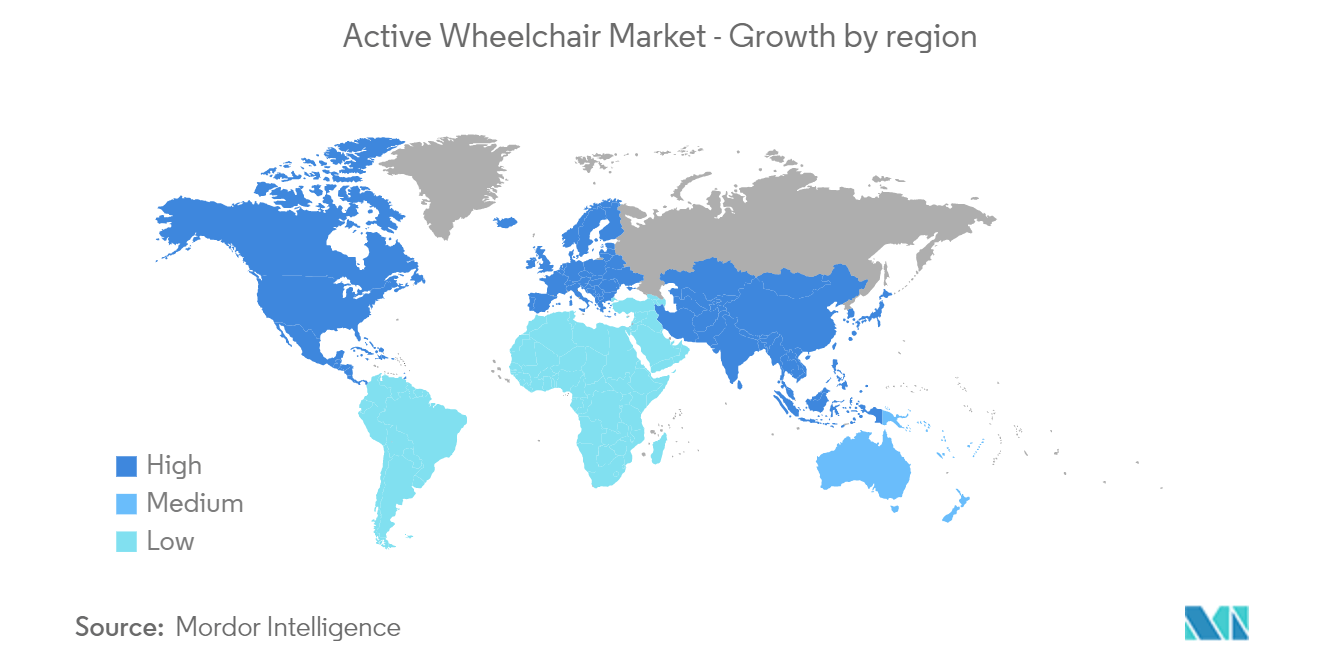
| Fastest Growing Market | Asia-Pacific |
| Largest Market | North America |
Major Players *Disclaimer: Major Players sorted in no particular order Image © Mordor Intelligence. Reuse requires attribution under CC BY 4.0. | |
Active Wheelchair Market Analysis by Mordor Intelligence
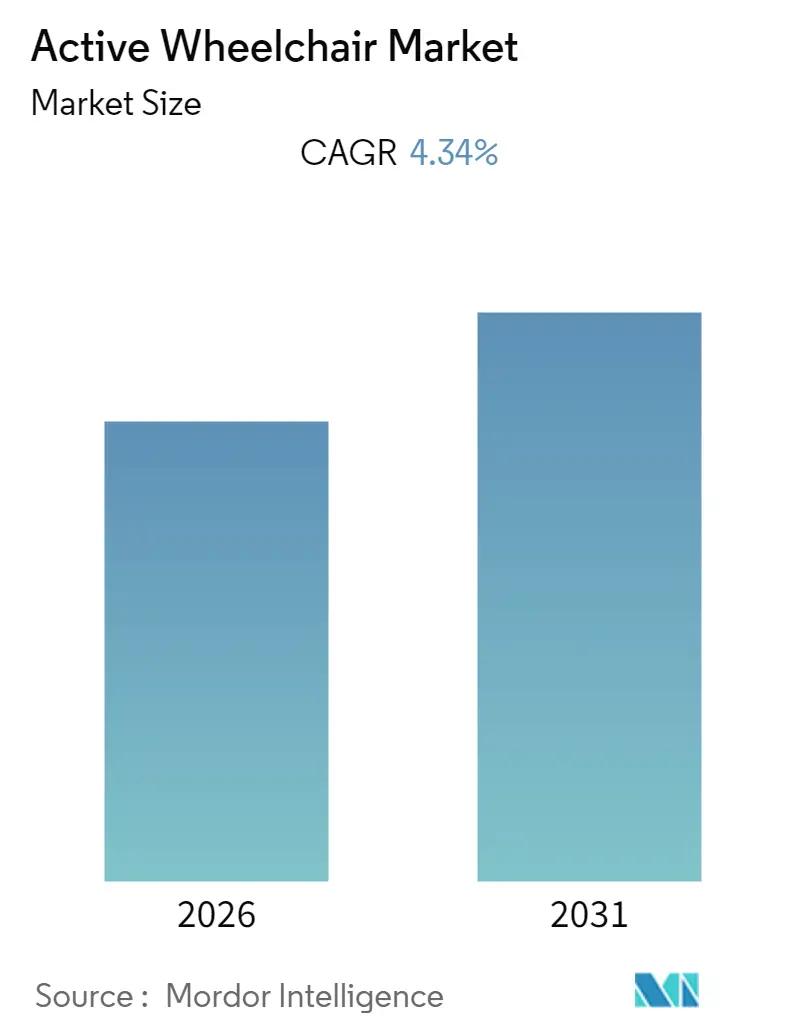
The Active Wheelchair Market size is expected to register a CAGR of 4.34% during the forecast period (2026-2031).
The healthcare system has witnessed enormous challenges as a result of the COVID-19 pandemic. All outpatient treatments were postponed or restricted during the COVID-19 pandemic to reduce the risk of viral transmission as most chronic pain therapies were regarded as non-urgent. There was a huge barrier for people with disabilities in accessing healthcare services and information. Also, they had a higher risk of suffering from depression because of the social distancing and associated isolation protocols, thereby having a profound impact on the market studied.
The active wheelchairs are utilized by physically active people to help in their day-to-day activities. These are highly beneficial than conventional wheelchairs in that they can be used even by people in sports. The ease of use and high technological growth that helps cater to the needs of the user are expected to support the growth of the market. Active wheelchairs also constitute a major portion of sports wheelchairs. The increase in awareness and the rising interest in disability sports are anticipated to drive the market.
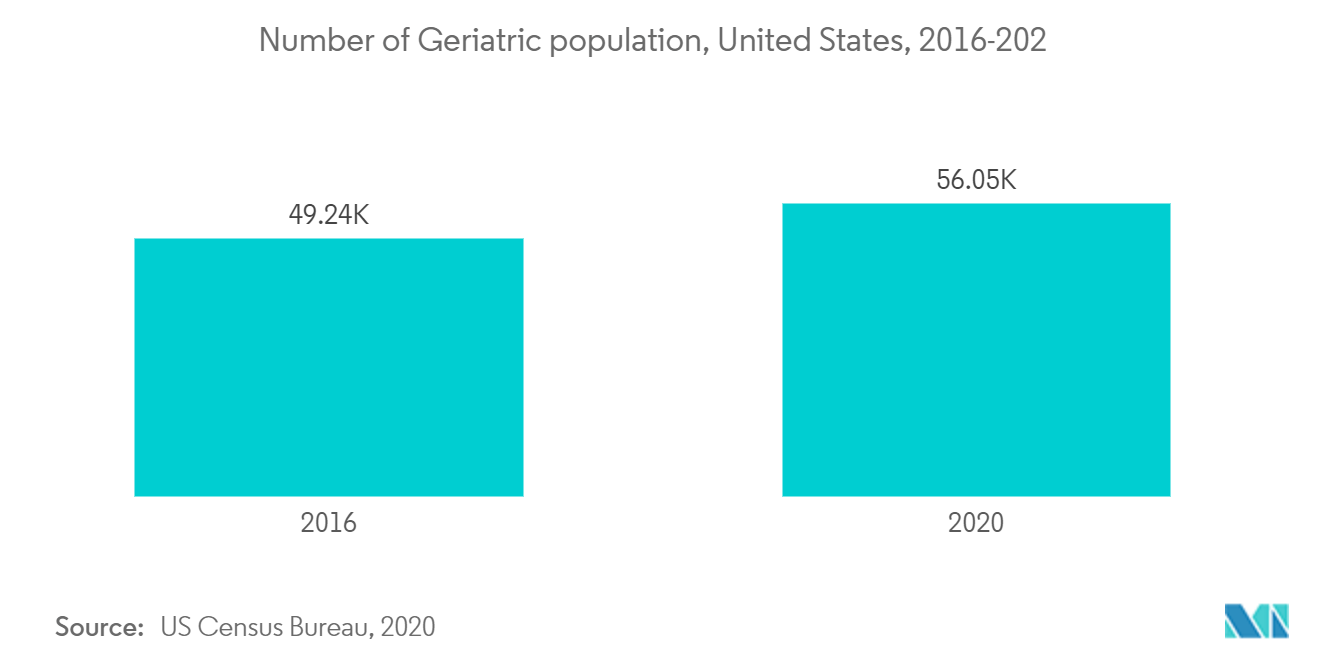
As per the data from the World Bank, the number of people above the age of 65 was 723.18 million as of 2020. The rise in the geriatric population and the increasing government initiatives for the betterment of the geriatric population are expected to improve the growth of the market.
The IDF Diabetes Atlas Tenth edition by the International Diabetes Federation showed that around 537 million adults are affected by diabetes as of 2021. The number of cases is projected to rise to 643 million by 2030 and to 783 million by 2045. Diabetic people who have foot complaints related to neuropathy such as ulcers and poor circulation may be advised for amputation. Such patients are most likely to opt for assistive mobility technology, which is expected to drive the expansion of the market.
Alzheimer's disease is the seventh leading cause of death by diseases in the world, as reported by the World Health Organization. The number of people affected by Alzheimer's in the United States in 2020 was 56 million, according to the 2020 Alzheimer's disease facts and figures report published by the Alzheimer's Association. The number is projected to grow to 88 million by 2050. The rapid upsurge in the number of cases is anticipated to boost the growth of the market during the forecast period.
Several initiatives by government organizations focusing on the availability and accessibility of wheelchairs to disabled persons help in the expansion of the active wheelchair market. For instance, in the United Kingdom, the NHS provides wheelchair services to the disabled, and the organization holds responsibility for the service and maintenance of the wheelchairs. In middle-income countries such as India, the rate of selling wheelchairs is relatively low due to their high cost. In February 2022, the Indian government's Department of Empowerment of Persons with Disabilities created Assistance to Disabled Persons for Purchase/Fitting of Aids/Appliances to provide grants-in-aid for the distribution of motorized tricycles and wheelchairs. The growing initiatives established by governments are expected to propel the growth of the active wheelchair market.
Note: Market size and forecast figures in this report are generated using Mordor Intelligence’s proprietary estimation framework, updated with the latest available data and insights as of 2026.
Global Active Wheelchair Market Trends and Insights
The Cerebral Palsy Segment is Expected to Hold a Major Market Share
Cerebral palsy is the major segment in the active wheelchair market. According to the Centers for Disease Prevention and Control, as of December 2020, approximately 1 to 4 per 1000 children are identified with cerebral palsy around the world. In the United States, the number is relatively higher, with 3 per 1000 children being affected by cerebral palsy. It is the most common motor disability among children in the United States. The huge patient pool and the rise in the necessity of active wheelchairs are expected to drive the growth of the market during the forecast period.
The spinal cord injury also holds a major share of the active wheelchair market. According to the data by the National Health Portal of India of February 2020, around 250,000 to 500,000 people around the world suffer from spinal cord injury. In the United States, the number of cases is 54 per million people in 2020, according to the National Spinal Cord Injury Statistical Center. The increase in the number of spinal injury cases every year is predicted to propel the development of the market.
The rise in the number of government initiatives for the welfare of people using wheelchairs is propelling the market forward. For instance, the US Agency for International Development (USAID) has a wheelchair program that looks for new innovative technologies to overcome barriers and promote improvement in the wheelchair sector. Professional groups such as the International Society for Prosthetics and Orthotics (ISPO) conduct structured professional training for wheelchair technologists, which is expected to have a positive impact on the active wheelchair market.


North America is Expected to Hold a Significant Share in the Market
The rise in the adoption of highly advanced techniques and systems in the manufacturing of active wheelchairs and the technological advancements made in the wheelchair segment are expected to boost the growth of the market in the North American region. The high awareness among the population on the availability of novel active wheelchair models in the market contributes to the high market growth in the region.
Also, the increasing prevalence of the geriatric population in the United States is expected to drive the demand for active wheelchairs in this region. According to the World Bank data, the number of people over the age of 65 was 54.796 million in the United States in 2020. The US census shows that the number of people over the age of 65 in the United States as of 2022 is 59.71 million. The rapid progression in the old age population in the region and their dependence on assistive mobility technology are expected to advance the expansion of the market in the North American region.
Government initiatives such as the 'Home and Community-Based Physical Activity Interventions to Improve the Health of Wheelchair Users' by the US National Institute of Health, 'Improving the Health of People with Mobility Limitations and Intellectual/Developmental Disabilities through State-based Public Health Programs' by the CDC's Disability and Health Promotion Branch, and similar programs focus on the fitness, function, and quality of life of the wheelchair users through improved physical activity.
Thus, the increasing awareness about the importance of active wheelchairs and increasing investments in the healthcare department are expected to propel the growth of the market in this region.

Competitive Landscape
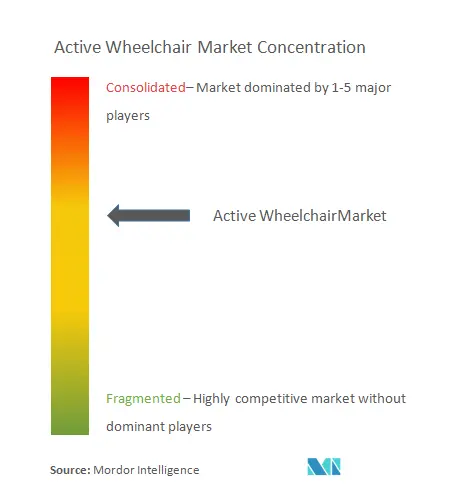
The active wheelchair market is fragmented and competitive and consists of several major players. In terms of market share, a few of the major players are currently dominating the market. Some of the companies currently dominating the market are Sunrise Medical, Mountain Trike, Numotion, Ki Mobility, Top End, Permobil, Karman Healthcare, Sportaid, Meyra GmbH, PER4MAX Medical, and others.
Active Wheelchair Industry Leaders
Sunrise Medical
Mountain Trike
Numotion
Ki Mobility
Permobil
- *Disclaimer: Major Players sorted in no particular order

Market Opportunities and Future Outlook
Product whitespace is expanding around active manual wheelchairs through lightweight power-assist and modular attachment ecosystems that preserve an active chair base while extending range and terrain capability. Recent launches highlight this convergence, including WHILLs carbon-fiber ultralight electric wheelchair (Modo Breeze, July 2026) and Permobil updates to TiLite TR and ZR titanium active manual models (March 2026), supporting upgrade cycles among experienced users and sports-oriented segments.
Access and supply-side structure create additional opportunity as distribution platforms and public programs broaden availability. DHCare signed a definitive agreement in June 2026 to acquire Ottobocks Human Mobility division, a move that can reshape product availability and service coverage across Europe through a larger mobility platform. In India, IIT Madras delivered the first batch of 25 indigenously developed YD One active wheelchairs to the Army Hospital (Research and Referral) in Delhi (June 2026), manufactured by Thryv Mobility, signaling pathways for localized manufacturing, institutional procurement, and broader adoption where cost has constrained uptake.
Recent Industry Developments
- June 2026: Permobil renewed its partnership with U.S. Rehab (VGM) to expand access to complex rehabilitation technology (CRT) and support provider workflows. The continuation strengthens channel reach for active and CRT-related mobility solutions through a large provider network, reinforcing service and reimbursement-oriented distribution.
- May 2026: SpinLife (a Numotion company) expanded in Central Florida by acquiring Triton Medical and opening a new retail location in Lady Lake, with the transaction completed on April 22, 2026. The move adds local footprint and service capacity, supporting faster delivery, fittings, and aftermarket support for mobility products.
- March 2024: Sunrise Medical introduced the QUICKIE Q50 R Carbon, positioned as a lightweight folding carbon-fiber power wheelchair. The launch raised competitive intensity in lightweight, portable powered mobility, a segment that overlaps with active-user preferences for transportability and performance.


Research Methodology Framework and Report Scope
Market Definition and Coverage
In this study, the active wheelchair market is defined as revenues earned from active-use wheelchairs used for daily mobility, including both manual and powered formats, across institutional and home settings. Values represent manufacturer and brand-level sales captured across major regions.
Scope exclusions: We exclude general patient transfer chairs, stretchers, and non-wheelchair mobility aids such as walkers, scooters, and crutches.
Segmentation Overview
- Product Type
- Manual Wheelchairs
- Power Wheelchairs
- Application
- Alzheimer's
- Diabetes
- Spinal Cord Injury
- Cerebral Palsy
- Other Applications
- Geography
- North America
- United States
- Canada
- Mexico
- Europe
- Germany
- United Kingdom
- France
- Italy
- Spain
- Rest of Europe
- Asia-Pacific
- China
- Japan
- India
- Australia
- South Korea
- Rest of Asia-Pacific
- Middle-East and Africa
- GCC
- South Africa
- Rest of Middle-East and Africa
- South America
- Brazil
- Argentina
- Rest of South America
- North America
Data Sources, Market Sizing, and Validation
Desk Research
Desk work starts with understanding the demand pool and the care pathways where active wheelchairs are prescribed and purchased, and then matching that with supply and distribution signals. We referred to public health and disability datasets such as those from the World Health Organization, the US CDC, the UK NHS, and the OECD, which help anchor population, injury, and aging trends linked to mobility needs.
To shape price and adoption assumptions, we also used sources such as US FDA databases for device clearances, UN Comtrade for trade flows of wheelchair-related categories, and peer-reviewed rehabilitation and assistive-technology journals that describe usage patterns and replacement cycles. This was complemented with company filings, investor presentations, and reputable press coverage, then cross-checked with paid subscriptions used for company financials and intelligence, news and financials, and patent databases to confirm product focus and geography footprints. The desk research sources listed here are illustrative, and many other public and paid references were used for data collection, validation, and clarification.
Primary Interviews and Surveys
Primary work was used to confirm what actually sells, how pricing shifts by configuration, and how demand changes by channel, before the final model was locked. We spoke with a mix of manufacturers, distributors, clinicians, rehab specialists, and procurement stakeholders across APAC, EMEA, and the Americas, so gaps from desk inputs could be filled and assumptions stress-tested against real buying behavior.
Distribution of primary research fieldwork respondents
| Company type | Respondent position | Region |
|---|---|---|
| Top tier: 33% | CXOs: 13% | APAC: 44% |
| Mid tier: 53% | Functional/Unit leaders: 28% | EMEA: 35% |
| Smaller Players: 14% | Managers: 59% | Americas: 21% |
Market-Sizing & Forecasting
The core model uses a top-down build that starts from region-wise disability and mobility-limitation pools, and then applies utilization and access filters to reconstruct addressable demand for active wheelchairs. To keep totals realistic, results are corroborated with selective bottom-up approximations, such as sampled brand revenues by region, distributor channel checks, and volume-by-ASP logic for key configurations, and then adjusted where the two views diverge.
Inputs that mattered most included treated and assisted population trends, replacement and refurbishment cycles, reimbursement and tender intensity in institutional buying, the mix shift between manual and powered active chairs, and average selling price movement by frame material and add-on features. When country-level data was thin, we used proxy indicators like import intensity, rehab facility density, and clinician feedback on prescribing trends, then applied conservative ranges before finalizing point estimates.
For forecasting, we relied on scenario analysis supported by a simple multivariate regression on the variables that experts repeatedly pointed to as decision drivers, such as aging trends, spinal cord injury incidence signals, public healthcare spend direction, and pricing inflation for key components. Assumptions were finalized only after they were consistent with primary feedback and desk signals over the 2026 to 2031 window shown on the study page.
Data Validation & Update Cycle
Outputs were validated through triangulation across independent checks, including regional demand signals, company-level revenue direction, trade movement where applicable, and pricing reality checks from channel conversations. When the model produced spikes or dips that did not match these signals, the assumptions were reviewed, and respondents were re-contacted to confirm whether the change was real or an artifact of timing or mix.
Before publishing, the work goes through a multi-step analyst review so calculations, unit conversions, and scope boundaries are consistent across geographies and years. Reports are refreshed annually, and interim updates are made when material events occur, such as reimbursement changes, large product introductions, or noticeable cost swings. Right before delivery, we run a final pass to ensure the newest public releases are reflected and the narrative still matches the numbers.
Mordor Intelligence's Active Wheelchair Market Estimate Compared With Other Published Estimates
Published market sizes for active wheelchairs can look far apart even when the topic sounds identical, because the year chosen, the currency timing, and the pricing logic behind ASPs are not always handled in the same way. Differences also show up when powered formats are blended into broader mobility device buckets, or when refurbishment and accessory revenues are mixed into the same total.
A refresh-led driver is how quickly assumptions are updated after inflation shifts, reimbursement tweaks, and mix changes between manual and powered units, which can move the ASP curve and then the total value. Monthly FX timing and how regional prices are normalized also matter, and this is why the January 2026 refresh and constant cross-checks of price-by-configuration are central to the final number used by Mordor Intelligence.
Benchmark comparison
| Source | Market Size | Gaps in Research Methodology |
|---|---|---|
| Mordor Intelligence | USD 1.87 B (2022) | |
| Trade Journal A | USD 1.79 B (2025) | Uses a later base year with a press-release style snapshot, and the scope appears to lean toward powered active formats, with limited visibility into how ASPs are normalized across regions and channels. |
| Industry Publisher B | USD 2.80 B (2025) | Seems to blend a broader wheelchair universe and applies an aggressive growth path, and the uplift is likely influenced by high-level ASP escalation without clear checks against replacement cycles and reimbursement-driven buying. |
Looking at the three values together, most of the spread can be explained by base-year selection and how pricing is carried forward, followed by what gets counted inside the wheelchair boundary. By keeping inputs tied to replacement behavior, channel pricing, and region-wise demand filters, our approach stays traceable and easier to replicate when assumptions need to be revisited.


Key Questions Answered in the Report
What is the current Active Wheelchair Market size?
The Active Wheelchair Market is projected to register a CAGR of 4.34% during the forecast period (2026-2031)
Who are the key players in Active Wheelchair Market?
Sunrise Medical, Mountain Trike, Numotion, Ki Mobility and Permobil are the major companies operating in the Active Wheelchair Market.
Which is the fastest growing region in Active Wheelchair Market?
Asia-Pacific is estimated to grow at the highest CAGR over the forecast period (2026-2031).
Which region has the biggest share in Active Wheelchair Market?
In 2025, the North America accounts for the largest market share in Active Wheelchair Market.
What years does this Active Wheelchair Market cover?
The report covers the Active Wheelchair Market historical market size for years: 2019, 2020, 2021, 2022, 2023 and 2024. The report also forecasts the Active Wheelchair Market size for years: 2026, 2027, 2028, 2029, 2030 and 2031.
Page last updated on:


 Your data is secure and never sold or shared.


