Action Camera Market Size and Share
Market Overview
| Study Period | 2020 - 2031 |
|---|---|
| Market Size (2026) | USD 7.93 Billion |
| Market Size (2031) | USD 13.82 Billion |
| Growth Rate (2026 - 2031) | 11.76% CAGR |
| Fastest Growing Market | Asia Pacific |
| Largest Market | North America |
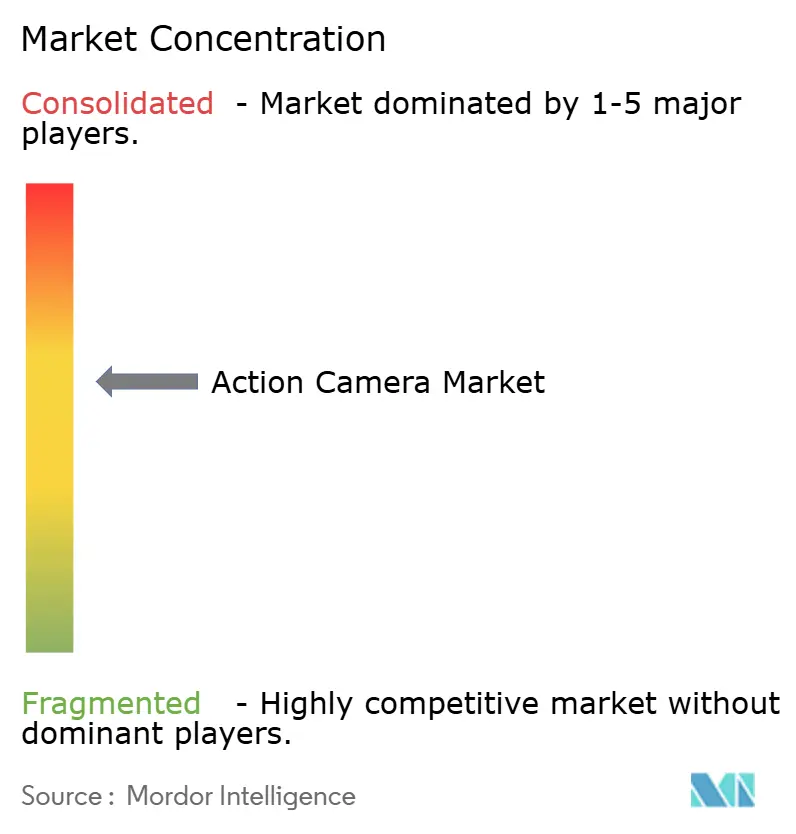
| Market Concentration | Medium |
Major Players *Disclaimer: Major Players sorted in no particular order Image © Mordor Intelligence. Reuse requires attribution under CC BY 4.0. | |
Action Camera Market Analysis by Mordor Intelligence
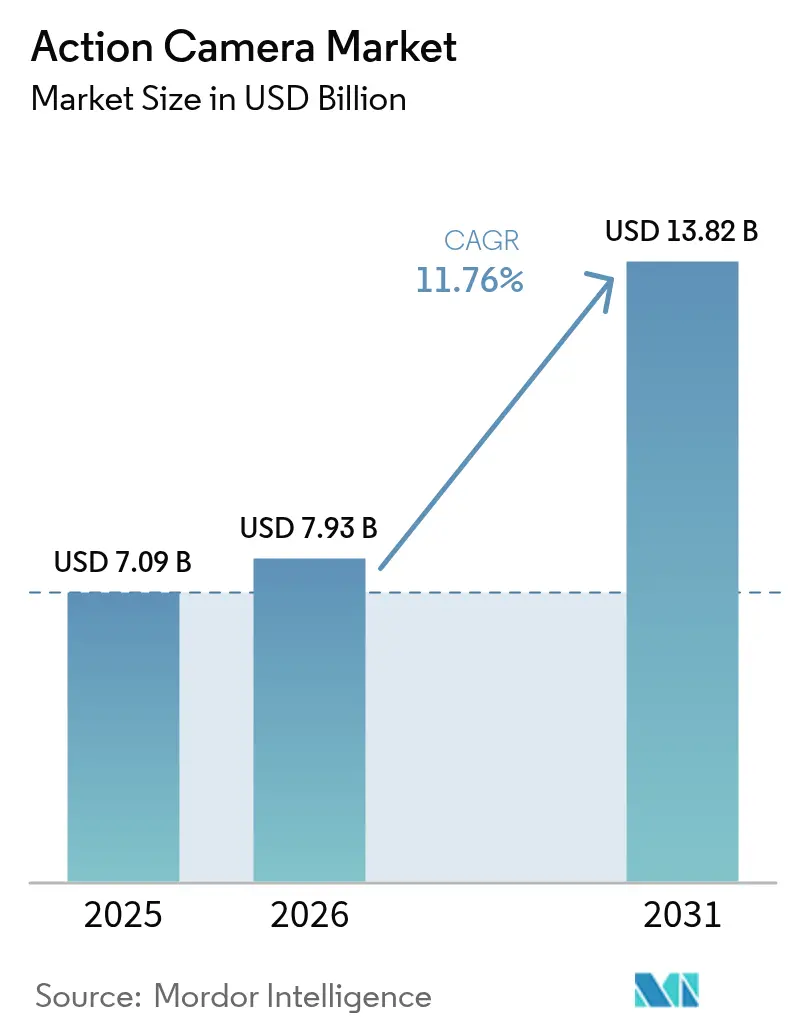
The Action Camera Market size was valued at USD 7.09 billion in 2025 and estimated to grow from USD 7.93 billion in 2026 to reach USD 13.82 billion by 2031, at a CAGR of 11.76% during the forecast period (2026-2031).
Robust gains reflect the migration of prosumer-grade 8K and 360° capture to mainstream price points, the boom in user-generated immersive content, and the widening use of rugged point-of-view cameras in emergency services, industrial inspection, and broadcasting. Demand is reinforced by government adventure-tourism campaigns, particularly across Asia-Pacific and Northern Europe, while enterprise contracts in law enforcement and firefighting provide steady revenue buffers.[1]College of Policing, “Body-worn cameras – how and when to use,” college.police.uk Competitive intensity has risen as smartphone gimbal systems close the stabilization gap, pushing manufacturers to differentiate through extreme-environment durability and AI-integrated editing workflows. Supply-chain concentration in memory and system-on-chip (SoC) components remains a cost and lead-time risk, yet manufacturers with vertical integration, most notably DJI, shield margins and accelerate product cycles.
Key Report Takeaways
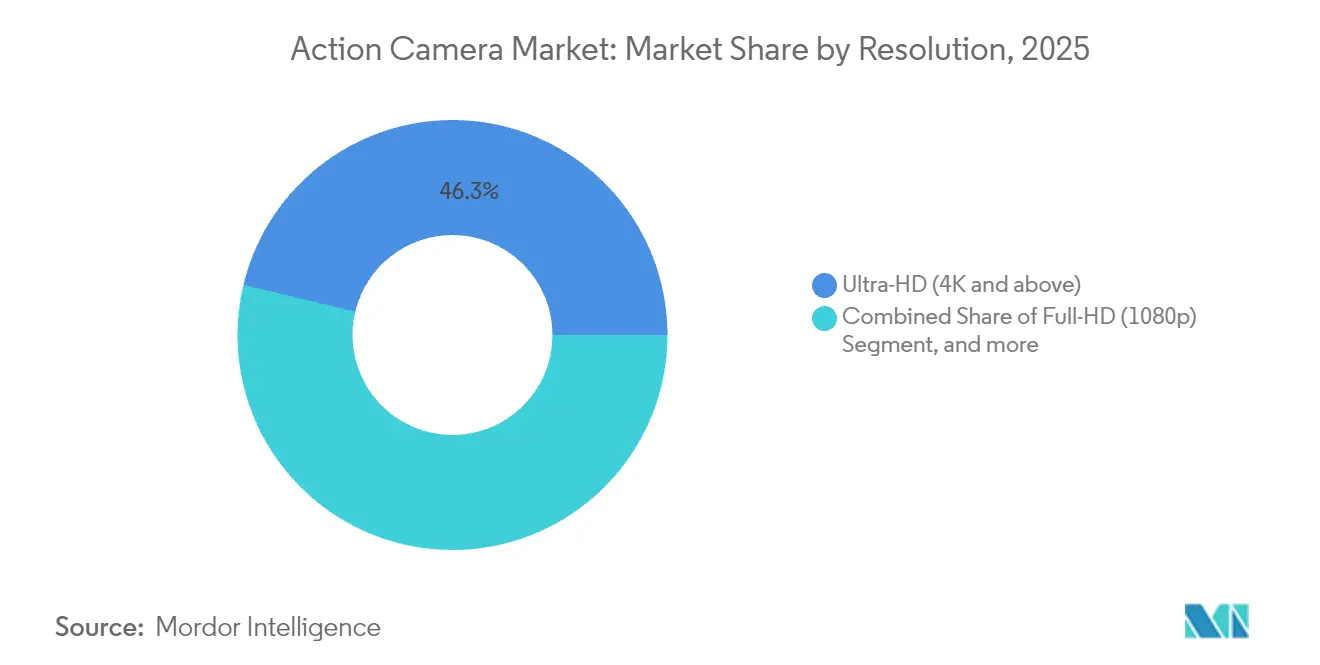
- By resolution, Ultra-HD captured 46.25% of the action camera market share in 2025 and is also advancing at a 13.09% CAGR through 2031, making it both the largest and fastest-growing resolution tier.
- By distribution channel, offline retail led with 51.65% revenue share in 2025, while brand web-stores are projected to post the fastest 13.25% CAGR through 2031 in the action camera market.
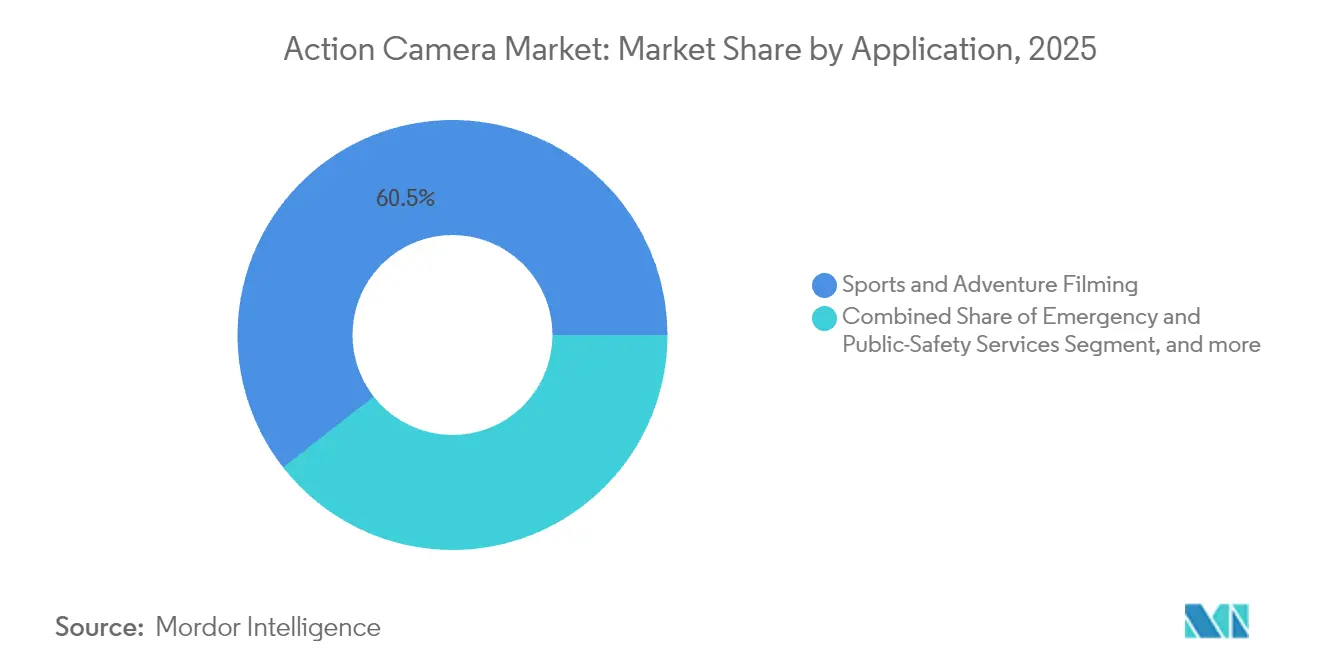
- By application, sports and adventure filming dominated at 60.55% share in 2025, whereas emergency and public-safety services are rising at a 14.61% CAGR to 2031 in the action camera market.
- By end-user, consumers accounted for a 62.90% share in 2025, while the professional and enterprise segment is expanding at a 14.18% CAGR through 2031 in the action camera market..
- By geography, North America commanded a 34.25% share in 2025, and Asia-Pacific is the fastest climber with a 14.95% CAGR through 2031 in the action camera market.
Note: Market size and forecast figures in this report are generated using Mordor Intelligence’s proprietary estimation framework, updated with the latest available data and insights as of 2026.
Global Action Camera Market Trends and Insights
Drivers Impact Analysis*
| Driver | (~) % Impact on CAGR Forecast | Geographic Relevance | Impact Timeline |
|---|---|---|---|
| Surging demand from immersive sports broadcasting | +2.10% | Global, with concentration in North America and Europe | Medium term (2-4 years) |
| Prosumer-grade 8K/360° capture driving replacement cycles | +2.80% | Global, led by Asia-Pacific manufacturing and North America adoption | Short term (≤ 2 years) |
| Integration with AI-powered editing ecosystems | +1.90% | North America and Europe, expanding to APAC | Medium term (2-4 years) |
| Government tourism campaigns promoting adventure sports | +1.40% | Regional, focused on New Zealand, Iceland, Norway, and emerging APAC destinations | Long term (≥ 4 years) |
| Rising adoption of body-worn cameras in emergency services | +2.30% | Global, with regulatory acceleration in North America and Europe | Medium term (2-4 years) |
| Micro-influencer boom on short-form video platforms | +1.70% | Global, with highest penetration in Asia-Pacific and North America | Short term (≤ 2 years) |
| Source: Mordor Intelligence | |||
Surging Demand from Immersive Sports Broadcasting
Sports broadcasters now embed helmet-mounted and vehicle-mounted cameras to deliver point-of-view 8K content that conventional rigs cannot match. Formula 1 coverage, extreme sports leagues, and even esports tournaments are adopting 360° feeds so viewers can select camera angles in real time, creating new licensing income for camera vendors.[2]Ben Sin, “DJI Action 5 Pro Review: The Best Battery And Low Light In An Action Camera,” Forbes, forbes.com Strategic partnerships between broadcasters and manufacturers increase brand visibility, stimulate consumer aspirational purchases, and generate specialized SKUs tailored for enterprise requirements.
Prosumer-grade 8K/360° Capture Driving Replacement Cycles
The leap from 4K to 8K resolution, illustrated by DJI’s July 2025 launch of the Osmo 360 (8K/30 fps, 100-minute run-time), compresses user replacement intervals to 18-24 months in the action camera market.[3]DJI Newsroom, “DJI Revolutionizes 360 Camera Market with the Osmo 360,” dji.com Enthusiasts value sensor utilization improvements of 25% and HDR prowess, while professional creators require 360° footage for VR platforms. Elevated storage needs foster sales of high-capacity memory accessories, reinforcing ecosystem stickiness.
Integration with AI-powered Editing Ecosystems
Firmware hooks into Adobe Premiere Pro and DaVinci Resolve now automate highlight-reel generation and on-device color grading. DJI’s 2025 updates added 8-bit and 10-bit color modes optimized for AI-assisted workflows, shrinking post-production from hours to minutes.[4]Garmin Ltd., “2023 Annual Report Final,” garmin.com Subscription-based cloud services deliver recurring income, and real-time stabilization applied during capture removes friction for casual users within the action camera market.
Rising Adoption of Body-worn Cameras in Emergency Services
Police, fire, and EMS agencies are rolling out evidence-grade cameras under standardized policies such as the College of Policing’s 2024 body-worn video guidelines, expanding the enterprise segment of the action camera market.[5]College of Policing, “Body-worn cameras – how and when to use,” college.police.uk Multi-year procurement contracts yield predictable revenue and favor vendors with encryption, chain-of-custody compliance, and rugged IP ratings. Average selling prices remain higher than in consumer channels, and devices stay in the field five-plus years.
Restraints Impact Analysis*
| Restraint | (~) % Impact on CAGR Forecast | Geographic Relevance | Impact Timeline |
|---|---|---|---|
| Smart-phone gimbal stabilization narrowing performance gap | -1.80% | Global, with highest impact in price-sensitive APAC markets | Short term (≤ 2 years) |
| High import tariffs on imaging sensors in key APAC countries | -1.20% | APAC core, with spillover effects to global pricing | Medium term (2-4 years) |
| Supply-chain exposure to single-source SoC vendors | -0.90% | Global, with manufacturing concentration in Taiwan and China | Medium term (2-4 years) |
| Data-privacy regulations curbing public POV recording | -0.70% | Europe and North America, with GDPR compliance requirements | Long term (≥ 4 years) |
| Source: Mordor Intelligence | |||
Smart-phone Gimbal Stabilization Narrowing Performance Gap
Mechanical gimbals for phones, priced around USD 150, now offer 4K/60 fps capture with stabilization metrics that approach dedicated cameras. Casual users who prize convenience shift spend away from entry-level action cameras, compelling manufacturers to add niche features such as underwater resilience and cold-weather endurance to justify premiums.[6]Reuters Staff, “Garmin forecasts 2025 results above estimates on strong outdoor wearables demand,” Reuters, reuters.com
High Import Tariffs on Imaging Sensors in Key APAC Countries
Component tariffs raise bill-of-materials costs for firms dependent on Japanese or European sensor fabs. Vertically integrated brands such as Sony absorb tariff impacts more readily, while specialist vendors juggle dual sourcing and higher inventory buffers, compressing gross margins.[7]Ambarella Inc., “Ambarella Announces Fourth Quarter and Fiscal Year 2025 Results,” ambarella.com
*Our forecasts treat driver/restraint impacts as directional, not additive. The impact forecasts reflect baseline growth, mix effects, and variable interactions.
Segment Analysis
By Resolution: Ultra-HD Dominance Accelerates Premium Migration
Ultra-HD formats held 46.25% share of the action camera market in 2025 and are climbing at a 13.09% CAGR as 4K becomes the entry specification and 8K evolves into the new prosumer benchmark. The action camera market size for Ultra-HD units is on track to account for the majority of revenue well before 2031 as component costs contract. DJI’s Osmo 360 underscores the trend by pairing 8K capture with run-times formerly reserved for 4K models. Full-HD retains footholds in cost-sensitive regions but loses relevance wherever high-bandwidth mobile streaming is mainstream.
Content creators gravitate to HDR and high bit-rate modes that enable professional-grade color grading, nudging average storage card capacities higher and creating cross-sell revenue. Other resolutions such as 2.7K linger in surveillance niches but exhibit declining shipments. Suppliers who manage thermal dissipation and battery chemistry most effectively secure design-win advantage as frame rates and bit-depths rise.


By Distribution Channel: Brand Web-stores Challenge Retail Dominance
Offline retail preserved 51.65% revenue in 2025, bolstered by tourist-zone outlets and airport electronics shops offering instant need-based purchases. Yet brand web-stores are growing fastest at 13.25% CAGR, allowing companies to pocket retail margins, bundle cloud subscriptions, and deploy targeted promotions. Manufacturers leverage first-party data to upsell accessories and renew service plans, enlarging lifetime value.
Direct channels also deliver early-access SKUs and region-exclusive colorways that maintain price discipline in the action camera market. Traditional e-commerce platforms like Amazon remain critical for reach but impose commission fees that pressure MSRP discipline. OEM bundling with helmets, drones, and auto accessories opens incremental shelf space, further diluting offline store dependence.
By Application: Emergency Services Drive Professional Segment Growth
Sports and adventure filming still leads with 60.55% share, yet body-worn cameras for law enforcement and firefighting are the fastest climbers at 14.61% CAGR to 2031. Evidence-grade ruggedization, pre-event buffering, and tamper-proof storage distinguish these units from consumer models. Governments favor multi-year procurement, making revenue less cyclical than retail sales.
Broadcasting and cinematography exploit compact rigs as specialty angle devices, especially with 8K sensors that intercut seamlessly with cinema cameras. Industrial inspection teams deploy action cameras in confined spaces, capitalizing on wireless live-view modes to minimize personnel risk. Personal vlogging continues to grow, although smartphone substitution is strongest in that sub-category.
By End-user: Professional Segment Gains Momentum Through Service Integration
Consumers retained a 62.90% share in 2025, but professional and enterprise customers are expanding at a 14.18% CAGR. The action camera market share for enterprise users will expand as organizations integrate cloud video management systems and AI-driven analytics. Service revenue—storage, AI editing, extended warranties—now rivals hardware margins for leading brands.
Enterprise buyers demand backward-compatible accessories and certified encryption, lengthening product life cycles and stabilizing demand. Consumer growth remains healthy where tourism authorities market adventure sports aggressively, though smartphones cap upside in casual day-in-the-life content segments.
Geography Analysis
North America’s 34.25% share in 2025 reflects premium ASPs and an entrenched outdoor recreation culture. Federal grants for first-responder video initiatives sustain professional demand, while national park visitation fuels consumer upgrades. The region’s firmware-update adoption is rapid, enabling manufacturers to monetize post-sale features via subscription.
Asia-Pacific is on a 14.95% CAGR trajectory as vertically integrated Chinese brands undercut legacy incumbents without sacrificing innovation. Domestic middle-class growth, government adventure-tourism campaigns, and export-ready supply chains reinforce momentum. Japan illustrates competitive churn, where DJI grew to 35.3% market share at GoPro’s expense, underscoring price-performance advantages.
Europe posts measured gains supported by adventure-sports participation and evidence-grade mandates, but GDPR heightens cloud-storage compliance hurdles. Manufacturers adapt by offering localized data centers and on-premise video servers. Early-stage adoption in the Middle East, Africa, and parts of South America pivots on improving broadband and economic reforms; however, currency volatility and import duties remain gating factors.


Regulatory Landscape
Action cameras sold with wireless connectivity fall under radio-equipment compliance regimes across major markets, with manufacturers required to meet safety, EMC, spectrum, and, increasingly, cybersecurity provisions. In Europe, the Radio Equipment Directive (Directive 2014/53/EU, as amended) applies to Wi-Fi/Bluetooth-enabled cameras, while the EU common charger requirement under Directive (EU) 2022/2380 pushes USB-C alignment for rechargeable portable device categories that overlap with connected imaging products.
Recent policy and enforcement changes add further gating factors. In Taiwan, BSMI implemented updated conformity assessment procedures for digital cameras from January 2025, shifting from a simple declaration-of-conformity approach toward module-based assessments and batch inspection. In the United Kingdom, the Radio Equipment (Amendment) (Northern Ireland) Regulations 2025 took effect on 16 December 2025 to keep NI requirements aligned with EU radio and cybersecurity-related provisions. In the United States, FCC actions tied to its Covered List and related equipment authorization rules (including July 2026 Federal Register actions) increase scrutiny for imaging equipment categories that could be classified as critical components in restricted platforms, raising compliance and supply-chain documentation burdens for vendors shipping connected cameras.
Value Chain Analysis
The action camera value chain begins with upstream components including CMOS image sensors, lenses and optical stacks, application processors/SoCs, memory, batteries, housings, and wireless modules. Suppliers of sensors and compute silicon shape product cadence, since higher-resolution capture (4K/8K), HDR, and on-device AI stabilization depend on leading-edge processing and timely access to memory. Assembly and test are concentrated in Asia, with design and manufacturing ecosystems clustered around southern China (notably Shenzhen and the broader Pearl River Delta), while alternate capacity in parts of Southeast Asia supports cost-focused models.
Midstream, brand owners integrate hardware with firmware, editing apps, and cloud workflows to differentiate beyond raw specifications, and accessories such as mounts, cases, microphones, batteries, and storage contribute incremental attach revenue. Downstream, products sell through offline CE chains and specialty retail, online marketplaces, and brand web-stores, while direct channels are increasingly used to bundle subscriptions and accessories. On the logistics and final configuration side, GoPro has also used US-based finishing and bundling infrastructure, including Foreign-Trade Zones Board-authorized production activity (April 2025) for camera bundles at its Louisville, Kentucky facility, illustrating a hybrid chain that combines Asia-centric manufacturing with regional final configuration and distribution efficiency.
Competitive Landscape
The action camera market shows moderate concentration: the leading five vendors control a significant share of 2024 revenue, with GoPro and DJI as front-runners. Smartphone gimbals encroach on lower tiers, so brands double down on extreme-environment durability, underwater depth ratings, and 360° workflows unavailable on phones. DJI leverages sensor in-house design and assembly to pace annual refreshes, showcased by the Osmo 360 with square HDR architecture that delivers 25% better sensor utilization.
Emerging Chinese entrants such as Insta360 and Akaso utilize direct-to-consumer logistics and social-platform marketing, squeezing mid-priced SKUs. Garmin differentiates through sports-specific integrations—as seen in its Varia Vue cycling light-camera hybrid—to lock in cyclists already using Garmin head units. Component suppliers such as Ambarella further influence dynamics by releasing SoCs with on-chip AI acceleration, enabling edge analytics that reduce cloud costs for enterprise clients.
Action Camera Industry Leaders
GoPro, Inc.
SZ DJI Technology Co., Ltd.
Garmin Ltd.
Sony Group Corporation
Nikon Corporation
- *Disclaimer: Major Players sorted in no particular order

Market Opportunities and Future Outlook
Professional-grade imaging in compact, rugged form factors is widening the action camera addressable market beyond sports into creator, broadcast, and field-use workflows where open-gate capture, color modes, and thermal management are decisive. The 2026 launch cycle underscores this shift: GoPro introduced the MISSION 1 line positioned as professional 8K and 4K open-gate compact cinema cameras (April 2026) and placed them on global retail shelves and GoPro.com (May 2026), which signals a clearer bridge between traditional action cameras and small-form production cameras. Parallel product moves, including SJCAM unveiling an 8K dual-lens SJ30 (April 2026), also reinforce the broader shift toward higher-resolution and multi-lens designs.
Whitespace remains in enterprise and regulated-use deployments, where buyers look for encryption, chain-of-custody handling, and policy-aligned operation for body-worn and point-of-view recording. The College of Policing body-worn video guidance (2024) reflects how formal policy frameworks shape procurement and feature requirements, favoring vendors that can pair rugged hardware with compliant video management options (cloud, localized hosting, or on-premise). Another opportunity area is silicon-led differentiation, and GoPro’s announcement of its GP3 5-nanometer custom imaging processor with an AI Neural Processing Unit (March 2026) points to a pathway for improving low-light capture, extending runtimes, and maintaining sustained high-bitrate recording without overheating.
Recent Industry Developments
- May 2026: GoPro commenced global retail and online availability for its MISSION 1 series cameras, mounts, and accessories. Wider shelf presence and direct-to-consumer availability support attach sales for mounts, batteries, and audio add-ons while expanding reach beyond early adopters.
- November 2025: DJI released the Osmo Action 6 with a larger 1/1.1-inch sensor, variable f/2.0 to f/4.0 aperture, and 50GB internal storage. The feature set raises the competitive bar for low-light performance and usability by reducing dependence on removable media for short shoots.
- September 2024: GoPro announced the HERO13 Black and the HERO 4K cameras, refreshing its lineup ahead of peak-season demand. The dual-tier update supports segmentation across premium and entry price points while keeping the ecosystem anchored to GoPro accessories and software workflows.


Research Methodology Framework and Report Scope
Market Definition and Coverage
For this methodology, the action camera market covers revenue earned from rugged, compact cameras designed to capture high motion or outdoor footage, including devices sold through online and offline channels for consumer and professional use.
Scope exclusions: We exclude smartphones, standard digital cameras, and camcorders that are not positioned or sold as action cameras, even if they are used outdoors.
Segmentation Overview
- By Resolution
- Ultra-HD (4K and above)
- Full-HD (1080p)
- Other Resolutions (≤720p, 2.7K)
- By Distribution Channel
- Offline Retail (CE Chains, Specialty Stores)
- Online Marketplaces (Amazon, JD, etc.)
- Brand Web-stores
- OEM / Bundling (Helmet, Drone kits)
- By Application
- Sports and Adventure Filming
- Professional Broadcasting and Cinematography
- Emergency and Public-Safety Services
- Industrial and Commercial Inspection
- Personal Vlogging / Lifestyle Content
- By End-user
- Consumer
- Professional / Enterprise
- By Geography
- North America
- United States
- Canada
- Mexico
- South America
- Brazil
- Argentina
- Rest of South America
- Europe
- Germany
- United Kingdom
- France
- Italy
- Spain
- Russia
- Rest of Europe
- Asia-Pacific
- China
- Japan
- India
- South Korea
- South-East Asia
- Rest of Asia-Pacific
- Middle East and Africa
- Middle East
- Saudi Arabia
- United Arab Emirates
- Turkey
- Rest of Middle East
- Africa
- South Africa
- Nigeria
- Rest of Africa
- Middle East
- North America
Data Sources, Market Sizing, and Validation
Desk Research
Desk research was used to build the fact base on demand triggers, shipment signals, and pricing direction before assumptions were carried into the model. We referenced public and official sources such as UN Comtrade for camera trade flows, USITC data for tariff and import context, World Bank macro indicators that influence discretionary electronics spending, and FCC equipment authorization listings that help confirm device launches and timing.
Along with this, we reviewed company filings and investor presentations where available, major retailer category pages for product availability and price bands, and reputable press coverage for launch cadence and feature shifts (for example, stabilization, waterproofing, and resolution upgrades). Select paid database subscriptions were used only for company financials and news tracking, plus patent databases to sense feature investment direction. These sources are illustrative and not exhaustive, and many additional public references were used for data collection, cross-checking, and clarification.
Primary Interviews and Surveys
Primary work was done through expert interviews and structured surveys with manufacturers, component ecosystem participants, distributors, retailers, and professional users who influence buying criteria. We covered the Americas, EMEA, and APAC so regional adoption differences, pricing practices, and channel mix could be validated and then used to tighten assumptions where desk research was not specific enough.
Distribution of primary research fieldwork respondents
| Company type | Respondent position | Region |
|---|---|---|
| Top tier: 37% | CXOs: 13% | APAC: 46% |
| Mid tier: 49% | Functional/Unit leaders: 38% | EMEA: 34% |
| Smaller Players: 14% | Managers: 49% | Americas: 20% |
Market-Sizing & Forecasting
Sizing starts with a top-down build where the addressable consumer electronics demand pool is reconstructed by region, and then filtered using action camera adoption signals by channel and use case. Once the demand pool is formed, the market value is derived by combining unit momentum indicators with realistic average selling price ranges, which are adjusted for mix shifts toward Ultra HD and 360-degree models.
To keep the totals grounded, selective bottom-up approximations are used as checks, such as sampling model-level prices across key channels, mapping launch timing to replacement cycles, and testing supplier and distributor feedback on unit run rates. Inputs that typically matter in this market include the share of online sales versus specialty retail, seasonality around travel and holiday promotions, regional uptake of Ultra HD versus Full HD, accessory and mounting ecosystem pull-through, and replacement behavior driven by battery life and durability expectations. Forecasts are built using scenario analysis, where base, conservative, and aggressive cases are guided by expert views on pricing erosion, feature-driven upgrade cycles, and regional discretionary spending trends, and then reconciled back to the historical pattern.
Data Validation & Update Cycle
Validation is done by checking the modeled market against independent signals such as visible channel pricing, trade and shipment direction, and the timing of product approvals and launches. When variances show up, the assumptions are re-opened and we re-contact sources if the gap is tied to a specific region, channel, or resolution mix change.
Before sign-off, the work is reviewed in multiple steps so math errors, currency timing issues, and unrealistic growth jumps can be caught early. Reports are refreshed annually, and interim updates are made when material events occur, such as major product cycles, channel disruptions, or policy changes that affect supply and pricing. Right before delivery, a final pass is completed so the client receives the most current view available.
Mordor Intelligence's Action Camera Market Size Measured Against Other Published Estimates
Published market sizes for action cameras often do not match because the market boundary is set differently, the base year is not the same, and pricing treatment varies by channel. The gap is usually widened further when some studies lean on a single demand proxy and do not re-check assumptions with regional channel feedback.
In this study, a key driver is whether adjacent devices are counted, such as rugged smartphones, body-worn cameras, or broader digital imaging hardware, and whether accessory revenue is blended into the camera value. Another driver is how fast average selling prices are allowed to fall when newer Ultra HD and 360 models expand, because promotion intensity and online mix change the realized price, not just the list price. The spread seen across sources is also influenced by refresh cadence and currency conversion timing, and the totals are kept closer to the defined action camera demand pool through resolution mix checks and channel-weighted pricing logic applied by Mordor Intelligence.
Benchmark comparison
| Source | Market Size | Gaps in Research Methodology |
|---|---|---|
| Mordor Intelligence | USD 7.93 B (2026) | |
| Global Consultancy A | USD 7.27 B (2025) | Uses a different base year and may apply a broader product and regional roll-up with a separate historical window, which shifts the starting value when compared year to year. |
| Industry Publisher B | USD 3.92 B (2024) | Anchors the estimate to an earlier year and can reflect a narrower counted scope or a different inclusion rule for device types, which reduces the measured value even before forecasting begins. |
Overall, the table shows that most of the difference comes from base-year selection, what is counted as an action camera versus adjacent devices, and how channel pricing is converted into a single average. By keeping the steps traceable to adoption signals, resolution mix, and price realization by channel, the model stays repeatable and easier to reconcile when new launch cycles or promotion patterns change the market.


Key Questions Answered in the Report
What is the projected value of the action camera market in 2031?
The market is forecast to reach USD 13.82 billion by 2031.
Which resolution segment is growing fastest?
Ultra-HD (4K and above) units are posting a 13.09% CAGR through 2031.
Why are emergency-service agencies adopting action cameras?
Body-worn video mandates and evidentiary needs are driving a 14.61% CAGR in the emergency-services application.
Which geography offers the highest growth rate?
Asia-Pacific is expanding at a 14.95% CAGR, propelled by vertically integrated manufacturing and rising domestic demand.
How are brands offsetting smartphone competition?
Vendors focus on extreme-environment durability, 360° capture, AI editing software, and subscription services that smartphones do not match.
Page last updated on: