
Global Actinic Keratosis Treatment Market Size and Share
Market Overview
| Study Period | 2020 - 2031 |
|---|---|
| Market Size (2026) | USD 7.47 Billion |
| Market Size (2031) | USD 9.13 Billion |
| Growth Rate (2026 - 2031) | 4.10 % |
| Fastest Growing Market | Asia Pacific |
| Largest Market | North America |
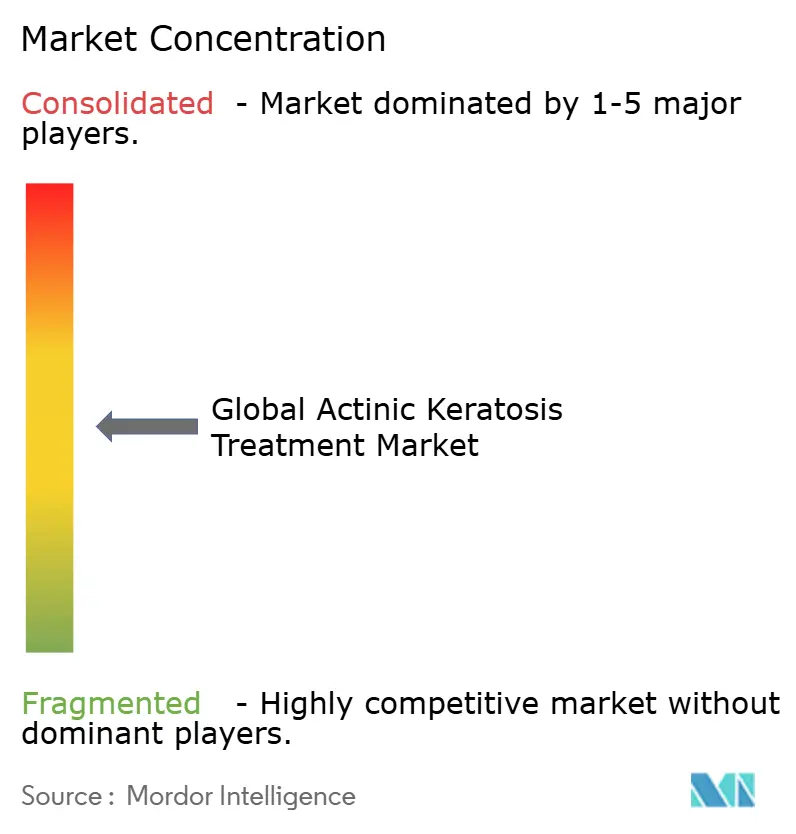
| Market Concentration | Medium |
Major Players
*Disclaimer: Major Players sorted in no particular order Image © Mordor Intelligence. Reuse requires attribution under CC BY 4.0. |
|
Global Actinic Keratosis Treatment Market Analysis by Mordor Intelligence
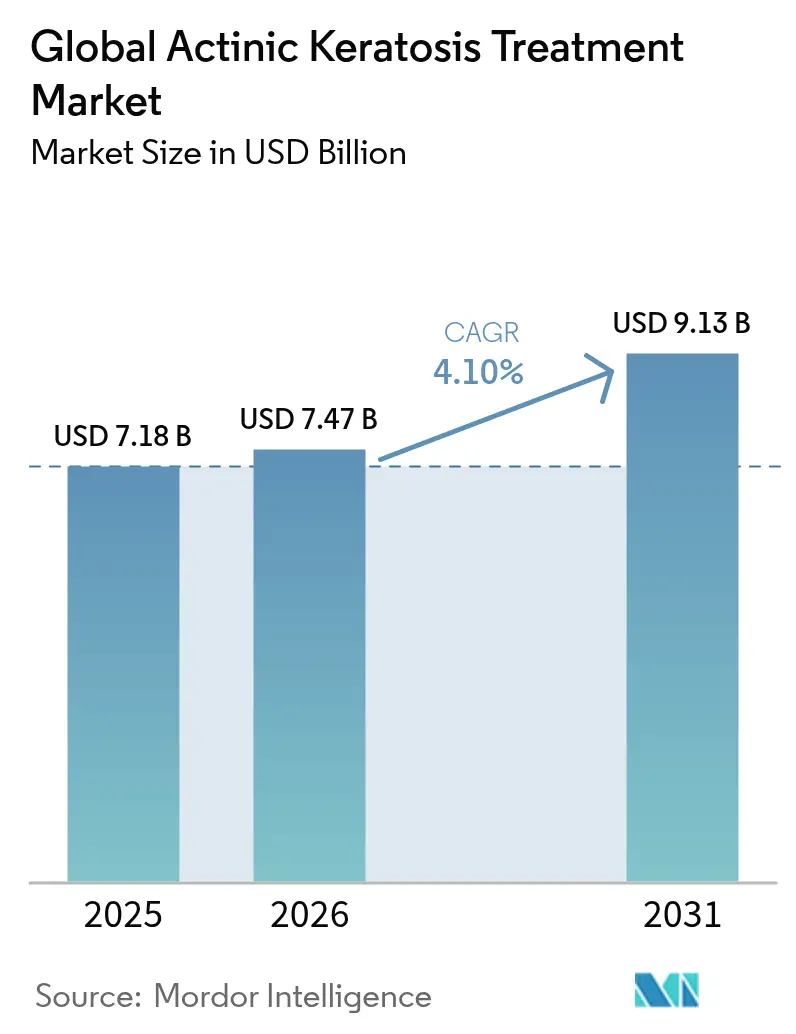
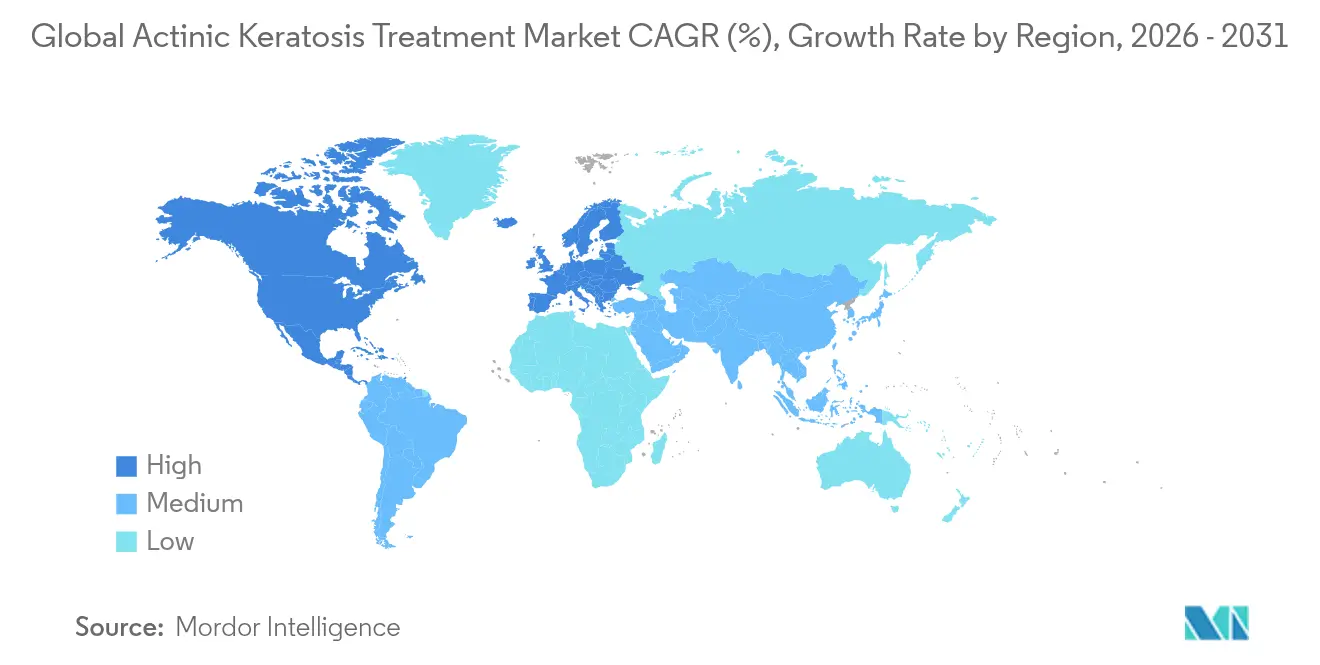
The actinic keratosis treatment market size is expected to grow from USD 7.18 billion in 2025 to USD 7.47 billion in 2026 and is forecast to reach USD 9.13 billion by 2031 at 4.10% CAGR over 2026-2031. This growth reflects rising lesion prevalence among aging, fair-skinned populations, rapid procedural innovation, and improving reimbursement clarity in major economies. North America retains leadership thanks to comprehensive insurance coverage and strong clinical research ecosystems, while Asia-Pacific, led by Japan and Australia, is expanding fastest on the back of demographic aging and wider dermatology access. Competitive rivalry remains moderate as established companies acquire pipeline assets and refine drug-device combinations, whereas smaller entrants emphasize daylight photodynamic therapy and AI-guided diagnosis. Procedural advances such as fractional laser systems and daylight-mediated PDT are accelerating physician adoption, even as topical therapies continue to dominate first-line care. Digital pharmacies, buoyed by pandemic-driven telehealth use, are reshaping distribution dynamics, while younger patient cohorts seek earlier, preventive intervention—signaling a gradual shift in treatment paradigms.
Key Report Takeaways
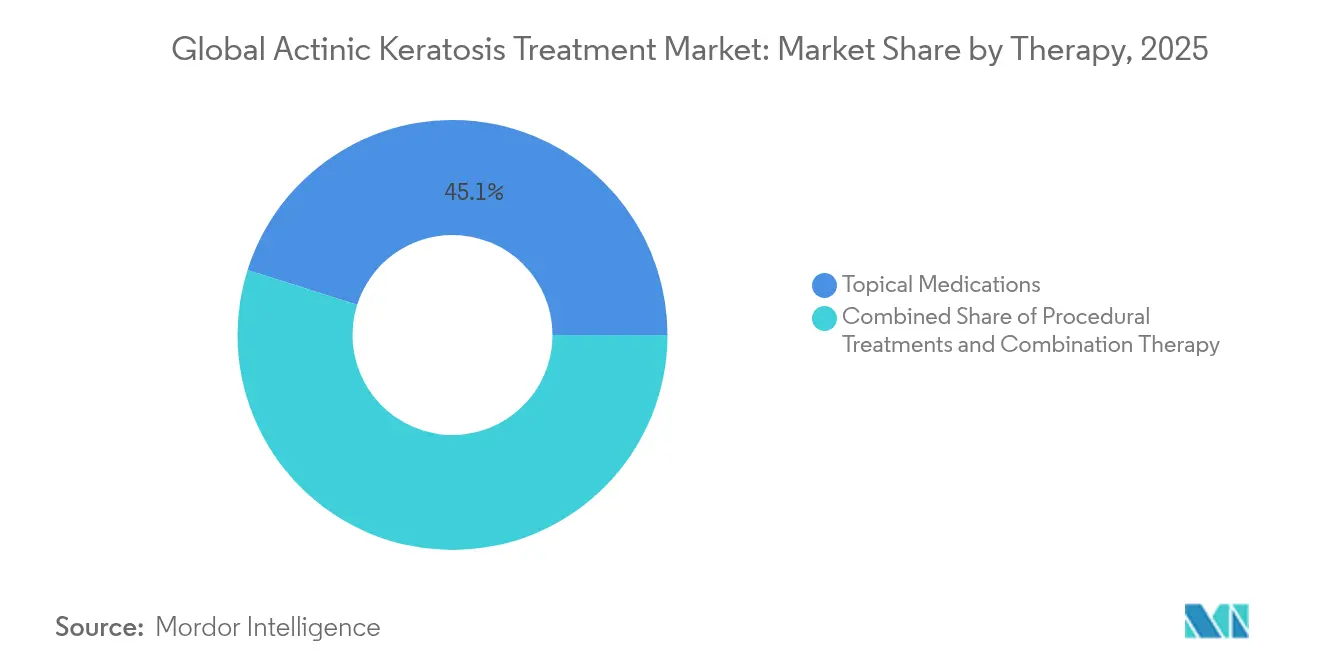
- By therapy, topical medications led with 45.12% of actinic keratosis treatment market share in 2025, while procedural treatments are projected to expand at a 5.12% CAGR through 2031.
- By end user, hospitals and oncology centers held 53.55% share of the actinic keratosis treatment market size in 2025, whereas home-care settings register the highest 4.73% CAGR to 2031.
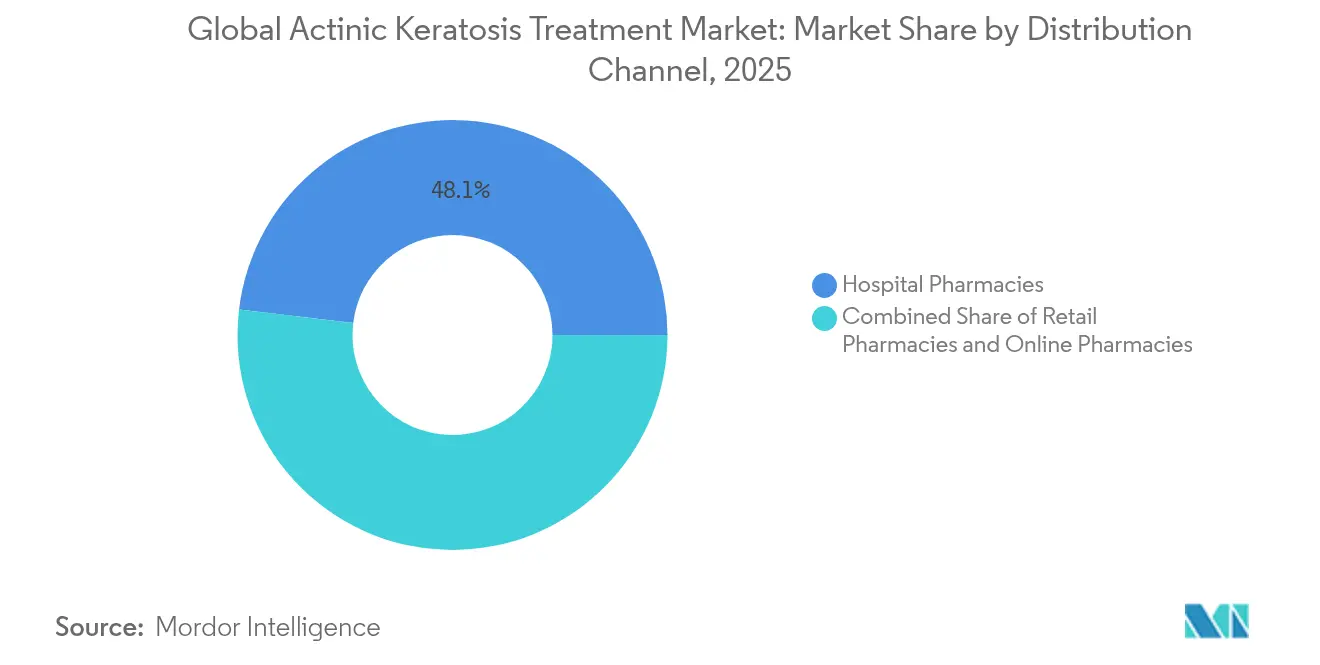
- By distribution channel, hospital pharmacies commanded 48.10% of the actinic keratosis treatment market in 2025; online pharmacies lead growth at a 5.06% CAGR through 2031.
- By patient age group, individuals older than 60 years captured 67.20% of the actinic keratosis treatment market in 2025, while the under-40 demographic is advancing at a 5.29% CAGR to 2031.
Note: Market size and forecast figures in this report are generated using Mordor Intelligence’s proprietary estimation framework, updated with the latest available data and insights as of 2026.
Market Trends and Insights
Drivers Impact Analysis of Global Actinic Keratosis Treatment Market*
| Driver | (~) Impact on CAGR Forecast | Geographic Relevance | Impact Timeline |
|---|---|---|---|
| Rising prevalence among aging, fair-skinned populations | +1.2% | Global, high in North America & Australia | Long term (≥ 4 years) |
| Growing demand for minimally-invasive dermatologic procedures | +0.8% | North America & EU; expanding to APAC | Medium term (2-4 years) |
| Expansion of reimbursement coverage for AK therapies in OECD markets | +0.6% | US & Germany lead | Short term (≤ 2 years) |
| Adoption of daylight-PDT protocols reducing chair-time & cost | +0.5% | Europe & North America | Medium term (2-4 years) |
| Regulatory approvals of novel agents boosting physician uptake | +0.3% | US & EU frameworks | Short term (≤ 2 years) |
| AI-enabled dermoscopy driving earlier diagnosis | +0.2% | North America & APAC | Long term (≥ 4 years) |
| Source: Mordor Intelligence | |||
Rising Prevalence of Actinic Keratosis Among Aging, Fair-Skinned Populations
Prevalence rates range from 11% to 25% in northern latitudes and reach 60% among Australian adults, underscoring a large and rising patient pool. Spain’s clinic data show 28.6% overall prevalence, with men disproportionately affected, which shapes therapy demand. Improved public screening and longer life expectancy push more lesions into clinical settings, while each lesion signals elevated squamous cell carcinoma risk—with malignant transformation estimated at 8% in immunocompetent patients. Payers view early treatment as cost-avoiding, supporting broader coverage for both topical and procedural care. Collectively these dynamics create durable demand across every major geography.
Growing Demand for Minimally-Invasive Dermatologic Procedures
Patient preference is shifting toward approaches that offer high clearance and minimal downtime. Photodynamic therapy achieves 85%–90% clearance after one or two sessions and outperforms cryotherapy on cosmetic outcome. Daylight protocols lower pain scores and cut clinic occupancy, making the modality more acceptable to pain-averse patients. Fractional laser platforms such as the dual-wavelength Fraxel FTX deliver targeted ablation with faster recovery, driving procedural uptake. AI screening tools that hit 87% sensitivity accelerate early diagnosis, enabling doctors to select minimally invasive options sooner. Together these advances propel the procedural segment’s rapid growth.
Expansion of Reimbursement Coverage for AK Therapies in OECD Markets
Payers increasingly cover photodynamic therapy and established topicals, seeing them as preventive strategies that curb downstream oncology costs. Major U.S. insurers now reimburse ALA-PDT on multiple body sites, widening patient eligibility [1]. The FDA recently allowed use of up to three tubes of Ameluz per session, reflecting regulatory flexibility and paving the way for shorter, more effective regimens. Europe’s guideline bodies echo this stance, recommending PDT as first-line therapy. Sustained reimbursement support reduces patient out-of-pocket exposure and improves adherence across high-income markets.
Adoption of Daylight-PDT Protocols Reducing Chair-Time & Cost
Daylight-mediated photodynamic therapy delivers ≥70% lesion response and limits the intense pain reported with LED-based systems. Patients complete light activation outdoors, freeing clinic rooms and boosting provider throughput. Practices report shorter waitlists and improved resource utilization. Cost advantages span reduced capital equipment, lower staffing needs, and higher daily patient volumes. Broader availability of field-directed daylight kits is poised to make PDT feasible even in smaller urban and rural clinics, widening access.
Regulatory Approvals of Novel Agents Boosting Physician Uptake
The FDA and EMA continue to fast-track topicals and device-drug combinations that demonstrate strong safety benefits. Expanded-area approval for tirbanibulin up to 100 cm² quadruples eligible surface area per treatment cycle and simplifies field therapy for multifocal lesions. Similar label extensions for Ameluz and emerging 5-FU plus calcipotriene regimens illustrate a regulatory tilt toward convenience. Positive verdicts encourage prescribers to transition patients away from legacy cryotherapy toward evidence-backed pharmacologic or PDT options.
AI-Enabled Dermoscopy Driving Earlier Diagnosis & Treatment Volumes
Deep-learning models now outperform general dermatologists on several lesion-classification tasks, with 77% specificity recorded in meta-analysis. Earlier identification of thin or subclinical lesions increases the total addressable treatment volume. Commercial tele-dermoscopy platforms integrate AI triage to flag suspicious keratoses before in-person visits, streamlining referrals and reducing specialty bottlenecks. Providers benefit through higher procedural throughput, while patients access treatment sooner under less invasive protocols.
Restraints Impact Analysis of Global Actinic Keratosis Treatment Market*
| Restraint | (~) Impact on CAGR Forecast | Geographic Relevance | Impact Timeline |
|---|---|---|---|
| Adverse-event profile of existing topicals limits patient compliance | –0.7% | Global, more severe in emerging markets | Short term (≤ 2 years) |
| High out-of-pocket costs in emerging economies | –0.4% | Asia-Pacific, Latin America, Africa | Long term (≥ 4 years) |
| Withdrawal of ingenol mebutate eroding clinician confidence | –0.3% | Europe & North America | Medium term (2-4 years) |
| Margin pressure from European bundled-payment pilots | –0.2% | Europe, possible OECD spread | Medium term (2-4 years) |
| Source: Mordor Intelligence | |||
Adverse-Event Profile of Existing Topicals Limits Patient Compliance
Local reactions such as erythema, pain, and crusting cause many patients to discontinue 5-fluorouracil prematurely, hampering clearance outcomes. Ingenol mebutate’s 2020 market exit after safety alarms magnified prescriber caution about newer molecules. Field-directed regimens often require covering large facial or scalp regions, creating visible inflammation that deters cosmetically sensitive patients. Ongoing studies exploring 5-FU–calcipotriene combinations aim to shorten treatment to four days while preserving high efficacy. Until tolerability improves, some patients will defer or refuse needed therapy.
High Out-of-Pocket Costs in Emerging Economies
Procedural sessions and biologics can exceed USD 100,000 annually, placing therapy beyond reach for self-pay patients in low-insurance markets [2]. Scarcity of specialists compounds cost hurdles: Ghana counts only 25 dermatologists for 25 million residents, pushing untreated lesions into advanced stages. While digital pharmacies promise cheaper generics, logistical limitations and payment barriers slow adoption. Price sensitivity will therefore cap penetration of premium therapies in many emerging markets.
*Our forecasts treat driver/restraint impacts as directional, not additive. The impact forecasts reflect baseline growth, mix effects, and variable interactions.
Global Actinic Keratosis Treatment Market Segment Analysis
By Therapy:
Procedural Treatments Gain Ground Despite Topical DominanceTopical medications held 45.12% of actinic keratosis treatment market share in 2025 as 5-fluorouracil, imiquimod, and newer tirbanibulin remain first-line for field therapy . Tirbanibulin’s label expansion to 100 cm² positions it for wider facial and scalp application, reinforcing topical leadership. Nonetheless, the procedural category is on a 5.12% CAGR trajectory, and its share of the actinic keratosis treatment market size is forecast to rise steadily toward 2031. Daylight-mediated PDT, fractional CO₂ lasers, and laser-assisted drug delivery are broadening the armamentarium, offering cosmetic advantages and shorter healing windows.
Procedural uptake varies by geography and reimbursement, yet clinical evidence continues to favor PDT over repeat topical courses for multi-lesion fields. Hospitals, dermatology clinics, and even ambulatory centers are investing in RhodoLED XL and similar platforms following recent FDA clearance. Cryotherapy, still widely used for isolated lesions, now competes with laser resurfacing that can remove diffuse ultraviolet damage in a single visit. As protocols mature, procedural treatments are expected to further dilute topical dominance, especially in markets where payers reward long-term clearance.

By End User:
Hospitals Sustain Volume While Home-Care Models ExpandHospitals and oncology centers accounted for 53.55% of actinic keratosis treatment market revenue in 2025, reflecting concentrated expertise and equipment-intensive procedures. Comprehensive reimbursement support and academic trial activity solidify their role in managing advanced or high-risk lesions. These facilities deploy integrated EHR, imaging, and AI triage that streamline field treatment mapping and follow-up. Nevertheless, capacity constraints and high overhead spur providers to triage stable cases into outpatient and home settings.
Home-care settings, aided by nurse-led phototherapy programs and self-applied topicals, are the fastest-growing channel at a 4.73% CAGR. Pilot programs demonstrate safe self-administration of narrow-band phototherapy and daylight-based PDT under virtual supervision, trimming transport and waiting costs. Teledermatology follow-up and app-based adherence reminders are critical enablers. As payers reimburse remote monitoring codes, home-care uptake is expected to accelerate, especially for maintenance and field therapies that do not require specialized devices.
By Distribution Channel:
Digital Transformation Accelerates Online GrowthHospital pharmacies remained primary dispensers with 48.10% of actinic keratosis treatment market sales in 2025, driven by integrated specialty care and biologic handling requirements. Close coordination with oncology and dermatology teams ensures timely procurement of photosensitizers and investigational agents. However, online pharmacies are expanding at 5.06% CAGR as consumers embrace e-prescriptions and doorstep delivery. The global digital pharmacy market is on course for USD 35.33 billion by 2026, underpinned by AI order routing, blockchain verification, and adherence analytics.
Retail chains deploy in-store clinics and telehealth pods to remain relevant, but regulatory shifts such as FDA’s DSCSA interoperability rules favor digitally native players. As topical demand rises in younger cohorts, convenient refill mechanisms sway share toward online channels. Hospitals will defend their position by embedding e-dispensing portals and specialty medication counseling, yet expect continued share leakage to virtual providers through 2031.
By Patient Age Group:
Prevention Moves Attention to Younger CohortsIndividuals older than 60 years control 67.20% of actinic keratosis treatment market spending, reflecting accumulated ultraviolet damage and multi-lesion burden. Management complexity increases with comorbidities, often requiring gentler regimens such as daylight-PDT or low-dose 5-FU. Payers and clinicians therefore prioritize tolerability and adherence tools for this segment.
The under-40 group advances at 5.29% CAGR, signaling earlier lifestyle-driven prevention. AI-dermoscopy kiosks in primary-care offices detect precancerous lesions sooner, funneling patients to quick-recovery procedures like laser resurfacing. Brand-driven social media campaigns by manufacturers of field sunscreens and cosmetic-oriented topicals further heighten risk awareness. Over time, proactive treatment in younger adults is projected to flatten future invasive skin cancer incidence, altering long-term demand distribution.
Geography Analysis
North America Actinic Keratosis Treatment Market
North America held 41.70% of the actinic keratosis treatment market in 2025, supported by insurance coverage that reimburses multiple AK therapies, advanced research infrastructure, and rapid uptake of AI diagnostic platforms. Academic centers in the United States spearhead trials for laser-assisted drug delivery and combination topicals, reinforcing regional technology leadership. Canada mirrors these trends through universal healthcare and robust dermatologist density. Ongoing consolidation may enhance purchasing power and accelerate technology roll-outs.
APAC Actinic Keratosis Treatment Market
Asia-Pacific, expanding at 6.08% CAGR, benefits from demographic aging and growing middle-class health spending, yet faces specialist shortages in emerging economies. Japan illustrates the aging burden, with 74% of skin cancer patients now over 70 years. Australia sets procedural adoption benchmarks, especially for daylight-PDT. China and India witness double-digit growth in teledermatology startups, though uneven reimbursement and limited dermatologist distribution restrain full-market potential. Regional AI algorithm developers work to recalibrate models for darker skin phototypes, which differ from Western training datasets.
Europe Actinic Keratosis Treatment Market
Europe remains a mature yet innovative arena. National health services endorse daylight-PDT, and bundled-payment pilots in Germany and the Nordics test cost-containment for dermatology episodes. The EMA’s decisive removal of ingenol mebutate underscores stringent safety oversight. Providers adjust formularies toward safer, evidence-heavy agents and invest in multi-wavelength laser workstations. Southern European countries, with higher UV indexes, allocate public funding to seasonal skin-cancer screening campaigns that feed procedure volumes during peak summer months.
Regulatory Landscape
Regulation in actinic keratosis (AK) treatment is shaped by drug-label management for established topicals and oversight for photodynamic therapy (PDT) drug-device workflows. In the United States, the FDA has been active in enabling broader field-treatment use through supplemental applications, including the June 2024 sNDA approval expanding tirbanibulin (Klisyri) treatment area from 25 cm2 to 100 cm2, and the May 2025 premarket approval for Sun Pharma's next-generation BLU-U LED blue light illuminator for use with Levulan Kerastick in AK. These actions reinforce a pathway where incremental label or hardware upgrades expand addressable patient segments without introducing new molecular entities.
In Europe, the EMA and European Commission continue post-approval lifecycle updates via EPAR procedures and label variations for key AK therapies. Biofrontera received a European Commission-approved extension in February 2024 for Ameluz PDT using artificial daylight following EMA CHMP assessment, supporting broader operational use cases for PDT in clinics. Ongoing pharmacovigilance and product-information maintenance are also reflected in EPAR updates, including EMA updates for Zyclara (imiquimod) in July 2025 and Klisyri (tirbanibulin) published in February 2026, underscoring continued scrutiny on safety, labeling clarity, and standardized use conditions across member states.
Value Chain Analysis
The AK treatment value chain spans active pharmaceutical ingredient (API) and formulation manufacturing for topical field therapies (notably 5-fluorouracil, imiquimod, and tirbanibulin) and an integrated drug-device workflow for PDT that links photosensitizer supply with certified illumination hardware, clinic protocols, and reimbursement administration. Label expansions that increase treatable surface area, such as the FDA's June 2024 approval extending Klisyri use up to 100 cm2, directly influence downstream packaging, inventory planning, and dispensing volumes across hospital and retail channels.
Commercialization and distribution are increasingly managed through regional rights transfers and local distributor partnerships to broaden geographic coverage and improve last-mile access. Examples include Sun Pharma Canada Inc. acquiring commercial rights to Levulan Kerastick in Canada (November 2025), and Biofrontera signing a distribution agreement for Ameluz in Croatia with Propharma d.o.o. (November 2025). Upstream, clinical-stage supply for emerging AK candidates depends on specialized cGMP capacity and technology transfer, illustrated by Torqur AG's March 2026 agreement with Lonza to manufacture clinical supply for its bimiralisib program at Lonza sites in Nansha (China) and Visp (Switzerland). This keeps CDMO partnerships as a gating factor for scaling next-generation therapies.
Competitive Landscape
Market fragmentation is moderate; the top five companies collectively control an estimated 48% of worldwide actinic keratosis treatment market revenue. LEO Pharma intensified acquisition activity, purchasing Timber Pharmaceuticals for USD 36 million and licensing a Boehringer compound for EUR 90 million, strengthening its early-stage dermatology pipeline. Sun Pharma’s USD 347 million buyout of Taro and USD 355 million deal for Checkpoint Therapeutics adds UNLOXCYT to its onco-dermatology portfolio, signaling appetite for differentiated topical and systemic assets.
Technology acts as a key differentiator. Biofrontera’s RhodoLED XL lamp with five panels offers optimized light distribution and positioning sensors, underpinning 2024 revenue of USD 37.3 million and FDA-approved expanded Ameluz use. Bausch Health’s launch of Fraxel FTX with dual wavelengths enhances precision resurfacing, appealing to both therapeutic and cosmetic segments. Galderma recorded record quarterly net sales of USD 1.129 billion as its prescription and consumer units leveraged cross-channel marketing.
Strategic partnerships extend reach. Biofrontera allied with LEO Pharma to co-promote Advantan and Skinoren in Germany, exploiting Biofrontera’s dermatology sales force. Organon’s planned acquisition of Dermavant and its VTAMA cream diversifies its women’s-health portfolio into high-growth dermatology segments. Pipeline intensity remains high, with multiple Phase III trials assessing next-generation photosensitizers, laser-activated drug particles, and topical-systemic combination regimens poised to expand therapeutic choice.
Global Actinic Keratosis Treatment Industry Leaders
-
Sun Pharmaceutical Industries Limited
-
Biofrontera AG
-
Bausch Health Companies Inc.
-
LEO Pharma A/S
-
Almirall, S.A.
- *Disclaimer: Major Players sorted in no particular order
Global Actinic Keratosis Treatment Market Companies Covered in this Report
- Bausch Health
- Almirall S.A.
- Biofrontera
- Sun Pharmaceuticals Industries
- Galderma
- Alma Lasers
- Hill Dermaceuticals Inc.
- GlaxoSmithKline
- Cipher Pharmaceuticals
- Leo Pharma
- Novartis
- DUSA Pharmaceuticals Inc.
- Athenex Inc.
- Theralase Technologies
- Cutera
- Hologic
- ThermiGen
- Valeant Pharmaceuticals Int’l
- Regeneron Pharmaceuticals
- Sanofi
Read Analysis of Global Actinic Keratosis Treatment Companies
Market Opportunities and Future Outlook
A near-term opportunity centers on scaling field-directed therapy for larger and non-facial treatment areas, supported by recent regulatory and clinical momentum. The FDA has enabled larger treatment footprints for established agents, including Klisyri expansion to 100 cm2 (June 2024) and Ameluz dosing flexibility via an sNDA that increased maximum allowed use to three tubes per session (October 2024). On the clinical evidence side, Biofrontera reported positive Phase 3 top-line results in February 2026 for Ameluz PDT treating actinic keratoses on extremities, neck, and trunk. This aligns product development with an expanded body-area treatment workflow and creates whitespace for clinics that currently rely on lesion-by-lesion destruction methods outside the face and scalp.
Another opportunity lies in modernization of PDT delivery and throughput, where hardware upgrades and protocol efficiency can lift utilization in dermatology clinics and ambulatory settings. Sun Pharma's next-generation BLU-U LED PDT illuminator received FDA PMA in May 2025, reflecting a shift toward LED-based systems that can simplify maintenance versus legacy lamp formats while supporting combination workflows with aminolevulinic acid photosensitizers. Clinical development also continues around photosensitizer-led PDT regimens, including Sun Pharma's phase 3 randomized study initiated in November 2025 (NCT07144345) evaluating a reformulated Levulan Kerastick with PDT, indicating ongoing product lifecycle work that can support differentiated clinic offerings within the AAD's 2022 actinic keratosis management framework that includes tirbanibulin and field-directed modalities.
Recent Industry Developments in Global Actinic Keratosis Treatment Market
- February 2026: Biofrontera announced positive top-line results from a Phase 3 study of Ameluz photodynamic therapy for actinic keratoses on the extremities, neck, and trunk. The readout supports a broader anatomical treatment narrative beyond face and scalp, strengthening the company's position in field-directed PDT as clinics look to treat larger, multi-site disease burdens.
- November 2025: Sun Pharma Canada Inc. acquired the commercial rights to Levulan Kerastick in Canada from Clarion Medical Technologies. The transaction expands Sun Pharma's dermatology portfolio in Canada and tightens control of a key photosensitizer asset that anchors combination PDT workflows with blue-light illuminators.
- June 2024: The FDA approved Almirall's supplemental NDA expanding Klisyri (tirbanibulin) use from 25 cm2 to 100 cm2 for actinic keratosis on the face or scalp. By enabling larger field treatment per course, the label expansion increases convenience in multifocal disease management and raises the competitive bar for other short-duration topical regimens.
Global Actinic Keratosis Treatment Market Report Scope and Research Methodology
Market Definition and Coverage
This market tracks the value of therapies used to treat actinic keratosis in routine care, including prescription topical drugs and in-clinic procedures provided to patients with clinically diagnosed lesions.
Scope exclusions: Cosmetic-only skin rejuvenation services and general sun care products that do not treat actinic keratosis are excluded.
Segments Covered in This Report
-
By Therapy
-
Topical Medications
- 5-Fluorouracil
- Imiquimod
- Tirbanibulin
- Diclofenac
- Ingenol Mebutate
- Other Topicals
-
Procedural Treatments
- Cryotherapy
- Photodynamic Therapy
- Laser Resurfacing
- Chemical Peels
- Curettage & Electrodessication
- Other Procedures
- Combination / Sequential Therapy
-
Topical Medications
-
By End User
- Hospitals & Oncology Centers
- Dermatology Clinics
- Ambulatory Surgical Centers
- Home-care Settings
-
By Distribution Channel
- Hospital Pharmacies
- Retail Pharmacies
- Online Pharmacies
-
By Patient Age Group
- < 40 Years
- 40 – 60 Years
- > 60 Years
-
By Geography
-
North America
- United States
- Canada
- Mexico
-
Europe
- Germany
- United Kingdom
- France
- Italy
- Spain
- Rest of Europe
-
Asia-Pacific
- China
- Japan
- India
- Australia
- South Korea
- Rest of Asia-Pacific
-
Middle East & Africa
- GCC
- South Africa
- Rest of Middle East & Africa
-
South America
- Brazil
- Argentina
- Rest of South America
-
North America
Data Sources, Market Sizing, and Validation
Desk Research
Desk research starts by mapping the disease and treatment pathway, then aligning it to measurable signals such as diagnosis volume, prescribing patterns, and procedure utilization. We referenced public and official sources including CDC and National Cancer Institute publications, FDA drug label and approval databases, Medicare and other public payer fee schedules, and OECD health statistics to frame care setting mix and utilization trends.
To convert these signals into market value, we also reviewed annual reports, investor decks, association and dermatology society education material, and reputable medical journals that describe treatment guidelines and persistence. Where needed, paid subscriptions that cover company financials, news, and patent activity were used to sanity check launch timing, generic entry, and therapy adoption. The sources listed here are illustrative only, and we also used other public and paid references to collect, cross-check, and clarify specific data points.
Primary Interviews and Surveys
Primary work focused on dermatology clinicians, hospital pharmacy and procurement contacts, and stakeholders involved in reimbursement and access, since these groups see real treatment switching and patient follow-up behavior. We also spoke with regional experts across the major geographies so assumptions on procedure share, refill behavior, and price movements could be checked against on-the-ground practice patterns.
Distribution of primary research fieldwork respondents
| Company type | Respondent position | Region |
|---|---|---|
| Top tier: 34% | CXOs: 13% | APAC: 41% |
| Mid tier: 52% | Functional/Unit leaders: 39% | EMEA: 34% |
| Smaller Players: 14% | Managers: 48% | Americas: 25% |
Market-Sizing & Forecasting
Sizing begins with a top-down demand pool build where diagnosed actinic keratosis patients are translated into treated cases by care setting and therapy mix, then priced using observed ranges for drugs and procedures. After that, we corroborate totals with selective bottom-up checks, such as sampled prescription volumes times typical net price, and procedure counts times average reimbursement, then we adjust when the two views disagree.
Key inputs that materially move the model include diagnosis and visit rates in dermatology, the share of patients treated with topical therapies versus in-office procedures, refill and adherence behavior for multi-week regimens, treatment recurrence assumptions, and price changes linked to generic entry and payer coverage. Forecasting uses scenario analysis tied to expert consensus on therapy adoption and guideline behavior, followed by a light time-series smoothing step to avoid overreacting to one-year swings in procedure volumes. When bottom-up visibility is thin in smaller countries, gaps are filled using proxy indicators like dermatologist density and relative procedure uptake, then re-checked in interviews.
Data Validation & Update Cycle
Validation is done by comparing modeled results against independent signals, including public reimbursement rates, observed prescribing direction, and reported therapy uptake trends, before the numbers are signed off. Outliers are reviewed at country level, and the underlying drivers are re-tested so the final totals do not depend on a single assumption.
Reports are refreshed annually, and interim updates are made when a material event occurs, such as a new approval, major label change, or a meaningful shift in reimbursement. Before delivery, a final analyst pass is completed so clients receive the most current view available at the time.
Mordor Intelligence's Actinic Keratosis Treatment Market Size Versus Other Published Estimates
Published market sizes for actinic keratosis treatment can differ even when they appear to cover the same disease, because included revenue streams, pricing basis, and timing assumptions are not always aligned. Differences also show up when one estimate relies more on list prices while another uses reimbursed values, or when procedure utilization is counted using a different care-setting mix.
Cosmetic laser resurfacing done for appearance rather than lesion clearance sits outside Mordor Intelligence's scope, which tends to pull down totals compared with estimates that blend in aesthetic dermatology revenues alongside medically indicated AK procedures. Other gaps usually come from how photodynamic therapy sessions are counted (per session versus per treated field), how drug prices are converted across currencies, and whether the update reflects recent generic entry and payer edits in the base year.
Benchmark comparison
| Source | Market Size | Gaps in Research Methodology |
|---|---|---|
| Mordor Intelligence | USD 7.18 B (2025) | |
| Global Research Publisher A | USD 7.17 B (2025) | Uses a base year anchored to 2024 and can apply a different net-to-list price adjustment for key topical drugs, which slightly shifts the 2025 roll-forward. |
| Healthcare Publisher B | USD 7.71 B (2025) | Can include a wider set of procedure-related revenues and may assume higher average realized prices, especially where payer mix and discounting are not re-validated by country. |
Across the three figures, the spread is mainly explained by what is counted as treatment revenue and how procedure utilization and pricing are translated into dollars for the same year. By keeping the model tied to treated-case volume, therapy mix, and realistic pricing checks that can be repeated each year, the final number stays transparent and easier to reconcile when assumptions change.
Key Questions Answered in the Report
What is the expected value of the actinic keratosis treatment market by 2031?
Forecasts place the sector at USD 9.13 billion by 2031, reflecting a 4.10% CAGR from 2026.
Who are the key players in Global Actinic Keratosis Treatment Market?
Sun Pharmaceutical Industries Limited, Biofrontera AG, Bausch Health Companies Inc., LEO Pharma A/S and Almirall, S.A. are the major companies operating in the Global Actinic Keratosis Treatment Market.
Which therapy category is growing fastest?
Procedural treatments such as daylight-mediated photodynamic therapy and fractional lasers are projected to grow at 5.12% CAGR through 2031.
Which region has the biggest share in Global Actinic Keratosis Treatment Market?
In 2025, the North America accounts for the largest market share in Global Actinic Keratosis Treatment Market.
Why are online pharmacies gaining traction?
Convenience, telehealth integration, and lower transaction costs are pushing online pharmacy sales forward at 5.06% CAGR.