
Acrylic Emulsions Market Size and Share
Market Overview
| Study Period | 2020 - 2031 |
|---|---|
| Market Size (2026) | USD 12.59 Billion |
| Market Size (2031) | USD 16.41 Billion |
| Growth Rate (2026 - 2031) | 5.44 % |
| Fastest Growing Market | Asia Pacific |
| Largest Market | Asia Pacific |
| Market Concentration | Medium |
Major Players *Disclaimer: Major Players sorted in no particular order Image © Mordor Intelligence. Reuse requires attribution under CC BY 4.0. | |
Acrylic Emulsions Market Analysis by Mordor Intelligence
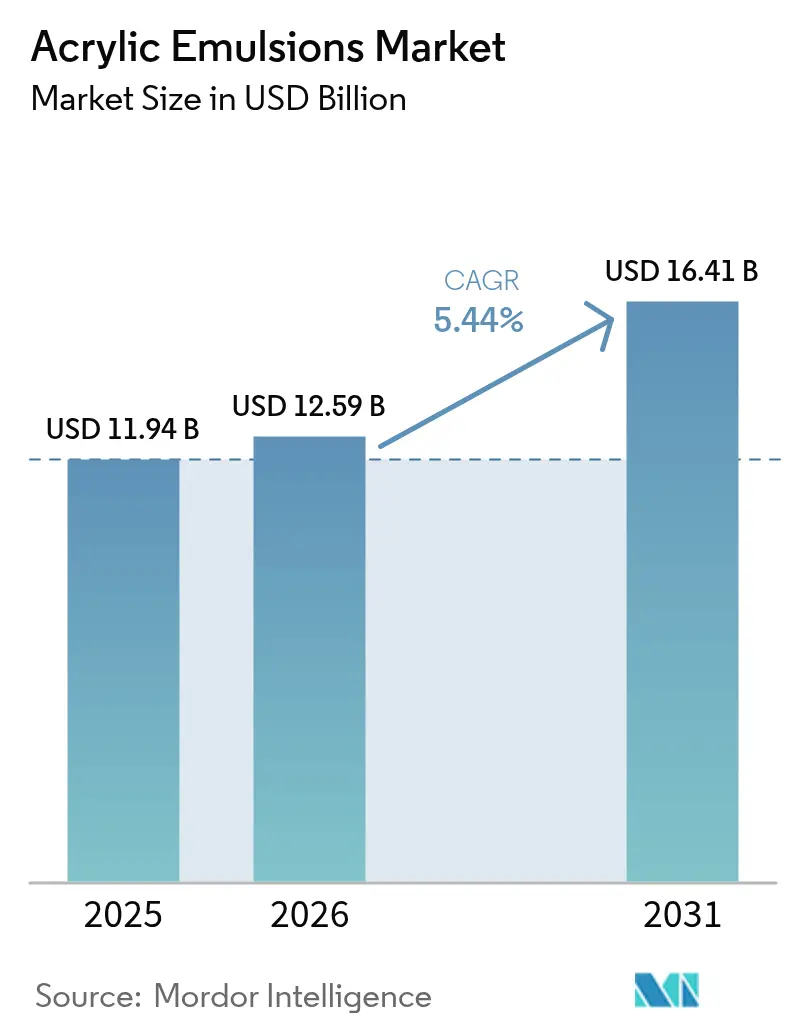
The Acrylic Emulsions Market size is expected to grow from USD 11.94 billion in 2025 to USD 12.59 billion in 2026 and is forecast to reach USD 16.41 billion by 2031 at 5.44% CAGR over 2026-2031. Regulatory pressure that favors water-borne formulations, steady infrastructure spending in Asia-Pacific, and rapid adoption of digital printing technologies underpin this expansion. Paint makers, adhesive formulators, and paper converters continue to switch from solvent to water-borne systems to secure compliance with low-VOC rules in the United States, Canada, and the European Union. At the same time, manufacturers are investing in self-crosslinking and PFAS-free chemistries to capture premium niches, while capacity additions in the United States and the Netherlands safeguard supply security. Though feedstock price volatility presses margins, technology upgrades and sustainability commitments provide headroom for value-based pricing, enabling producers to preserve profitability even when monomer costs fluctuate.
Key Report Takeaways
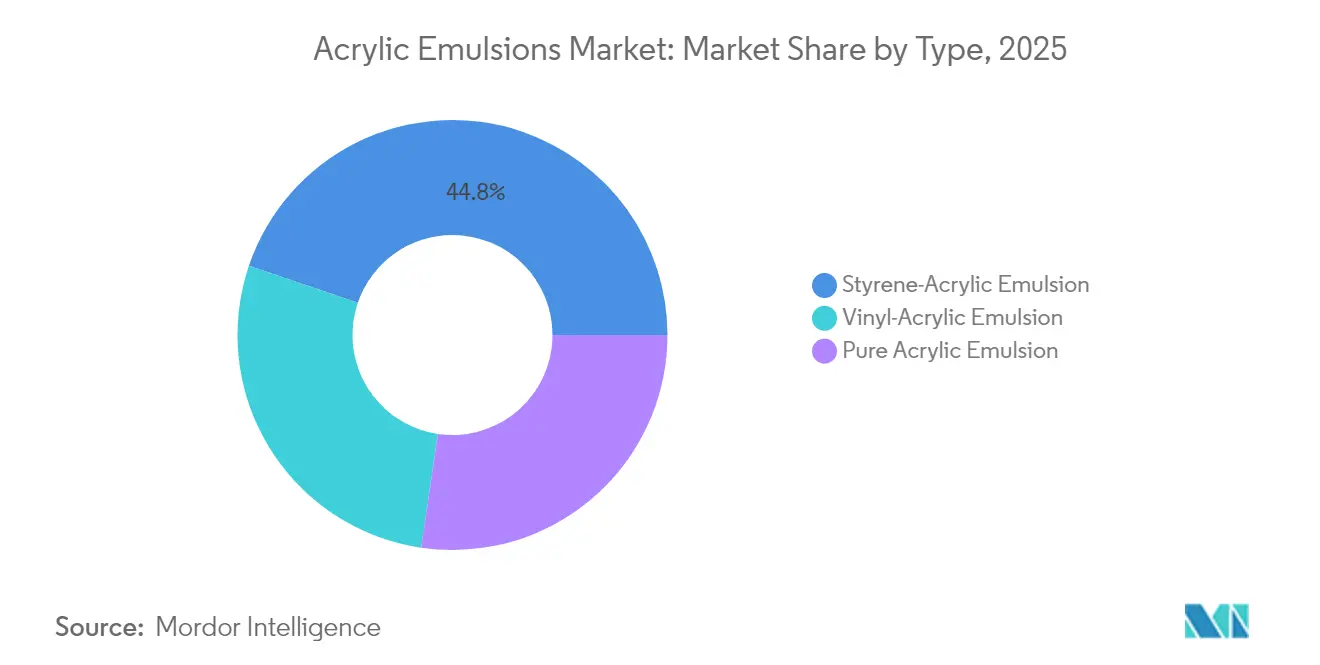
- By type, styrene-acrylic captured 44.78% acrylic emulsions market share in 2025, whereas vinyl-acrylic is forecast to expand at a 6.14% CAGR through 2031.
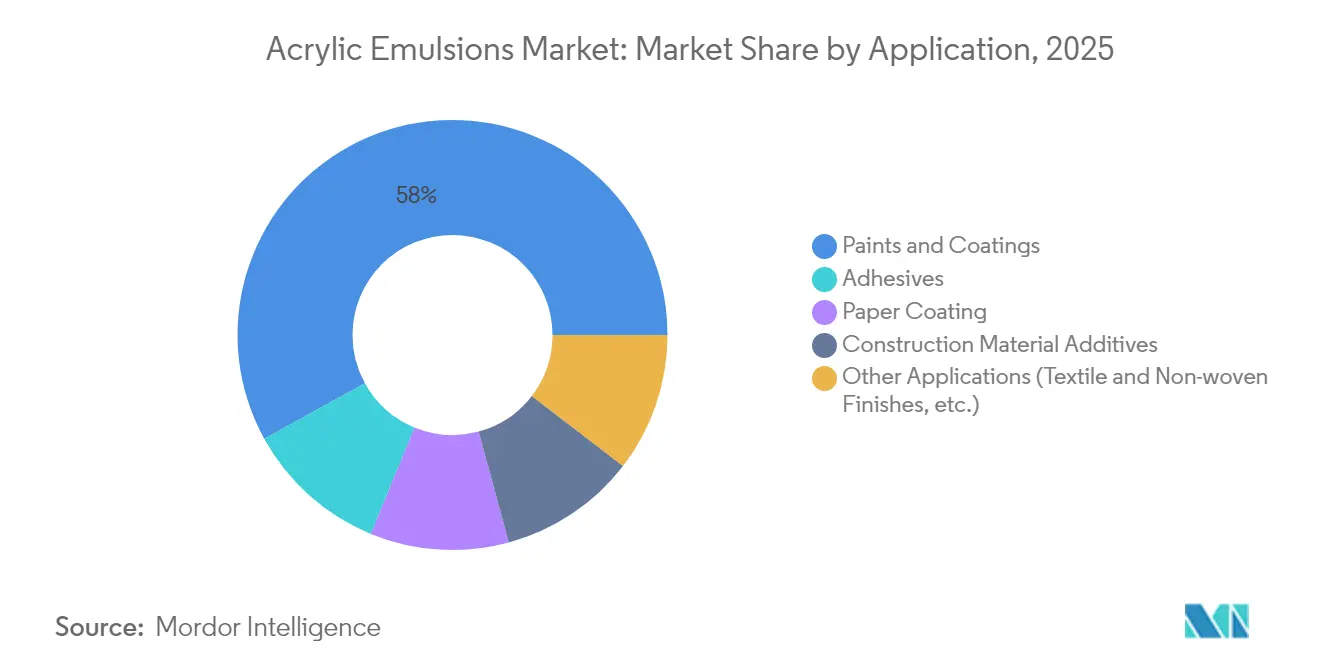
- By application, paints and coatings accounted for 58.02% of the acrylic emulsions market size in 2025; adhesives are set to grow the fastest at 6.03% CAGR to 2031.
- By geography, Asia-Pacific led with 46.05% revenue share in 2025 and is advancing at a 5.98% CAGR to 2031.
Note: Market size and forecast figures in this report are generated using Mordor Intelligence’s proprietary estimation framework, updated with the latest available data and insights as of 2026.
Market Trends and Insights
Drivers Impact Analysis of Acrylic Emulsions Market*
| Driver | (~) % Impact on CAGR Forecast | Geographic Relevance | Impact Timeline |
|---|---|---|---|
| Low-VOC push for water-borne paints/coatings | +1.2% | North America and Europe | Medium term (2-4 years) |
| Booming construction spending in developing nations | +1.8% | Asia-Pacific core; Latin America, MEA spill-over | Long term (≥ 4 years) |
| Digital ink-jet printing inks adoption | +0.7% | North America and Europe | Short term (≤ 2 years) |
| Shift to food-grade flexible-pack adhesives | +0.9% | Asia-Pacific and North America | Medium term (2-4 years) |
| Cool-roof and reflective coatings demand | +0.6% | Hot-climate regions worldwide | Long term (≥ 4 years) |
| Source: Mordor Intelligence | |||
Low-VOC Push for Water-Borne Paints and Coatings
California continues to cap VOC content for flat architectural paint at 50 g/L, compelling formulators to phase out solvent-rich chemistries. The United States Environmental Protection Agency extended aerosol coating compliance dates to January 2027, granting producers time to perfect water-based blends that match solvent-borne performance. Canada enforced VOC limits across 130 consumer product categories in January 2024, reinforcing a global regulatory shift that channels demand toward acrylic emulsions. Producers are therefore scaling self-crosslinking systems that raise film hardness without external crosslinkers, widening the addressable market. These policy moves give the acrylic emulsions market multi-year visibility and help offset monomer-cost swings.
Booming Construction Spending in Developing Countries
China’s 2025 budget maintains a 5% GDP growth target, supported by USD 1.11 trillion in infrastructure outlays, while India increased 2025–26 capital expenditure by 11.1% to INR 11.11 lakh crore. New highways, metros, and industrial parks lift consumption of architectural coatings, concrete additives, and flexible packaging adhesives that employ acrylic dispersions. Across Southeast Asia, manufacturing relocations drive factory construction, magnifying volumes. Because acrylic emulsions provide durability, adhesion, and low odor, they remain the binder of choice for builders that must meet tightening environmental standards. Rising middle-class income levels also spur residential repaint cycles, keeping baseline demand resilient.
Digital Ink-Jet Printing Inks Adoption
Label converters and folding-carton printers are migrating from analog to digital presses to run shorter jobs and enable customized packaging. Acrylic emulsions supply the resin backbone in water-based ink-jet formulations that demand rapid film formation, high color density, and strong substrate bonding. BASF’s new water-based dispersion line in Heerenveen, the Netherlands, targets this requirement and expands supply for European converters[1]. Printers benefit from odor-free operation and lower fire-code compliance costs, accelerating substitution away from solvent inks. The trend diversifies sales beyond traditional paint channels and cushions producers against cyclical construction swings.
Shift to Food-Grade Flexible-Pack Adhesives
Regulators are scrutinizing adhesives that contact food, leading packagers to phase out PFAS-containing chemistries in favor of safer acrylic systems. Studies show water-borne all-acrylic latexes can produce high-peel lamination bonds without fluorinated surfactants. Global snack and ready-meal brands now demand adhesive suppliers certify compliance with FDA and EU food-contact rules, enabling acrylic emulsions to secure premium pricing. As flexible packaging displaces rigid containers, the volume upside compounds, reinforcing long-term growth for the acrylic emulsions market.
Restraints Impact Analysis of Acrylic Emulsions Market*
| Restraint | (~) % Impact on CAGR Forecast | Geographic Relevance | Impact Timeline |
|---|---|---|---|
| Preference for polyurethane dispersions | -0.8% | Global, strongest in industrial coatings | Medium term (2-4 years) |
| Acrylic monomer price volatility | -1.1% | Global, acute in cost-sensitive uses | Short term (≤ 2 years) |
| UV yellowing of styrene-rich emulsions | -0.4% | Global, mainly exterior façade coatings | Long term (≥ 4 years) |
| Source: Mordor Intelligence | |||
Preference for Polyurethane Dispersions
Water-borne polyurethane dispersions often outclass acrylics in chemical and abrasion resistance, allowing them to gain ground in automotive trim, wood flooring, and heavy-duty metal coatings. Recent research on 2K UV-curable polyurethane chemistries highlights breakthroughs in low-emission performance. While acrylics answer with hybrid designs and self-crosslinking networks, the gap in very high-stress environments remains, capping share growth in select premium niches. Yet acrylics retain cost and process advantages in the mid-performance tier, ensuring balanced competition rather than outright displacement.
Acrylic Monomer Price Volatility
Global methacrylic acid and butyl acrylate prices swung widely in 2024–25 as oversupply in Asia met soft downstream demand. Spot declines of 12% in early 2025 provided temporary relief but also created inventory risks when prices rebounded. Producers cope by adopting formula-based contracts and hedging feedstock through vertical integration. BASF’s move to bio-based ethyl acrylate starting Q4 2024 moderates carbon footprints and introduces supply diversity, yet buyers still monitor crude-linked propylene costs that influence acrylic acid economics. Persistent volatility encourages formulators to optimize recipes for cost flexing, potentially delaying new-grade adoption.
*Our forecasts treat driver/restraint impacts as directional, not additive. The impact forecasts reflect baseline growth, mix effects, and variable interactions.
Acrylic Emulsions Market Segment Analysis
By Type:
Styrene-Acrylic Dominance Faces Vinyl ChallengeStyrene-acrylic grades held 44.78% of global revenue in 2025. Their balanced hardness, water resistance, and price position them as the workhorse for interior architectural paint and paper saturation lines. Through 2031, styrene-acrylic volumes will climb steadily, but the segment’s share will edge downward as users diversify into vinyl-rich systems. Vinyl-acrylic emulsions are set to grow 6.14% annually, riding demand for flexible construction adhesives, sealants, and low-temperature coated boards. Pure acrylics command the premium tier, favored in high-gloss exterior walls and cool-roof elastomeric where colour retention and UV durability are paramount.
Advanced self-crosslinking technologies reinforce this hierarchy. Studies show DAAM-ADH networks in styrene-acrylic road sealants boost bond strength by more than 50% over conventional grades. Producers market modular platforms that let customers fine-tune Tg and hardness with minimal lab reformulation, saving time to market. Meanwhile, vinyl-acrylic suppliers stress plasticizer-free flexibility that withstands thermal cycling in laminate flooring and weather-barrier membranes. Pure acrylics leverage bio-based monomer options to target sustainability-conscious architects, widening the value gap versus lower-priced chemistries.

By Application:
Paints Maturity Contrasts Adhesives GrowthPaints and coatings consumed 58.02% of worldwide volume in 2025, reflecting decades of entrenched usage in architectural walls, roof membranes, and industrial primers. Regulatory tailwinds assure a steady replacement cycle as solvent systems exit. Nonetheless, the mature nature of repaint demand restrains segment CAGR, compelling suppliers to differentiate on washability, scrub resistance, and tint retention. Adhesives constitute the most vibrant outlet, expanding 6.03% per year as flexible packaging overtakes rigid formats and as modular construction needs high-performance laminating and flooring glues.
Paper coating users adopt water-borne barrier layers to eliminate PFAS. Research on silicone-modified acrylic lattices shows promise for grease-proof wraps, illustrating the segment’s technology cross-fertilization. Construction additives, though smaller in absolute terms, gain relevance as concrete modifiers that cut shrinkage and raise freeze-thaw endurance. Textile and non-woven finishes capitalize on soft-hand emulsions that impart anti-pilling and flame-retardant attributes without harsh solvents. Collectively, these applications diversify revenue streams and buffer the acrylic emulsions market against cyclical downturns in any single end use.
Geography Analysis
APAC Acrylic Emulsions Market
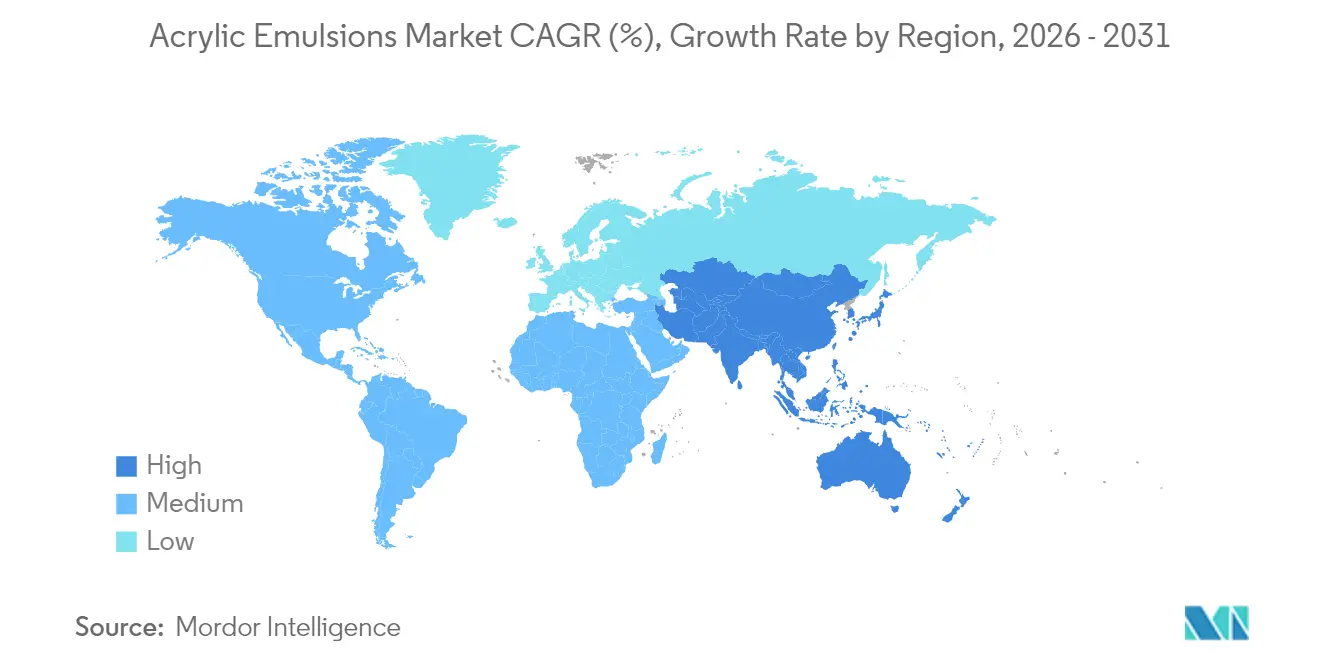
Asia-Pacific contributed 46.05% of global revenue in 2025 and will post a 5.98% CAGR to 2031. China’s Verbund site expansions supply local binders for booming public-works paint consumption, while India’s elevated capex pipeline translates directly into fresh commercial and residential floor space. ASEAN members such as Vietnam and Indonesia host export-oriented furniture and packaging clusters that rely on water-borne coatings to meet OECD buyer standards. The region also houses world-scale feedstock plants, enabling integrated players to balance cost pressure and drive economies of scale.
North America Acrylic Emulsions Market
North America remains a regulatory trendsetter. The EPA’s revised aerosol rules and CARB’s low-VOC caps force continuous R&D investment, yet they simultaneously defend incumbents with proven compliance credentials. Infrastructure renewal under the U.S. Infrastructure Investment and Jobs Act pumps spending into bridges, transit hubs, and public buildings, all of which favor durable, low-odor coatings. Canada’s country-wide VOC regulations, effective 2024, harmonize requirements and simplify cross-border product portfolios. Mexico’s maquiladora network attracts appliance and automotive manufacturers that specify water-borne finishes to secure export approvals.
EMEA and South America Acrylic Emulsions Market
Europe emphasizes sustainability leadership. BASF’s shift to bio-based ethyl acrylate and the Dutch dispersion expansion illustrate the region’s drive to decarbonize the chemicals value chain. Germany supports cool-roof retrofits through building-efficiency subsidies, widening the market for reflective acrylic membranes. France and the United Kingdom promote circular-economy criteria in public procurement, favoring resins with life-cycle-assessment backing. Although South America and the Middle-East and Africa together represent less than 10% of global consumption, rising urbanization and increased access to mortgage financing encourage residential repainting and infrastructure projects, providing long-run upside.
Value Chain Analysis
The acrylic emulsions value chain starts upstream with petrochemical, and increasingly bio-attributed, feedstocks used to produce acrylic acid and acrylate esters, such as butyl acrylate and 2-ethylhexyl acrylate. Depending on emulsion type, this also incorporates styrene and vinyl monomers. Emulsion polymerization then takes place in water using initiators and surfactants, with APEO-free surfactants increasingly specified, typically in temperature-controlled stainless-steel reactors with nitrogen blanketing, followed by finishing steps including filtration, quality control, and packaging into drums, IBCs, or bulk for shipment.
In the midstream, integrated chemical producers and specialty polymer manufacturers sell acrylic emulsions directly to paint and coating producers, adhesive formulators, paper and packaging converters, and ink manufacturers, or through regional distributors and toll blenders that adjust solids content, Tg, and additive packages. Downstream, formulators use these emulsions in architectural and industrial paints, pressure-sensitive and flexible packaging adhesives, paper coatings, construction additives, and textile or nonwoven finishes. Product qualification and certification are often tied to customer specifications and sustainability programs. Recent value-chain actions point to two themes: (1) localization and monomer-to-dispersion integration, and (2) partnerships to accelerate lower-carbon inputs, such as Arkema and Catalyxx (September 2025) on a bio-based acrylic resins value chain and Synthomer and Lummus Technology partnering to license acrylic acid esters technology.
Competitive Landscape
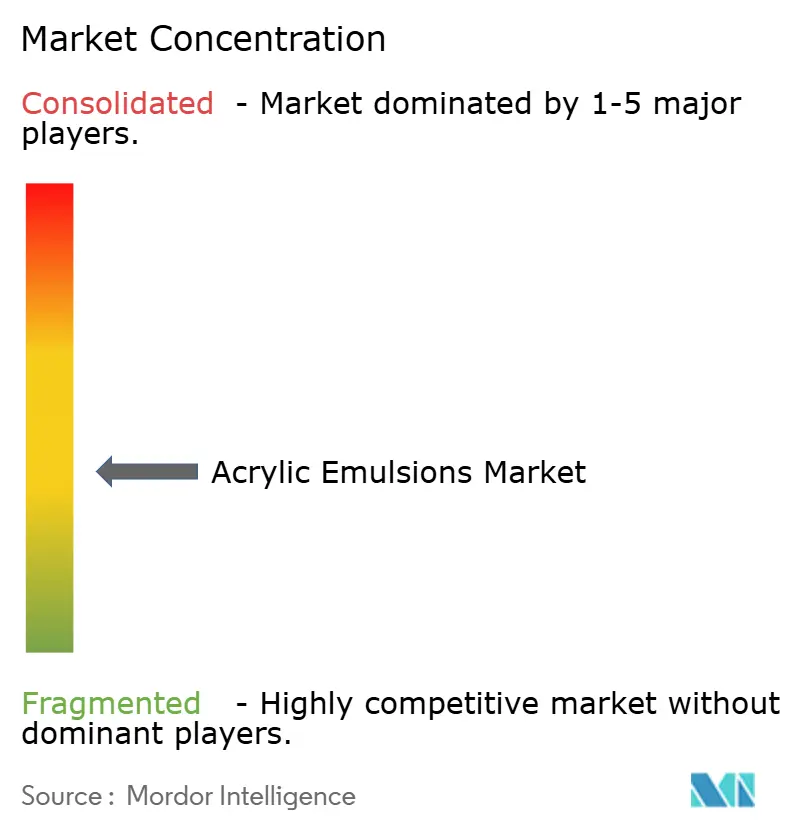
The acrylic emulsions market is moderately fragmented. BASF, Dow, Arkema, and Synthomer anchor global supply with integrated monomer production, broad technology platforms, and multi-continent manufacturing footprints. These leaders funnel double-digit R&D budgets into self-crosslinking lattices, PFAS-free dispersions, and bio-mass-balance resins that carry certified carbon-footprint reductions. Second-tier specialists such as Lubrizol and Synthomer carve revenue from niche segments like graphic-arts binders, pressure-sensitive adhesives, and non-woven hygiene finishes.
Strategic moves center on capacity expansions in growth regions. Lubrizol is investing USD 20 million to boost North Carolina output, shortening lead times to U.S. converters and coating blenders. BASF commissioned a new water-borne dispersion train in the Netherlands in 2024 to serve European packaging and ink-jet customers. Mergers complement organic growth: Synthomer finalized the USD 226 million acquisition of Hexion’s performance adhesives business, adding North American acrylic expertise and targeting USD 12 million in annual cost synergies.
Sustainability acts as the primary differentiation lever. BASF now offers more than 60 acrylic grades under its biomass-balance or renewable-raw-material schemes, claiming up to 30% lower cradle-to-gate carbon footprints. Dow markets EVOQUE pre-composite polymer technology that lifts titanium dioxide hiding efficiency, letting paint makers cut TiO₂ levels and save cost and embodied carbon. Intellectual-property filings in low-temperature crosslinkers and nanoclay-reinforced barrier coatings underscore the innovation tempo, erecting patent fences that raise entry barriers for new contenders.
Acrylic Emulsions Industry Leaders
-
BASF SE
-
Dow
-
Arkema Group
-
Synthomer plc
-
Celanese Corporation
- *Disclaimer: Major Players sorted in no particular order
Acrylic Emulsions Market Companies Covered in this Report
- AICA Kogyo Co.Ltd.
- AkzoNobel N.V.
- Allnex GMBH
- Anhui Sinograce Chemical Co., Ltd.
- Arkema
- Asian Paints Ltd.
- Axalta Coating Systems LLC
- BASF
- Celanese Corporation
- DIC Corporation
- Dow
- Gellner Industrial, LLC.
- H.B. Fuller Company
- Lubrizol
- Mallard Creek Polymers
- Nippon Paint Holdings Co., Ltd.
- Osaka Organic Chemical
- PPG Industries, Inc.
- Synthomer plc
- The Cary Company
Market Opportunities and Future Outlook
White space appears most clearly where formulators need water-borne performance upgrades while also complying with tighter sustainability requirements, especially in architectural coatings, construction chemicals, packaging adhesives, and paper applications. Capacity and supply-chain localization create room for regional product lines and customer-specific grades. BASF added a new dispersions production line at Mangalore, India (February 2026) and expanded dispersions capacity at Durban, South Africa (March 2026), both aimed at shortening lead times for coatings and construction customers and supporting local formulation ecosystems. On the monomer side, BASF advanced its acrylic acid value chain build-out in Zhanjiang, China, with July 2025 mechanical completion for glacial acrylic acid and butyl acrylate plants and March 2026 construction commencement for an integrated expansion that includes additional butyl acrylate and 2-ethylhexyl acrylate capacity, improving availability of key inputs that affect emulsion cost and supply security.
Technology opportunities also cluster around bio-based and PFAS-free pathways that maintain durability, scrub resistance, and adhesion for high-wear interior and facade coatings, along with food-grade flexible packaging adhesives. Published research in 2026 on bio-based latex routes using plant oil-derived monomers and polymerizable emulsifiers reflects continued development of higher renewable-carbon binders without stepping away from water-borne performance requirements. Portfolio reshaping can create openings for acquirers and regional specialists to support established customer bases, including Mitsubishi Chemical Corporation agreeing to transfer its acrylic emulsion business and related operations of Japan Coating Resin Corporation to Konishi, with completion scheduled for December 1, 2026, which may trigger requalification cycles and new supply agreements across paint, adhesive, and paper customers.
Recent Industry Developments in Acrylic Emulsions Market
- April 2026: Dow commercialized the OPTI-MATT MT-8 acrylic emulsion extender for low-sheen architectural coatings. The 100% acrylic, non-film-forming extender is designed to increase scuff and mar resistance while keeping matte aesthetics. It supports higher-performance water-borne paint formulations where durability complaints can drive reformulation.
- July 2025: BASF reached mechanical completion for its glacial acrylic acid and butyl acrylate plants at the Zhanjiang Verbund site in China. This milestone progresses backward integration for acrylate monomers that underpin acrylic emulsions. It also strengthens supply assurance and supports localized sourcing for Asia-Pacific coatings and adhesives customers.
- April 2024: Lubrizol invested USD 20 million to upgrade acrylic emulsion manufacturing at its Gastonia, North Carolina facility. The project increased reactor flexibility and improved downstream filtration capability. This enables faster scale-up of new emulsion grades for coatings and related applications, while reducing constraints for regional supply.
Acrylic Emulsions Market Report Scope and Research Methodology
Market Definition and Coverage
For this study, the acrylic emulsions market is defined as water-based acrylic polymer emulsions sold as a raw material for downstream formulation in products such as paints, coatings, adhesives, and construction additives, measured on a value basis across major regions.
Scope exclusions: We exclude finished paints, finished adhesives, and other formulated end products where acrylic emulsions are only one ingredient in the final selling price.
Segments Covered in This Report
- By Type
- Pure Acrylic Emulsion
- Styrene-Acrylic Emulsion
- Vinyl-Acrylic Emulsion
- By Application
- Paints and Coatings
- Construction Material Additives
- Paper Coating
- Adhesives
- Other Applications (Textile and Non-woven Finishes, etc.)
- By Geography
- Asia-Pacific
- China
- Japan
- India
- South Korea
- ASEAN Countries
- Rest of Asia-Pacific
- North America
- United States
- Canada
- Mexico
- Europe
- Germany
- United Kingdom
- France
- Italy
- Spain
- Russia
- NORDIC Countries
- Rest of Europe
- South America
- Brazil
- Argentina
- Rest of South America
- Middle-East and Africa
- Saudi Arabia
- South Africa
- Rest of Middle-East and Africa
- Asia-Pacific
Data Sources, Market Sizing, and Validation
Desk Research
Desk work starts by mapping where acrylic emulsions are produced and consumed, and then translating those signals into a consistent demand view by region. Public sources used for this include UN Comtrade trade statistics for related polymers and dispersions, U.S. EPA information on VOC rules that support waterborne adoption, Eurostat construction and industrial indicators that track coatings demand, and peer-reviewed journals that cover waterborne binder performance and formulation shifts.
We also review company filings and investor presentations to understand capacity additions, plant utilization commentary, and end-market exposure, which helps keep assumptions aligned with operating realities. Patent databases are checked to see where R&D focus is moving (for example, low-VOC and durability improvements), and an import-export shipment-level database is used selectively to sanity-check cross-border flows where customs categories are available. These desk sources are illustrative rather than exhaustive, and other public references were also consulted to fill gaps, verify data points, and clarify assumptions.
Primary Interviews and Surveys
Primary work focuses on validating how demand is split across paints and coatings, construction additives, adhesives, and other uses, and on confirming how pricing typically moves with feedstock, energy, and compliance costs. Interviews were conducted with producers, distributors, and downstream formulators across APAC, EMEA, and the Americas, so regional volume patterns and realistic ASP ranges could be cross-checked before the model was finalized.
Distribution of primary research fieldwork respondents
| Company type | Respondent position | Region |
|---|---|---|
| Top tier: 37% | CXOs: 12% | APAC: 39% |
| Mid tier: 45% | Functional/Unit leaders: 33% | EMEA: 36% |
| Smaller Players: 18% | Managers: 55% | Americas: 25% |
Market-Sizing & Forecasting
Sizing is built using a top-down and bottom-up approach. We start by reconstructing regional demand pools using coatings and construction activity indicators, then translate them into acrylic emulsion consumption through penetration and use-rate checks. To keep the output practical, we corroborate totals with selective bottom-up approximations such as sampled supplier volumes, distributor channel checks, and typical ASP-by-grade ranges shared in interviews.
Key inputs that influence the model include building and construction output trends, architectural and industrial coatings production signals, waterborne share progression driven by VOC compliance, capacity additions and utilization commentary, and regional import-export movements for related polymer dispersion categories. Forecasts are extended using scenario analysis, where baseline growth is linked to macro construction and manufacturing outlook, and then stress-tested with faster or slower adoption of waterborne formulations and different pricing trajectories. Where bottom-up volume signals are incomplete in smaller countries, gaps are handled through proxy ratios tied to coatings demand and trade intensity, and then reviewed again with experts for reasonableness.
Data Validation & Update Cycle
Validation is done in multiple steps so obvious overcounts and hidden gaps are caught early. We compare model outputs against independent signals such as coatings activity, construction indicators, and trade flows, and then investigate outliers that do not match the direction of those indicators. If a key assumption moves materially, such as a sharp change in waterborne demand or pricing, respondents are re-contacted to confirm whether the change is structural or temporary.
Before sign-off, the model and the logic are reviewed by another analyst, and checks are repeated at regional and global levels so totals reconcile cleanly. Reports are refreshed annually, with interim updates when major events occur, and a final pre-delivery review is done so clients receive the most current view available at the time of release.
Mordor Intelligence's Acrylic Emulsions Market Size Measured Against Other Published Estimates
Published market sizes for acrylic emulsions can differ even when the topic name looks the same, since firms do not always count the same product scope, pricing basis, and demand signals. Differences also come from how quickly assumptions are refreshed, and whether the numbers are checked against real-world indicators like coatings activity and trade movements.
Some external estimates blend in adjacent emulsion polymers or treat a wider set of formulated materials as part of the market. Finished paints, finished coatings, and finished adhesives are kept out of the total when Mordor Intelligence sizes acrylic emulsion raw material sales, which narrows the value pool compared with broader definitions.
Benchmark comparison
| Source | Market Size | Gaps in Research Methodology |
|---|---|---|
| Mordor Intelligence | USD 11.94 B (2025) | |
| Global Consultancy A | USD 10.23 B (2025) | Uses a lower 2025 pricing basis in several regions and applies more conservative waterborne adoption inputs for coatings, which reduces the value total even when demand direction is similar. |
| Industry Research Desk B | USD 10.02 B (2024) | Starts from a 2024 base year and may merge blended type definitions, so year alignment and product classification do not match a pure acrylic-emulsion raw material value scope. |
Overall, the spread is explained mostly by year selection, price construction, and whether adjacent categories are blended into the total. Because the steps are tied to observable indicators and repeatable checks, the output stays practical for planning across regions and end-use demand cycles.
Key Questions Answered in the Report
Why are water-borne acrylics gaining share in architectural paint?
Low-VOC regulations in the United States, Canada, and Europe limit solvent content, pushing paint makers toward water-based acrylic binders that comply without sacrificing film durability.
What is the fastest-growing application for the acrylic emulsions market through 2031?
Adhesives lead growth at a projected 6.03% CAGR, fueled by flexible packaging demand and stricter food-contact requirements that favor acrylic chemistry.
Which region contributes the most to global consumption?
Asia-Pacific holds 46.05% of 2025 revenue and is expected to post a 5.98% CAGR as China and India expand infrastructure and manufacturing capacity.
How will digital printing affect acrylic emulsion demand?
Ink-jet printers rely on water-based acrylic inks for rapid curing and high color density, creating a diversified growth avenue beyond traditional paint and coating markets.
What role does sustainability play in competitive strategy?
Leading suppliers differentiate through bio-based monomers, PFAS-free grades, and carbon-reduction certifications, enabling premium pricing and long-term customer contracts.