
Abrasion Resistant Coating Market Size and Share
Market Overview
| Study Period | 2020 - 2031 |
|---|---|
| Forecast Data Period | 2026 - 2031 |
| Historical Data Period | 2020 - 2024 |
| Growth Rate | 4.94 % |
| Fastest Growing Market | Europe |
| Largest Market | Asia Pacific |
| Market Concentration | Medium |
Major Players *Disclaimer: Major Players sorted in no particular order Image © Mordor Intelligence. Reuse requires attribution under CC BY 4.0. | |
Abrasion Resistant Coating Market Analysis by Mordor Intelligence
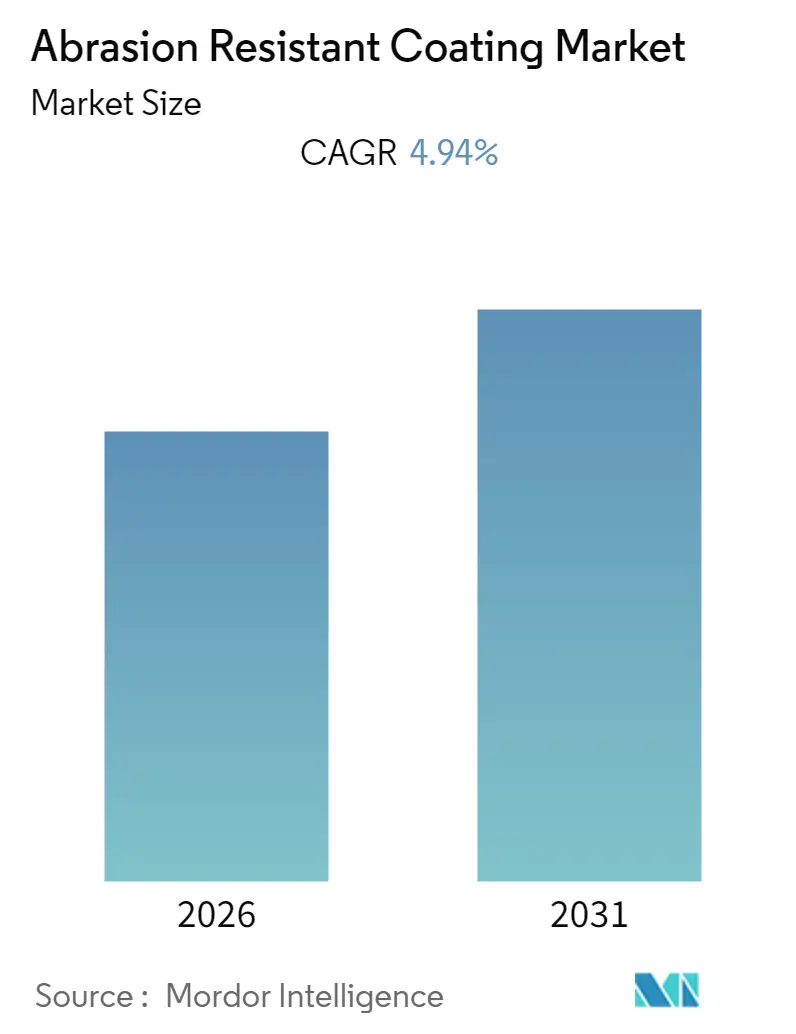
Abrasion Resistant Coating market size in 2026 is estimated to grow from 2025 value with 2031 projections, growing at 4.94% CAGR over 2026-2031.
- Increasing adoption of renewable sources of energy is likely to offer various opportunities for the growth of the market.
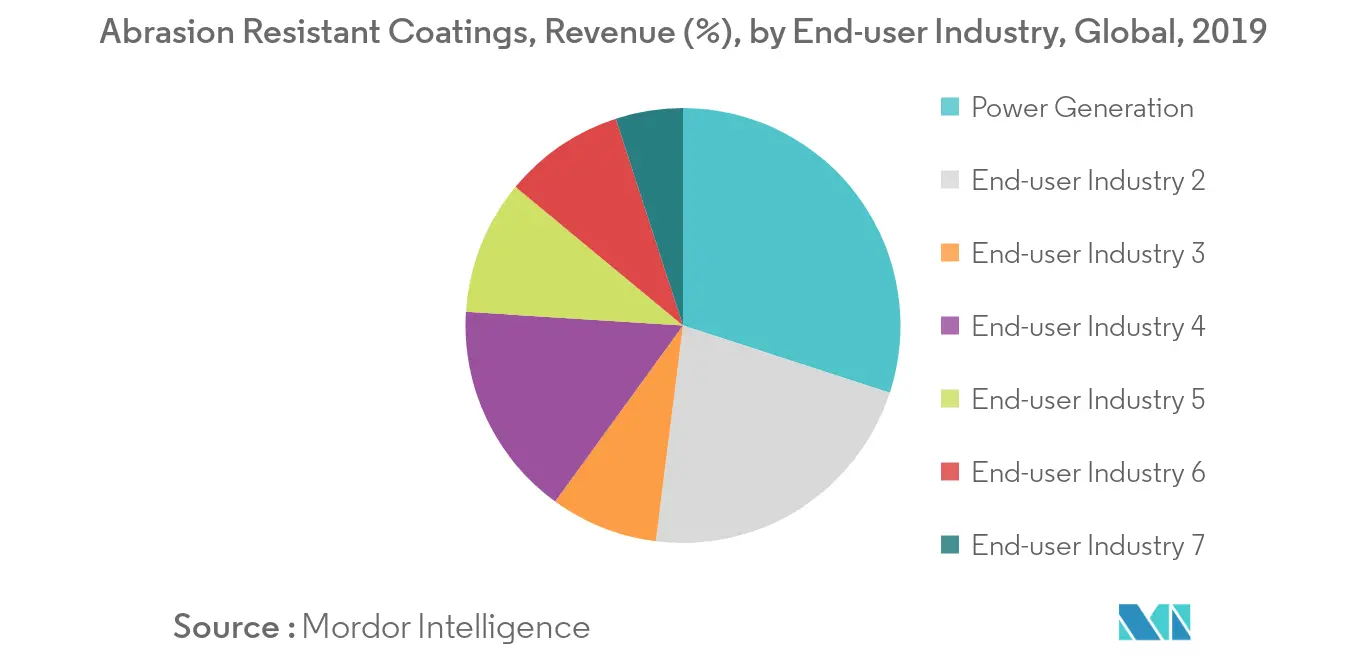
- By end-user industry, power generation segment is expected to dominate the market owing to increasing demand demand and popularity of high-temperature polymer-based coatings, which propel the growth for global abrasion resistant coating market in the power generation industry.
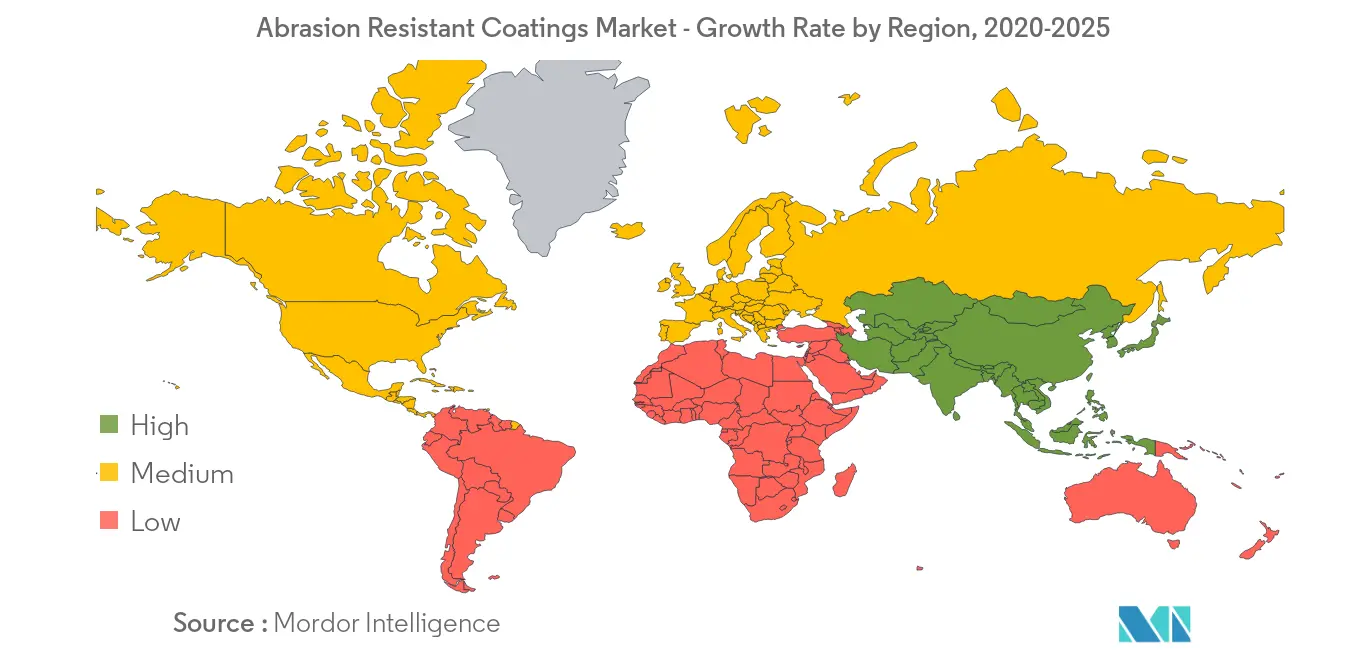
- Asia-Pacific region dominated the market across the globe with the largest consumption from countries such as China and India.
Note: Market size and forecast figures in this report are generated using Mordor Intelligence’s proprietary estimation framework, updated with the latest available data and insights as of 2026.
Global Abrasion Resistant Coating Market Trends and Insights
Increased Demand from Power Generation Industry
- In the power generation end-use industry, abrasion resistant coatings are used in applications such as wind turbine blades, concrete cooling towers, valves, containment vessels, nuclear components, generators, dam structure, and turbines. The use of abrasion resistant coatings in this industry is mostly to withstand weather conditions.
- In the wind energy industry, fluoropolymers-based abrasion resistant coatings are used in wind blades, which enhances the operability of the blades by 20 years as compared to traditional paints and gelcoats. It improves UV stability, enables minimal dirt pick up, and offers excellent abrasion resistance and low reflectivity.
- Coatings are primarily used to reduce or eradicate surface wear, most notably in application areas that are not appropriate for lubricants. For instance, lubricants and greases cannot be used in high-temperature or radioactive environments and also where operating times are high. The coatings are designed with the main objective of extending the life of a product.
- Along with corrosion, these coatings are also resistant to abrasion, and wear and tear. Thus, they increase the reliability of product up to 5 years. Furthermore, increasing upstream and downstream industries across the world, growing need for coatings on drilling equipment and pipelines, and rising need for better performance of the product in vulnerable environments are also expected to fuel the market growth.
- Owing to all the above-mentioned factors, Abrasion Resistant Coating Market is expected to grow rapidly over the forecast period.
Asia-Pacific Region to Dominate the Market
- Asia-Pacific is expected to be the fastest growing regional Abrasion Resistant Coating Market. The high potential in the region for the growth of power generation industry boosts the demand for Abrasion Resistant Coating Market.
- Under the plan 'Made in China 2025', it is expected that China will supply over 10% home-made commercial aircraft to the domestic market by 2025. This is expected to propel the demand for the abrasion resistant coatings market during the forecast period.
- The construction industry is the second-largest industry in India and has shown promising growth in 2019 with a re-energized output of around 8%. It is predicted that India's construction industry is set to emerge as the third-largest market in the world by the end of forecast period. With government initiatives such as the Bharatmala scheme, UDAN and AMRUT serving as major growth drivers, this segment is estimated to be worth nearly USD 700 billion by 2023. The burgeoning construction industry is expected to fuel the demand for the market studied in India over the forecast period.
- Increasing investments in the defense sector and restructuring efforts undertaken by ship manufacturing companies are the other factors driving the abrasion resistant coatings market in the region.
- The aforementioned factors, coupled with government support, are contributing to the increasing demand for Abrasion Resistant Coating Market during the forecast period.
Regulatory Landscape
VOC-emission control and chemical-substance compliance continue to shape abrasion resistant coating formulations and application practices across end-use industries such as marine, transportation, and industrial infrastructure. In the United States, the EPA amended the National Volatile Organic Compound Emission Standards for Aerosol Coatings in January 2025 under the Clean Air Act, reinforcing compliance needs for VOC-controlled coating systems used in maintenance and specialized applications.
Performance and chemical management requirements also tighten through standards and international rules. The International Maritime Organization adopted Resolution MSC.557(108) in May 2024, amending performance standards for protective coatings in seawater ballast tanks with effect from 1 January 2026, which is relevant for abrasion and corrosion-resistant protective coatings in marine environments. On chemicals reporting, the U.S. EPA finalized actions under TSCA that affect data and compliance workflows: in April 2026 it set the PFAS reporting rule submission window to begin on January 31, 2027, and in May 2026 it issued TSCA Significant New Use Rules for specific substances effective 21 July 2026, increasing traceability and supplier declaration requirements for certain coating chemistries.
Value Chain Analysis
The abrasion resistant coating value chain starts with upstream feedstocks and functional inputs such as epoxy, polyurethane, fluoropolymer, and polyester resins, ceramic and carbide powders, pigments (including titanium dioxide), solvents, and performance additives. These materials move to formulators and manufacturers (for example Akzo Nobel N.V., PPG Industries, The Sherwin-Williams Company, Arkema Group, and Jotun), then to distribution through direct industrial channels and authorized dealers, and finally to applicators using liquid, powder, or thermal spray processes before reaching end users across oil and gas, marine, power generation, transportation, mining, and construction.
Qualification and verification are critical midstream steps, with performance typically validated through widely used abrasion and wear methods such as ASTM D4060 and EN ISO 7784-3, alongside sector standards and practices supported by bodies such as AMPP. The chain is also exposed to raw-material volatility and availability constraints, especially for epoxy resins, solvents, and pigments, which can shift procurement toward negotiated pricing and closer supplier relationships while increasing the importance of inventory positioning and multi-sourcing for high-performance formulations.
Competitive Landscape
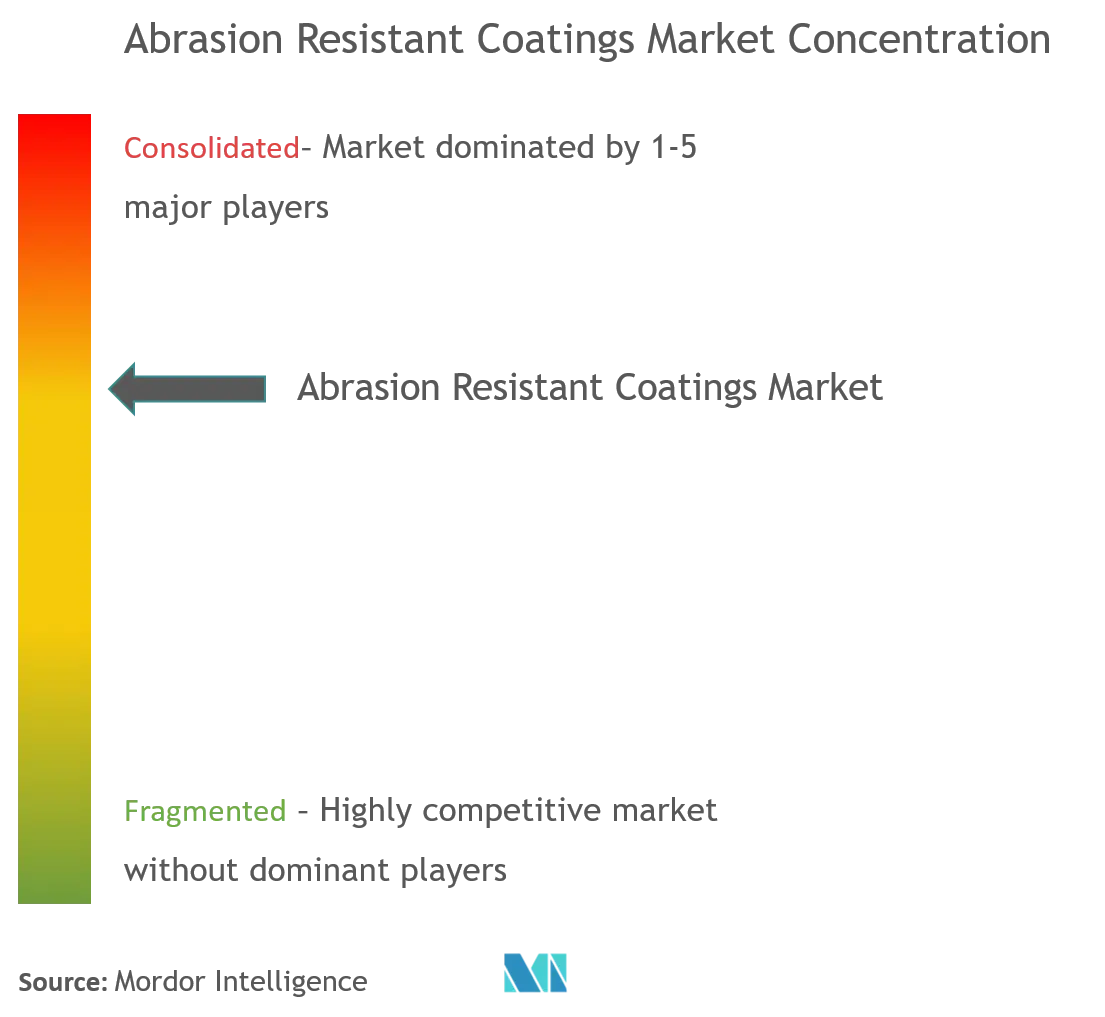
The Abrasion Resistant Coating Market is partially consolidated in nature with a few major players dominating a significant portion of the market. Some of the major companies are Akzo Nobel N.V., Saint-Gobain Performance Plastics (Saint-Gobain), Arkema Group, Jotun, and The Sherwin-Williams Company among others.
Abrasion Resistant Coating Industry Leaders
-
Arkema Group
-
The Sherwin-Williams Company
-
Jotun
-
Saint-Gobain Performance Plastics (Saint-Gobain)
-
Akzo Nobel N.V.
- *Disclaimer: Major Players sorted in no particular order
Market Opportunities and Future Outlook
Renewables and power-generation assets create opportunities for abrasion resistant systems that also manage UV exposure, weathering, and erosion on large, maintenance-intensive surfaces. The report context points to wind turbine blades and other power-generation components as key application areas, including fluoropolymer-based systems used on blades to improve durability versus traditional paints and gelcoats, supporting longer operating life in harsh environments.
Formulation and capacity investments around advanced performance inputs are another area of opportunity, particularly where coatings need to balance mechanical wear resistance with evolving restrictions around VOCs and certain substances. In March 2026, Arkema announced a 20% expansion of Kynar PVDF production capacity at its Changshu site in China (with a 2028 start-up plan) and cited an additional capacity increase beginning in Q2 2026 at its Calvert City, Kentucky site, expanding supply options for fluoropolymer-based coating systems. In April 2026, Nouryon expanded manufacturing capacity for Levasil colloidal silica in Guangzhou, China for catalyst and performance coatings, supporting broader availability of functional fillers and additives used to enhance abrasion and durability performance in industrial coating formulations.
Recent Industry Developments
- March 2026: AkzoNobel announced it is supplying marine coatings for three new ferries, including the use of Interzone 954GF on car decks for abrasion and corrosion protection. The contract points to continued demand for high-durability protective systems in marine environments where mechanical wear and chemical exposure overlap.
- January 2025: ISO published ISO 9466:2025 covering coating of passenger rail vehicles, including application processes and acceptance criteria. The update supports more standardized qualification and inspection expectations for coating performance in transportation fleets where abrasion resistance is critical.
- May 2024: The International Maritime Organization adopted Resolution MSC.557(108) amending performance standards for protective coatings in seawater ballast tanks, effective 1 January 2026. The timeline requires shipowners, yards, and coating suppliers to align product approvals and application practices with the updated standard for marine protective coatings.
Research Methodology Framework and Report Scope
Market Definition and Coverage
For this study, the abrasion resistant coating market is defined as revenue earned from coating materials that are selected mainly to reduce wear from friction, sliding, impact, and particle erosion on assets in industrial and infrastructure settings.
Scope exclusions: We exclude surface hardening or plating that is not sold as a coating system, along with decorative paints where abrasion resistance is not a buying requirement.
Segmentation Overview
- Type
- Metal/Ceramic Coatings
- Carbide Coatings
- Oxide Coatings
- Nitride Coatings
- Others
- Polymer Coatings
- Polyester
- Fluoropolymer
- Epoxy
- Polyurethane
- Others
- Metal/Ceramic Coatings
- End-user Industry
- Oil and Gas
- Marine
- Power Generation
- Transportation
- Mining
- Construction
- Others
- Geography
- Asia-Pacific
- China
- India
- Japan
- South Korea
- Rest of Asia-Pacific
- North America
- United States
- Canada
- Mexico
- Europe
- Germany
- United Kingdom
- France
- Italy
- Rest of Europe
- South America
- Brazil
- Argentina
- Rest of South America
- Middle-East and Africa
- Saudi Arabia
- South Africa
- Rest of Middle-East and Africa
- Asia-Pacific
Data Sources, Market Sizing, and Validation
Desk Research
Desk work starts by mapping where abrasion wear shows up in real equipment and where coatings are specified, so later interviews can be focused on the right use cases. We usually refer to public sources such as the USGS (minerals and mining activity), US EIA (oil and gas activity indicators), the International Energy Agency (power generation trends), UN Comtrade (trade flows for related chemicals and coating inputs), and ASTM or ISO publications for test methods that influence specification language.
Company annual reports, investor decks, and technical datasheets are then used to understand product positioning, typical application methods, and where pricing tends to shift with resin and filler costs. For cross-checks, we also use paid subscriptions for company financials and intelligence, and for patent databases to track where newer wear-resistant chemistries are gaining attention. The sources listed above are not exhaustive, and we also used other public references and datasets during data collection, validation, and clarification.
Primary Interviews and Surveys
Primary work is used to convert broad demand signals into coating-specific demand by end use and geography, and then to pressure-test assumptions that desk research cannot confirm. We speak with coating formulators, applicators, distributors, and procurement or maintenance teams from end-user industries, and inputs are balanced across APAC, EMEA, and the Americas so regional operating conditions are reflected. These discussions also help confirm what is counted as abrasion resistant in tender language, how recoat cycles change by environment, and what price movement looks like when specifications tighten.
Distribution of primary research fieldwork respondents
| Company type | Respondent position | Region |
|---|---|---|
| Top tier: 38% | CXOs: 16% | APAC: 48% |
| Mid tier: 45% | Functional/Unit leaders: 40% | EMEA: 34% |
| Smaller Players: 17% | Managers: 44% | Americas: 18% |
Market-Sizing & Forecasting
Market sizing is built using a top-down and bottom-up combination, where industrial activity indicators are converted into an addressable coating demand pool, followed by coating mix and spend assumptions to reach revenue. For abrasion resistant coatings, the model is mainly driven by variables such as mining output and capex cycles, oil and gas throughput and maintenance intensity, marine and port asset upkeep, power plant maintenance schedules, and the share of assets moving to higher wear protection specifications. Typical recoat intervals and the split between polymer versus metal or ceramic systems are then applied so demand is not overstated.
The totals are corroborated with selective bottom-up approximations, including sampled price-per-kilogram or price-per-liter ranges multiplied by estimated consumption in high-wear assets. We also run channel checks with applicators and distributors to identify gaps. Where smaller local suppliers do not report clean revenue splits, we fill the gap using capacity signals, product mix cues from catalogs, and interview-based share ranges, then normalize the results back to the demand pool.
For forecasting, we use scenario analysis supported by short-run trend smoothing, because maintenance spending can move differently across mining, marine, and energy even in the same year. The base case blends expected industrial output, capex direction, and specification tightening, and it is adjusted after expert review on whether assumptions like recoat cycles and price progression look realistic in each major region.
Data Validation & Update Cycle
Validation is done through multiple checks so the final number stays consistent with real-world signals. We compare outputs against independent indicators such as industrial production direction, energy and mining activity trends, and reported coatings performance claims that influence specification adoption. Any outliers are reviewed before sign-off. If an interview suggests a major shift, such as a change in maintenance spend or a new regulatory specification in a high-wear sector, we re-contact sources and adjust the assumptions.
Reports are refreshed annually, with interim updates when a material event could change the market path, such as sharp feedstock price swings or major capex delays in mining or oil and gas. Before delivery, an analyst performs a final pass so clients receive the most current view aligned to the latest available data.
Mordor Intelligence's Abrasion Resistant Coating Market Size Compared Against Other Published Estimates
Published market values for abrasion resistant coatings can look far apart because each publisher draws the line differently on what counts as abrasion protection and where it is applied. Pricing and volume assumptions are also updated on different timelines.
Differences also show up when some studies start from broad protective coatings demand and then apply a smaller share, instead of tying demand to wear-driven maintenance needs. A common gap driver is scope expansion into adjacent categories like general-purpose protective coatings, floor coatings, or corrosion-only linings that may not be selected for abrasion performance. Some forecasts also lean on aggressive price escalation or optimistic industrial growth assumptions, which can lift the headline value quickly. Some estimates fold in plating and surface treatment revenues and then report the combined total. In Mordor Intelligence, the count is limited to coating systems specified for abrasion wear reduction, with recoat cycles and end-use activity checks used to keep totals tied to a repeatable demand pool.
Benchmark comparison
| Source | Market Size | Gaps in Research Methodology |
|---|---|---|
| Mordor Intelligence | USD 12.30 B (2026) | |
| Industry Research Publisher A | USD 14.20 B (2025) | Uses a wider definition that can pull in multiple application technologies and adjacent wear-protection treatments, and it starts from a higher 2025 base without clearly showing recoat-cycle discipline by end use. |
| Industry Research Publisher B | USD 12.30 B (2026) | Covers a broad technology and substrate list and emphasizes a longer 10-year runway, which can amplify growth assumptions around industrial capex and pricing if intermediate demand checks are limited. |
The spread in published numbers is mainly explained by what is included as abrasion protection and how strongly pricing and industrial activity are assumed to move. By keeping the sizing steps tied to wear-driven maintenance indicators, typical recoat behavior, and end-use specific demand signals, the estimate stays easier to follow and simpler to reproduce when conditions change.
Key Questions Answered in the Report
What is the current Abrasion Resistant Coating Market size?
The Abrasion Resistant Coating Market is projected to register a CAGR of 4.94% during the forecast period (2026-2031)
Who are the key players in Abrasion Resistant Coating Market?
Arkema Group, The Sherwin-Williams Company, Jotun, Saint-Gobain Performance Plastics (Saint-Gobain) and Akzo Nobel N.V. are the major companies operating in the Abrasion Resistant Coating Market.
Which is the fastest growing region in Abrasion Resistant Coating Market?
Europe is estimated to grow at the highest CAGR over the forecast period (2026-2031).
Which region has the biggest share in Abrasion Resistant Coating Market?
In 2025, the Asia Pacific accounts for the largest market share in Abrasion Resistant Coating Market.
What years does this Abrasion Resistant Coating Market cover?
The report covers the Abrasion Resistant Coating Market historical market size for years: 2019, 2020, 2021, 2022, 2023 and 2024. The report also forecasts the Abrasion Resistant Coating Market size for years: 2026, 2027, 2028, 2029, 2030 and 2031.