Earphones And Headphones Market Size and Share
Market Overview
| Study Period | 2020 - 2031 |
|---|---|
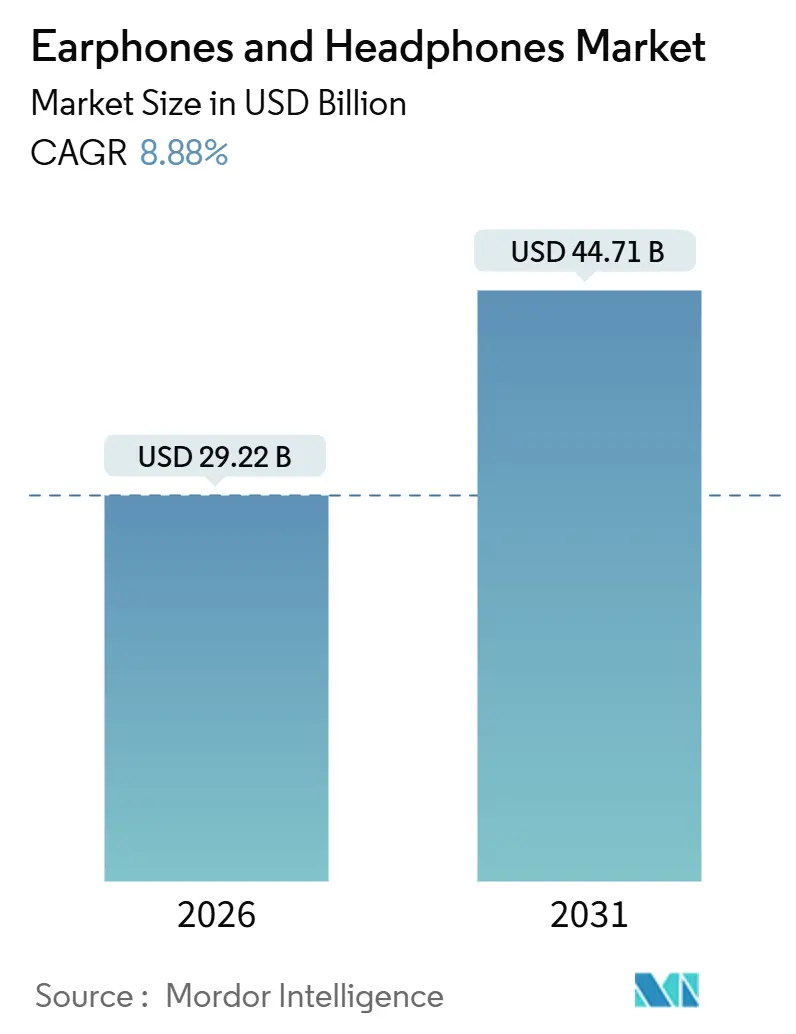
| Market Size (2025) | USD 29.22 Billion |
| Market Size (2030) | USD 44.71 Billion |
| Growth Rate (2026 - 2031) | 8.88% CAGR |
| Fastest Growing Market | Asia Pacific |
| Largest Market | North America |
| Market Concentration | Low |
Major Players *Disclaimer: Major Players sorted in no particular order Image © Mordor Intelligence. Reuse requires attribution under CC BY 4.0. | |
Earphones And Headphones Market Analysis by Mordor Intelligence
The earphones and headphones market reached a value of USD 29.22 billion in 2026 and is forecast to climb to USD 44.71 billion by 2031, reflecting an 8.9% CAGR and underscoring the escalating demand for connected, sensor-rich personal-audio devices. The market’s current expansion is driven by the rapid migration from wired headsets to wireless designs that integrate adaptive noise cancellation, spatial-audio processing, and biometric sensing. Premium true wireless models now arrive with onboard neural processors that tune sound signatures in real time, while mid-tier products leverage the same codec upgrades within months, shrinking the innovation gap. Subscription-bundled hardware programs are shortening replacement cycles from three years to under two, providing vendors with recurring revenue streams that offset rising compliance costs. Competitive dynamics continue to intensify, as regional challengers use local manufacturing and subsidy-backed supply chains to undercut global brands by as much as 60% without sacrificing headline features.
Key Report Takeaways
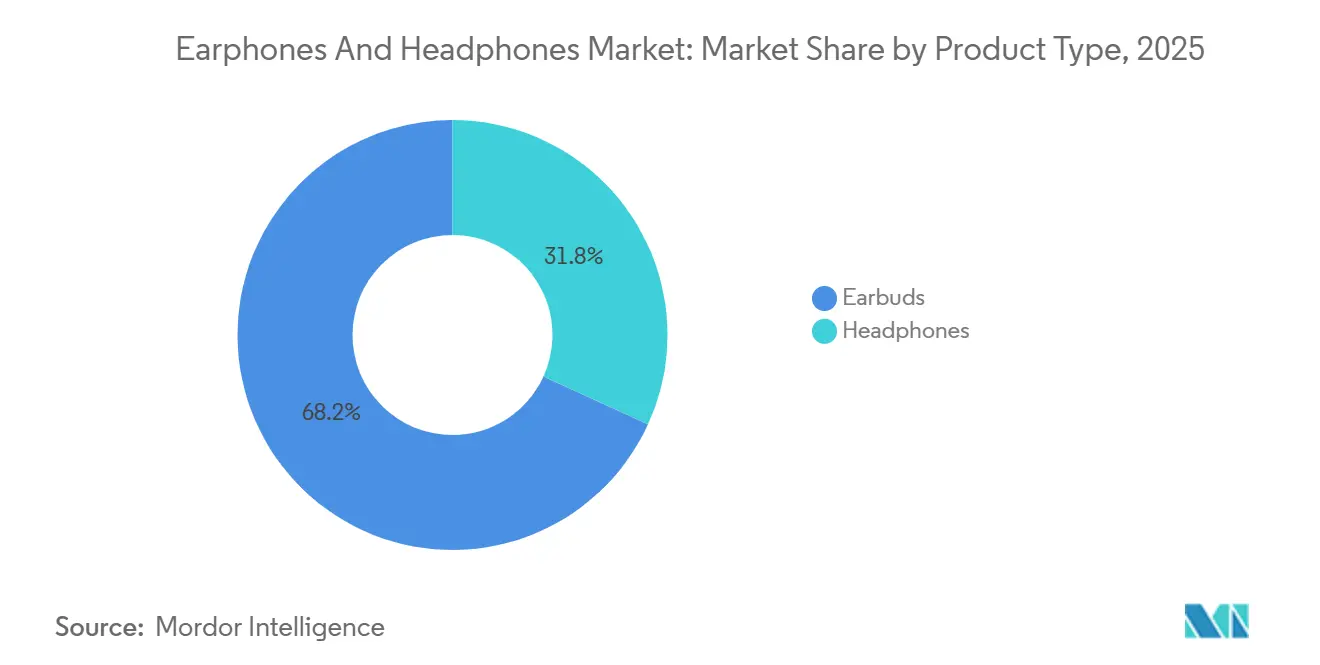
- By product type, true wireless stereo earbuds led with 68.18% revenue share of the earphones and headphones market in 2025, while hybrid ANC headphones are set to record a 10.01% CAGR through 2031.
- By connectivity, wireless designs commanded 72.63% share of the earphones and headphones market in 2025; hybrid ANC earphones are forecast to expand at 10.01% CAGR through 2031.
- By form factor, in-ear models captured 55.29% of the earphones and headphones market share in 2025; open-ear and bone-conduction designs are advancing at a 9.68% CAGR through 2031.
- By price band, the sub-USD 50 tier accounted for 52.57% of the earphones and headphones market in 2025, yet the USD 151–300 segment is projected to grow at a 10.22% CAGR through 2031.
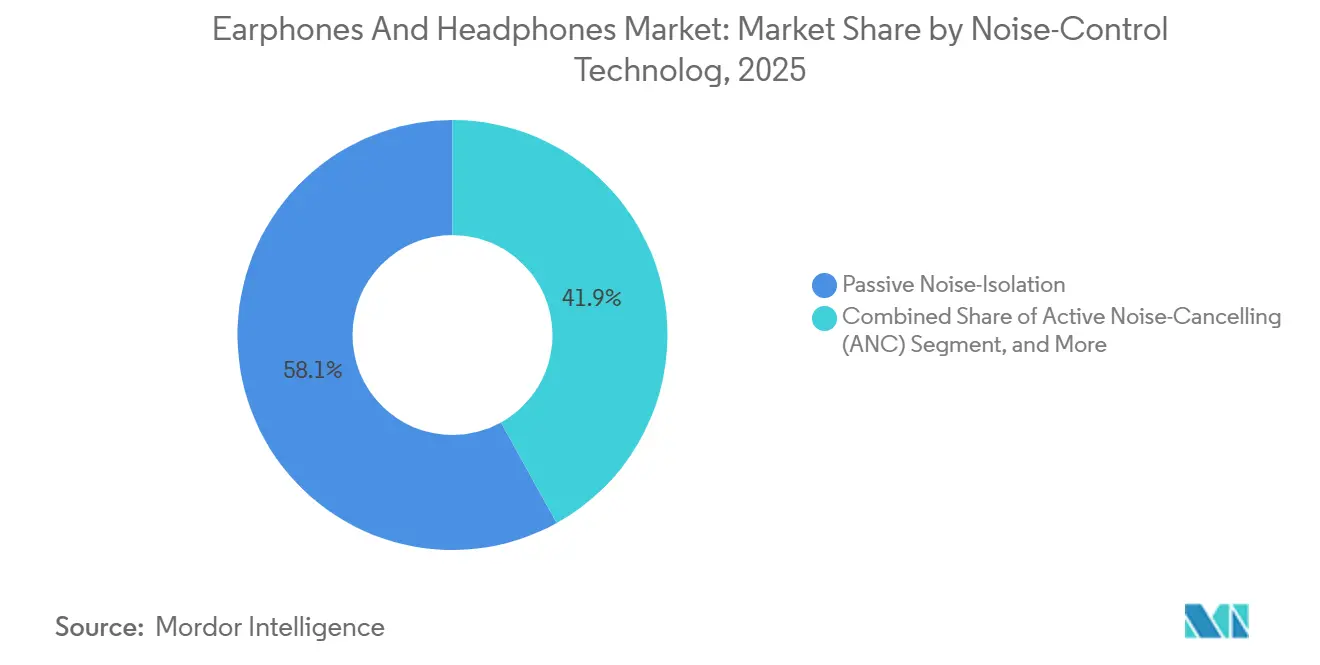
- By noise control technology, passive isolation held 58.06% of the earphones and headphones market in 2025, yet the hybrid ANC segment is projected to grow at a 10.01% CAGR through 2031.
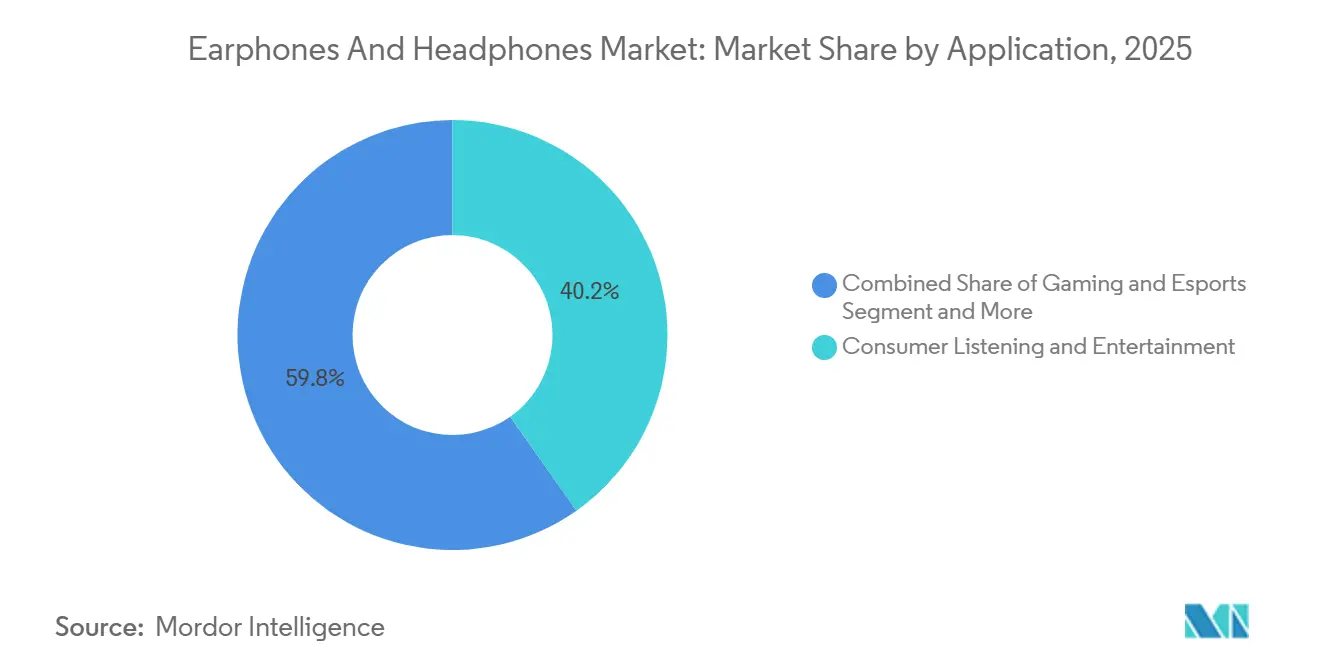
- By application, the consumer listening and entertainment held 40.22% of the earphones and headphones market size in 2025, yet the sports and fitness segment is projected to rise at a 9.92% CAGR through 2031.
- By distribution channel, the E-commerce and direct-to-consumer sites held 62.06% of the earphones and headphones market size in 2025. The segment is also projected to rise at a 10.15% CAGR through 2031.
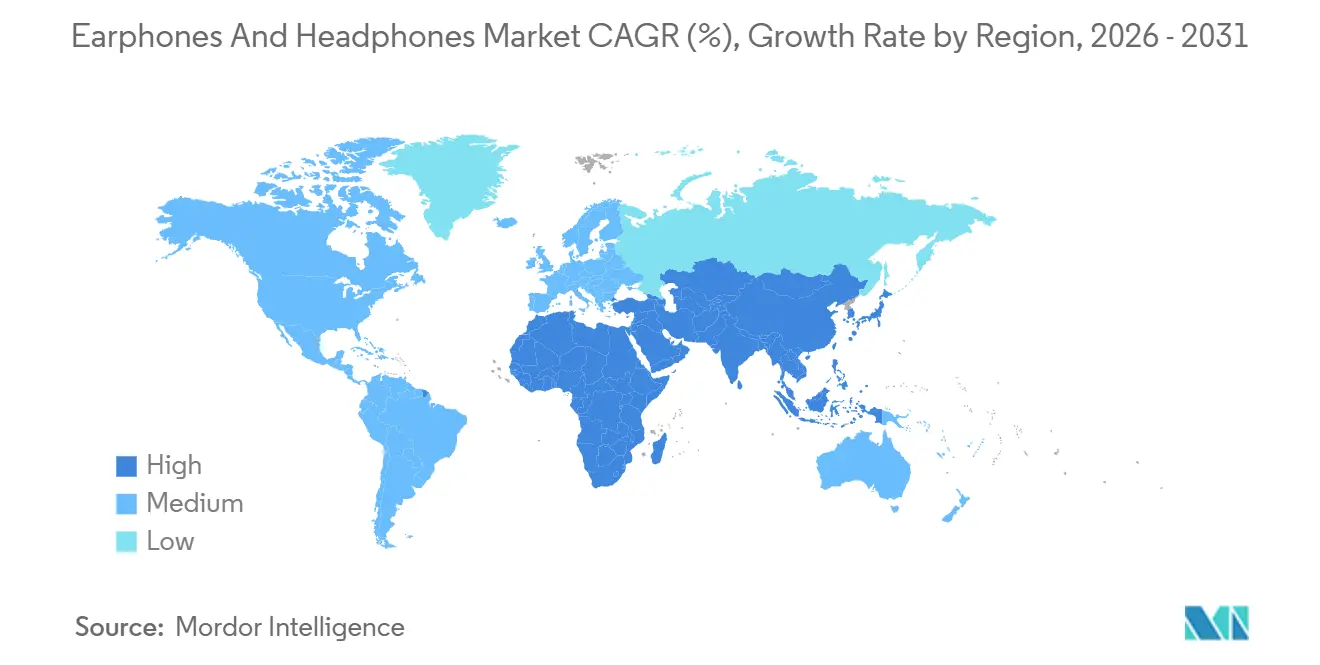
- By geography, Asia Pacific accounted for 35.78% of the earphones and headphones market size in 2025, while the Middle East is poised for the fastest regional growth at 9.5% CAGR through 2031.
Note: Market size and forecast figures in this report are generated using Mordor Intelligence’s proprietary estimation framework, updated with the latest available data and insights as of January 2026.
Global Earphones And Headphones Market Trends and Insights
Drivers Impact Analysis
| Driver | (~) % Impact on CAGR Forecast | Geographic Relevance | Impact Timeline |
|---|---|---|---|
| In-App Spatial-Audio Ecosystems Accelerating Premium TWS Adoption in Asia | +1.80% | Asia Pacific core, spillover to North America | Medium term (2-4 years) |
| Enterprise Hybrid-Work Policies Fueling Demand for Boom-Mic Headsets in North America | +1.20% | North America and Europe | Short term (≤2 years) |
| Gen-Z Fitness Boom Boosting Open-Ear and Bone-Conduction Sales in Europe | +1.00% | Europe, expanding to North America | Medium term (2-4 years) |
| AI-Enabled Adaptive Noise-Cancellation Differentiating Flagship Models Globally | +1.50% | Global, early adoption in North America and Asia Pacific | Long term (≥4 years) |
| Esports Sponsorships Driving High-Fidelity Gaming Headphones in Middle East | +1.20% | Middle East core (Saudi Arabia, UAE), spillover to North Africa | Medium term (2–4 years) |
| Subscription-Bundled Hardware Models Lifting Upgrade Cycles | +1.50% | North America and Western Europe core, emerging uptake in Asia Pacific | Short to medium term (1–3 years) |
| Source: Mordor Intelligence | |||
In-App Spatial-Audio Ecosystems Accelerating Premium TWS Adoption in Asia
Streaming platforms in China, Japan, and South Korea now treat earbuds as extensions of mobile operating systems rather than commodity accessories. Dolby Atmos and Apple Spatial Audio became default check-box features on Tencent Video and Apple Music catalogs in 2025, encouraging users to upgrade hardware every 18–24 months when older chipsets cannot process head-tracking commands without latency spikes. [1]Apple Inc., “AirPods Pro (3rd Generation) – Technical Specifications,” Apple.com Qualcomm’s Snapdragon Sound S7 Gen 3 platform carried aptX Lossless and spatial-audio rendering to Android devices, allowing Samsung and Xiaomi to match Apple’s experience at a 30–50% price discount. This dual-ecosystem rivalry incentivizes chipset vendors to release annual revisions, embedding headphone upgrades into the same cadence as smartphone refreshes.
Enterprise Hybrid-Work Policies Fueling Demand for Boom-Mic Headsets in North America
Hybrid-work norms have cemented the boom-mic headset as a standard office peripheral. Logitech’s Zone Vibe 125 and Jabra’s Evolve2 75 pair flip-to-mute arms with AI beamforming that masks keyboard clatter, satisfying corporate mandates for intelligible speech during video calls.[2]Logitech International, “Logitech Completes Acquisition of HP’s Poly Business,” Logitech.com Financial services and healthcare firms adopted encrypted USB-C dongles such as Dell’s WL5024 Pro to secure voice traffic under privacy regulations. These enterprise-grade models sustain 40% gross margins despite consumer price compression, primarily because IT departments consolidate purchases under multiyear support contracts.
Gen-Z Fitness Boom Boosting Open-Ear and Bone-Conduction Sales in Europe
Gen-Z runners and cyclists across Germany, the Netherlands, and Scandinavia increasingly favor open-ear designs that preserve ambient awareness. Shokz’s OpenFit Air directs sound toward the ear canal without obstructing it, while its OpenRun Pro 2 uses bone conduction to transmit audio through the cheekbone, mitigating moisture buildup and infection risks. Safety guidelines that encourage audible perception of traffic have provided a regulatory tailwind, and partnerships with Garmin and Strava reinforce the fitness-tracking proposition. European retail chains report double-digit sell-through increases for open-ear SKUs positioned near cycling and running accessories.
AI-Enabled Adaptive Noise-Cancellation Differentiating Flagship Models Globally
Machine-learning-driven ANC now defines premium positioning. Bose’s CustomTune measures ear-canal resonance and optimizes filters within milliseconds, reducing the pressure sensation typical of legacy. Sony’s WH-1000XM6 employs dual neural processors that isolate voice bands while suppressing wind rumble during calls. Apple’s H2 chip samples 48,000 data points per second to cancel noise before it reaches the eardrum, earning a USD 100–150 premium over passive-isolation models. Smaller brands lacking proprietary silicon increasingly license Qualcomm reference platforms, narrowing differentiation and intensifying price competition.
Restraints Impact Analysis
| Restraint | (~) % Impact on CAGR Forecast | Geographic Relevance | Impact Timeline |
|---|---|---|---|
| Proliferation of Counterfeit Earbuds Depressing ASPs in South America | -0.8% | South America, spillover to Africa | Short term (≤2 years) |
| Battery-Waste Regulations Increasing Compliance Costs in Europe | -0.6% | Europe, expanding to North America | Medium term (2-4 years) |
| Spectrum-Interference Issues Limiting Ultra-Low-Latency LE Audio in Dense Cities | -0.4% | Global urban centers | Long term (≥4 years) |
| Health-Related Concerns on SPL Exposure Curbing Volume Limits | -0.5% | Global focus in Europe and North America | Medium term (2-4 years) |
| Source: Mordor Intelligence | |||
Proliferation of Counterfeit Earbuds Depressing ASPs in South America
Customs authorities in Brazil seized more than 1.2 million fake earbuds in 2024, yet replicas that mimic Apple or Samsung designs still enter informal channels at one-third of authentic retail prices.[3]Brazilian Federal Revenue Service, “Customs Seizure Report: Counterfeit Electronics 2024,” Gov.br These products employ uncertified lithium-ion cells that pose fire risks, and when incidents occur, consumers often blame brand owners, eroding goodwill. Multinationals now embed NFC tags and QR-coded serials to enable smartphone verification, but the added USD 1–2 bill-of-materials cost squeezes margins in entry-level tiers. Unless enforcement improves, legitimate vendors will continue facing price erosion and warranty claims they did not cause.
Battery-Waste Regulations Increasing Compliance Costs in EU
The European Union’s revised WEEE and Battery directives obligate manufacturers to finance take-back and recycling programs and to meet a 65% collection rate by 2025 and 70% by 2030.[4]European Commission, “Waste Electrical and Electronic Equipment Directive 2024 Revision,” Eur-lex.europa.eu Compact TWS designs present intricate disassembly challenges: lithium-polymer cells, magnets, and PCBs are glued into housings smaller than 5 cm, forcing producers to invest in robotics such as Apple’s Daisy, which dismantles 200 devices per hour. Smaller brands without capital for automation rely on third-party recyclers, adding EUR 0.50–1.50 per unit and eroding already-thin 25% gross margins. The compliance burden accelerates consolidation as firms lacking scale exit or license designs to white-label assemblers.
Segment Analysis
By Product Type: TWS Earbuds Sustain Volume Lead While Over-Ear Designs Retain Audiophile Loyalty
True wireless stereo models accounted for 68.18% of global revenue in 2025 and are projected to expand at a 9.9% CAGR through 2031, keeping the earphones and headphones market on its current innovation treadmill. Flagships combine sub-5 mm system-on-chip packages, six-hour battery endurance per bud, and spatial-audio rendering that once required dedicated digital signal processors. Apple’s H2, Samsung’s proprietary codec, and Qualcomm’s QCC5181 collectively demonstrate how power management and compute convergence enable lighter, more comfortable buds. Over-ear headphones nevertheless maintain carve-outs in studio mixing, professional broadcast, and long-haul travel. Sennheiser’s Momentum 4 integrates 42 mm transducers and adaptive ANC, servicing travelers who prize isolation and extended comfort during 12-hour flights. Audio-Technica’s ATH-M50x still ships more than 1 million units annually to engineers who insist on the reference flatness of wired monitoring rigs. The coexistence of pocketable convenience and circumaural fidelity suggests each form factor will continue addressing discrete use cases rather than converging into a single hybrid design.
Complementary opportunities emerge for brands that cross-pollinate technologies between categories. Sony’s WH-1000XM6 borrows the adaptive ANC cluster from its WF-1000XM earbuds, while Bose’s CustomTune references ear-canal scanning techniques perfected in its in-ear line. Gamers remain a separate cohort: Razer’s BlackShark V2 Pro and Corsair’s HS80 integrate low-latency RF dongles for tournament use, a function less relevant to mainstream listeners. As headset processors become more modular, vendors may introduce modular driver housings that detach for portability, though such innovations risk cannibalizing established segments without clear incremental revenue.
By Form Factor: In-Ear Dominance Confronted by Open-Ear Migration
In-ear and canal-fit models secured 55.29% of 2025 revenue thanks to natural passive isolation, silicone tips that attenuate 15–25 dB of ambient noise, and gym-friendly IP ratings. Yet open-ear and bone-conduction designs are expanding at a 9.7% CAGR through 2031 as fitness-oriented Gen-Z users demand situational awareness on urban streets. Shokz’s OpenFit Air demonstrates how directional speakers angled toward the ear canal can deliver acceptable bass response without blocking environmental cues, addressing regulatory recommendations that cyclists maintain ambient hearing. Over-ear headphones retain prominence in critical listening environments, benefiting from 40–50 mm drivers that reproduce sub-20 Hz frequencies. On-ear sets, once the style icon of commuter chic, chart a shrinking addressable base as consumers either prioritize the immersive seal of over-ears or the feather-weight freedom of TWS buds.
Manufacturers experiment with hybrid shells combining open-ear frames and detachable ANC pods, but user adoption remains speculative. Weight distribution, sweat ingress protection, and battery compartment placement emerge as engineering constraints. Retailers increasingly group open-ear SKUs inside running-accessory aisles rather than audio displays, suggesting cross-category merchandising will determine velocity as much as acoustics.
By Connectivity: Wireless Momentum Outpaces Residual Wired Niche
Wireless designs contributed 72.63% of 2025 revenue and will widen their lead on a 9.3% CAGR, propelled by Bluetooth LE Audio and the LC3 codec that supports near-CD fidelity at sub-300 kbps bitrates. The protocol’s low-latency attribute brings competitive parity with 2.4 GHz gaming dongles, erasing one of the last wired advantages for mainstream users. Neckband-style earbuds retain a following in emerging markets, offering 12–16 hour endurance courtesy of larger battery housings. Wired headphones hang on in studio environments and among audiophiles skeptical of codec claims, with Beyerdynamic’s DT 1990 Pro and Grado’s SR325x exemplifying USD 500-plus investments centered on signal purity. Infrared and legacy RF links fade into aviation and home-theater niches, unlikely to return as consumer standards.
The cost of Bluetooth silicon dropped 35% between 2023 and 2025, opening the door for USD 25 entry-level buds that still advertise LE Audio compatibility. Yet Wi-Fi congestion and urban spectrum interference remain pain points; brands that optimize adaptive frequency hopping enjoy measurably lower call-drop rates in crowded environments, a selling point visible in user-generated benchmarks on e-commerce portals.
By Noise-Control Technology: Hybrid ANC Rises While Passive Isolation Endures
Passive isolation still captured 58.06% of 2025 revenue, thanks to zero power draw and negligible bill-of-materials impact. Nevertheless, hybrid ANC is the fastest mover, expanding 10.01% CAGR through 2031. Bose’s CustomTune and Sony’s dual-sensor designs blend feedforward and feedback microphones with machine-learning filters that adjust to wearer motion and atmospheric pressure within 200 ms. Transparency modes graduated from exotic add-ons to default toggles on every premium TWS model introduced after 2024, reflecting user expectations for seamless transitions between isolation and awareness. Mid-price segments integrate single-channel feedforward ANC that blocks low-frequency drone, but as component costs slide, hybrid arrays will penetrate sub-USD 100 devices, raising the bar for baseline performance. Open-ear headsets incorporate directional ANC to cancel driver leakage rather than external noise, a niche technical twist that further fragments the category.
Note: Segment shares of all individual segments available upon report purchase
By Price Band: Value Tier Remains Dominant, Mid-Premium Gains Momentum
The sub-USD 50 bracket retained more than half of 2025 revenue, buoyed by Xiaomi’s Redmi Buds 6 and Anker’s Soundcore Liberty 4, which pair Bluetooth 5.3 radios with six-hour batteries for USD 30–50 price tags. However, the USD 151–300 segment is growing at a 10.22% CAGR as consumers pay premiums for spatial audio, lossless codecs, and IPX7 ratings, without reaching flagship territory. Samsung’s Galaxy Buds 3 Pro, launched at USD 249, underscores the sweet spot: AI-driven ANC, 360-degree head tracking, and USB-C charging below the Apple price umbrella. Above USD 300 lives a connoisseur enclave of Sennheiser, Grado, and Beyerdynamic enthusiasts who invest in external DAC-amps and hi-res libraries. The USD 51–150 middle ground often contains legacy flagships discounted 30–40%, creating value propositions that blur neat price-performance strata.
By Application: Entertainment Dominates, Sports and Fitness Accelerate
Consumer listening and entertainment generated 40.22% of 2025 revenue, supported by Spotify, Apple Music, and Tencent Music vying for subscribers via high-resolution tiers that demand compatible hardware. Sports and fitness usage rises at 9.92% CAGR, riding the wave of heart-rate sensors in Jabra’s Elite 8 Active and IP68 casings in Shokz’s OpenRun Pro 2 that sync with Strava-powered training plans. Gaming headsets enjoy new momentum in the Middle East, where Saudi Arabia’s Vision 2030 earmarked USD 38 billion for esports, securing Razer and Corsair brand visibility in shopping malls once reserved for console kiosks. Professional studio monitoring remains stable but price-resilient, with Audio-Technica and Sennheiser contracting multi-year supply deals with broadcast networks. Enterprise communication, once considered a plateau, now finds fresh impetus as hybrid-work persistence embeds certified headsets in corporate asset lists, raising refresh frequency to match laptop lifecycles.
By Distribution Channel: Online Grows as Offline Reinvents
E-commerce and direct-to-consumer sites captured 62.06% of 2025 sales and are forecast to expand 10.15% CAGR through 2031. Brand webstores bundle music subscriptions or cloud-gaming vouchers, nudging buyers toward premium SKUs and recurring revenue. Marketplaces like Amazon, JD.com, and Flipkart refine recommender algorithms that surface comparisons and user-demo videos, lowering buyer hesitation. Offline stores defend relevance by converting square footage into experiential zones: Apple’s Spatial Audio demo pods and Samsung’s Galaxy Studio provide immersive trials unavailable on a screen. Specialty retailers such as Crutchfield curate amplifier-headphone pairings, leveraging staff expertise as a moat against algorithmic suggestions. Hybrid click-and-collect models offer next-day pickup, bridging instant gratification with showroom advantages.
Geography Analysis
Asia Pacific led with 35.78% of global revenue in 2025, driven by burgeoning smartphone penetration in India, Indonesia, and Vietnam, where first-time buyers outnumber replacement customers by 3 to 1. Domestic Chinese brands that combine design agility with local manufacturing captured more than half of the segment below USD 100, pushing multinationals to localize assembly or cede share. Japan and South Korea still record the highest per-capita spend on premium audio, driven by Sony and Samsung ecosystems that integrate wearables into broader device suites. India’s boAt shipped over 15 million units in 2024, using smartwatch bundles to cross-sell earbuds and illustrating how regional specialists can outmaneuver global giants on volume.
North America maintained a 28% share in 2025, anchored by an installed base of more than 200 million AirPods that refresh every two to three years and by enterprise headset mandates tied to Microsoft Teams rollouts. Europe followed at 22%, with replacement cycles extending toward 36 months amid macroeconomic caution and regulatory scrutiny on battery sustainability. The Middle East accelerates at 9.5% CAGR through 2031 as Saudi Arabia’s Public Investment Fund bankrolls esports arenas, pulling high-fidelity gaming headsets into mainstream retail assortments. South America struggles with counterfeit dilution and currency volatility but represents latent potential once enforcement stabilizes, especially in Brazil’s 220 million-strong market. Africa remains nascent, yet mobile-money platforms in Kenya and Nigeria shorten the path between brand webstores and underserved consumers, hinting at a leapfrog pattern similar to smartphone adoption.
Competitive Landscape
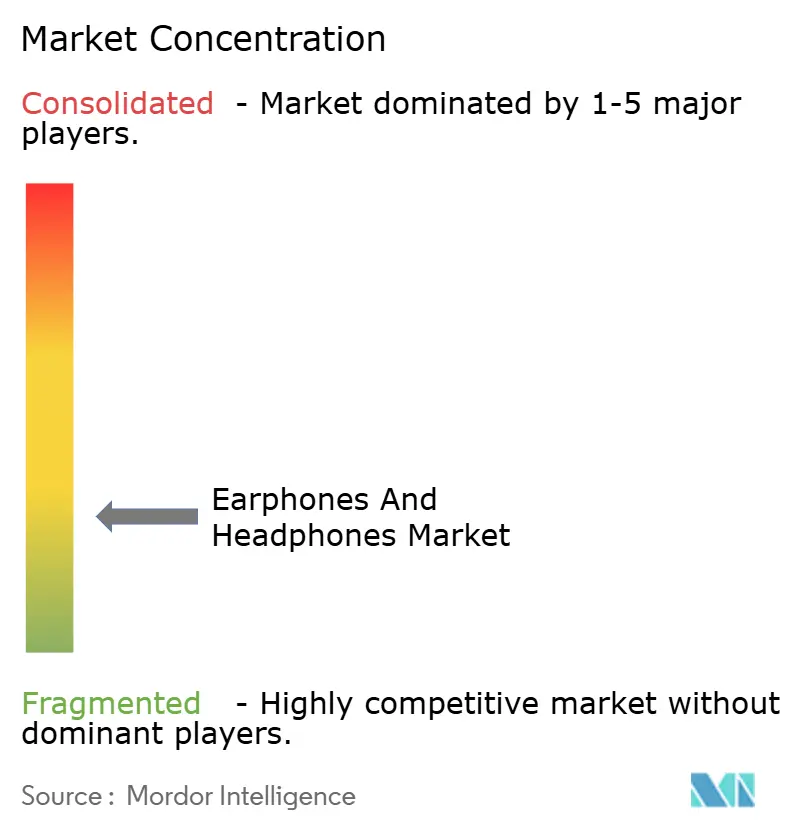
The top five vendors. Apple, Sony, Samsung, Bose, and Xiaomi accounted for 45% of revenue in 2025, underscoring a moderately concentrated battlefield that still leaves room for regional disruptors. Apple dominates premium TWS through seamless H2-chip pairing across iPhones, iPads, and Macs, sustaining average selling prices of USD 249 and margins above 35%. Sony and Bose compete on acoustic fidelity and adaptive ANC, while Samsung leverages Galaxy-level bundling to boost attach rates. Xiaomi and boAt scale via cost-efficient local factories, accepting sub-20% gross margins to flood price-sensitive tiers and seed brand awareness for upselling.
Technology leadership centers on chipsets and codec roadmaps. Qualcomm’s Snapdragon Sound brings lossless streaming and sub-20 ms latency to more than 30 Android brands, eroding Apple’s historical latency advantage. Bluetooth SIG’s finalization of the LE Audio catalog enables Auracast broadcasting from a single hub to multiple listener headsets, promising public-venue applications once spectrum coexistence hurdles are resolved. Counterfeit mitigation and battery-recycling mandates pose twin challenges that disproportionately affect mid-tier entrants with thin balance sheets, encouraging licensing partnerships, and potential acquisitions by well-capitalized incumbents eager to fill portfolio gaps.
Earphones And Headphones Industry Leaders
Sony Group Corporation
Skullcandy Inc.
Sennheiser Electronic GmbH & Co. KG (Sennheiser)
Harman International Industries Incorporated
Bose Corporation
- *Disclaimer: Major Players sorted in no particular order
Recent Industry Developments
- January 2026: Apple launched AirPods Pro 3 featuring an H2 chip that processes 48,000 samples per second for adaptive ANC and introduced USB-C charging to align with updated European port mandates.
- December 2025: Qualcomm unveiled the Snapdragon Sound S7 Gen 3 platform with aptX Lossless and sub-20 ms latency, with 25 device makers committed to integration by mid-2026.
- November 2025: Samsung boosted Galaxy Buds 3 Pro production by 30% at its Vietnam site to meet demand spikes in Southeast Asia and India, halving online lead times.
- October 2025: Bose acquired spatial-audio specialist Immersion Networks, gaining patents on head-tracking algorithms scheduled for QuietComfort Ultra integration in 2026.
Research Methodology Framework and Report Scope
Market Definitions and Key Coverage
Our study defines the earphones and headphones market as every factory-built in-ear, on-ear, and over-ear audio device, wired or wireless, sold to consumers, enterprises, and gamers, valued at first commercial sale. According to Mordor Intelligence, the scope spans true-wireless stereo (TWS) earbuds, Bluetooth and USB headsets, neckbands, and studio monitoring cans while keeping form-factor overlap to a minimum.
Scope exclusion: Medical hearing aids, mixed-reality headsets, car infotainment speakers, and standalone smart speakers lie outside this study.
Segmentation Overview
- By Product Type
- Headphones
- Earphones/Earbuds
- By Form Factor
- Over-Ear
- On-Ear
- In-Ear/Canal
- Open-Ear/Bone-Conduction
- By Connectivity
- Wired
- Wireless
- True Wireless Stereo (TWS)
- Neckband
- RF/Infra-red
- By Noise-Control Technology
- Active Noise-Cancelling (ANC)
- Passive Noise-Isolation
- Open-Transparency/Ambient Mode
- By Price Band
- Sub-USD 50 (Value)
- USD 51-150
- USD 151-300
- Above USD 300
- By Application
- Consumer Entertainment and Music
- Gaming and Esports
- Sports and Fitness
- Professional Studio and Broadcast
- Enterprise/Call-Center/UC&C
- By Distribution Channel
- Online
- E-commerce Marketplaces
- Brand Webstores
- Offline
- Consumer Electronics Chains
- Specialty Audio Stores
- Hypermarkets/Supermarkets
- Online
- By Geography
- North America
- United States
- Canada
- Mexico
- Europe
- Germany
- United Kingdom
- France
- Italy
- Spain
- Nordics
- Rest of Europe
- Asia-Pacific
- China
- Japan
- South Korea
- India
- South East Asia
- Australia
- Rest of Asia-Pacific
- South America
- Brazil
- Rest of South America
- Middle East
- United Arab Emirates
- Saudi Arabia
- Rest of Middle East
- Africa
- South Africa
- Rest of Africa
- North America
Detailed Research Methodology and Data Validation
Primary Research
Analysts interviewed Asian contract manufacturers, audio-chip suppliers, European e-tail category managers, and esports venue engineers, then balanced their perspectives with quick consumer pulse surveys in the United States, India, and Brazil. The conversations validated shipment funnels, feature-adoption rates, and retail mark-ups.
Desk Research
We began with public pillars such as ITU telecom subscriber files, UN Comtrade HS 851830 trade flows, the Consumer Technology Association shipment digest, Bluetooth SIG adoption dashboards, and OECD household-income series. Company filings gathered via D&B Hoovers, patent alerts on Questel, and news scanned on Dow Jones Factiva grounded price curves and vendor shares. These examples illustrate, not exhaust, the wider document pool we reviewed.
Market-Sizing & Forecasting
A top-down smartphone and PC install-base rebuild, matched with attachment and replacement cycles, sets the initial demand pool. Selective bottom-up checks, such as supplier shipment roll-ups and sampled ASP × volume from leading online channels, refine totals. Key modeled variables include TWS penetration, active-noise-cancelling share, online channel mix, premium-band drift, and disposable-income elasticity. Multivariate regression blended with scenario analysis converts these inputs into the 2025-2030 trajectory, and any segment gaps are bridged through ratio imputation anchored on primary feedback.
Data Validation & Update Cycle
Outputs pass variance scans against historical trade data and quarterly vendor disclosures, and any anomaly triggers a second analyst review before sign-off. Reports refresh each year, with interim flashes when supply shocks or major regulations materially shift the market.
Why Mordor's Earphones and Headphones Market Baseline Is Highly Credible
Published estimates often diverge because firms set different boundaries, metrics, and refresh speeds.
We've anchored our baseline on consistent inclusion of TWS and professional headsets and expressed values in constant 2024 dollars, giving decision-makers a figure that neither overlooks high-growth niches nor double-counts bundled accessories.
Key gap drivers
Some studies drop office and esports headsets.
Others inflate totals by layering retail margins over producer revenue.
Refresh cadences vary; Mordor captures mid-2025 shipments, whereas several peers reference earlier snapshots.
Benchmark comparison
| Market Size | Anonymized source | Primary gap driver |
|---|---|---|
| USD 69.04 B (2025) | Mordor Intelligence | - |
| USD 85.80 B (2024) | Global Consultancy A | Retail mark-up added, professional headsets excluded |
| USD 58.08 B (2024) | Trade Journal B | Sub-USD 50 TWS and parts of Latin America omitted |
The comparison shows that our disciplined scope selection, mixed-method validation, and timely refresh make Mordor's baseline the most balanced and traceable yardstick for strategic planning.
Key Questions Answered in the Report
What is the current valuation of the earphones and headphones market?
The earphones and headphones market size stands at USD 69.04 billion in 2025 and is projected to reach USD 102.74 billion by 2030.
Which region is expanding the fastest?
Asia Pacific is forecast to grow at a 10.7% CAGR between 2025 and 2030, fueled by middle-class expansion and aggressive pricing from local brands.
What technology trend is most influencing premium models?
AI-enabled adaptive noise-cancellation and spatial-audio integration are the leading differentiators in flagship earphones and headphones.
How are EU regulations affecting product design?
The EU common-charger directive and battery-waste rules compel manufacturers to adopt USB-C ports and design for easier battery removal, increasing compliance costs.
Which price tier shows the highest growth potential?
The above-USD 300 premium segment is expected to advance at a 12% CAGR through 2030 thanks to consumer demand for advanced features and ecosystem connectivity.
Why are open-ear designs gaining traction?
Gen-Z fitness trends emphasize safety and awareness during outdoor activities, driving a 9.7% CAGR for bone-conduction and other open-ear formats.