
Market Overview
| Study Period | 2020 - 2031 |
|---|---|
| Forecast Data Period | 2026 - 2031 |
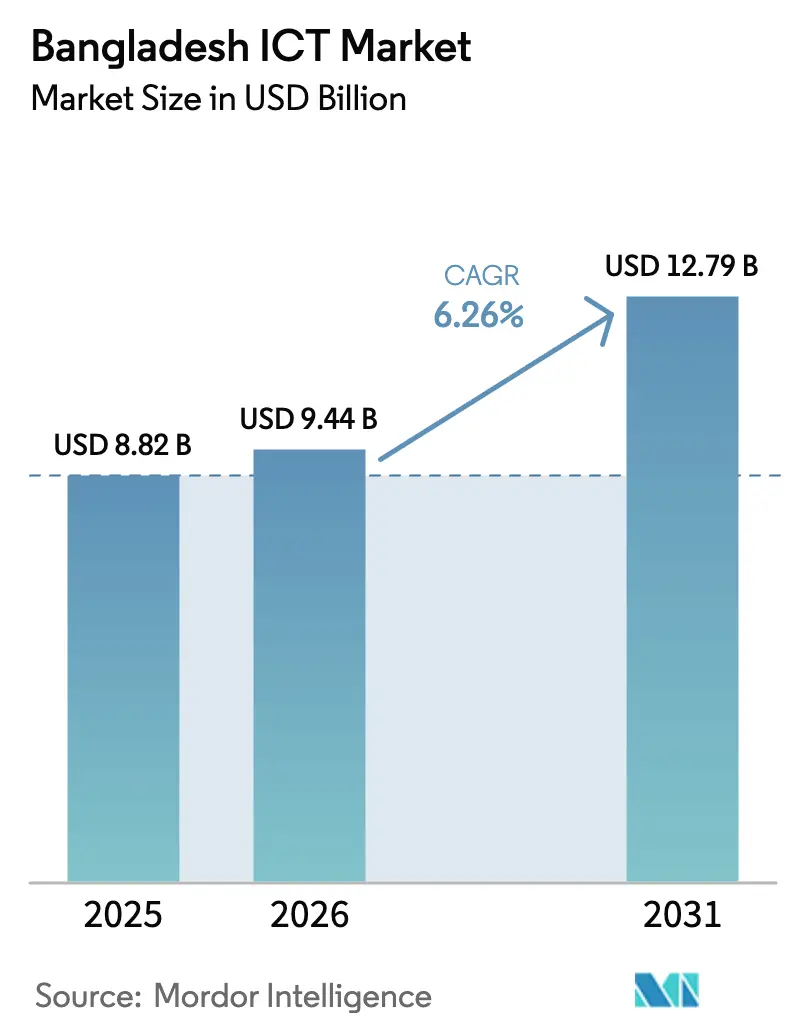
| Base Year Market Size (2025) | USD 8.82 Billion |
| Market Size (2026) | USD 9.44 Billion |
| Market Size (2031) | USD 12.79 Billion |
| Growth Rate (2026 - 2031) | 6.26 % |
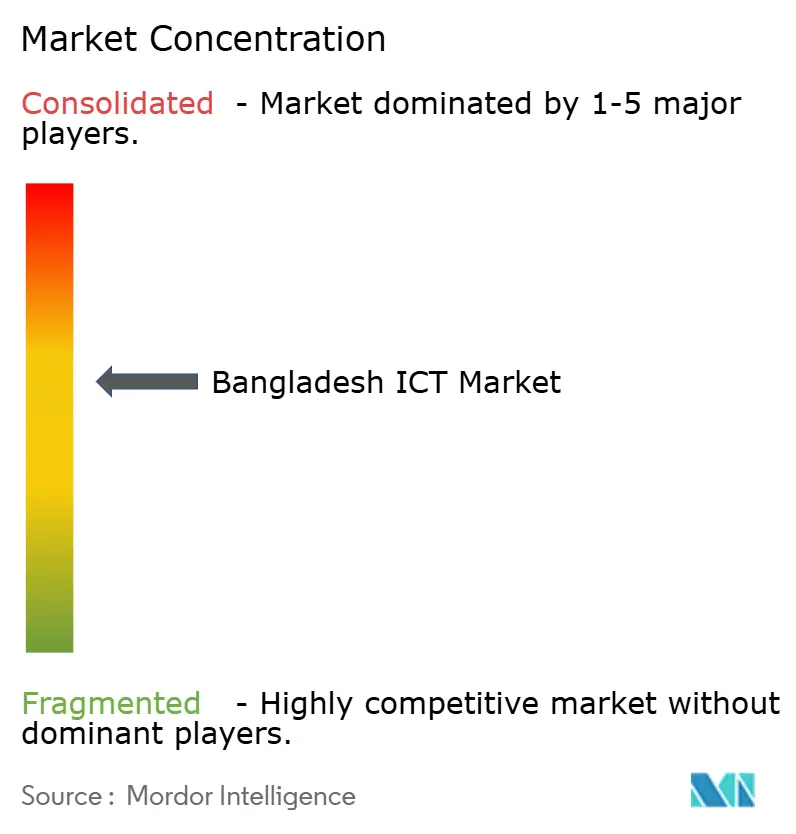
| Market Concentration | Medium |
Major Players
*Disclaimer: Major Players sorted in no particular order Image © Mordor Intelligence. Reuse requires attribution under CC BY 4.0. |
|
Bangladesh ICT Market Analysis by Mordor Intelligence
The Bangladesh ICT Market size is projected to be USD 8.82 billion in 2025, USD 9.44 billion in 2026, and reach USD 12.79 billion by 2031, growing at a CAGR of 6.26% from 2026 to 2031. A pivotal transition from discrete hardware purchases toward subscription-based cloud, cybersecurity, and managed services is underway as enterprises align with the Smart Bangladesh 2041 digital vision. Cloud adoption is gaining critical mass because local data-center capacity, SaaS billing in local currency, and hybrid deployment models now meet the data-sovereignty rules of the Digital Security Act 2018. At the same time, spectrum availability and foreign-ownership liberalization are reshaping investment flows, enabling mobile carriers and hyperscale cloud platforms to accelerate 5G and edge rollouts even while elevated spectrum fees consume 16% of operator revenue, far above the 10% Asia-Pacific median. Hardware sales remain hampered by 25% import tariffs, yet production clustering inside the Sheikh Hasina Hi-Tech Parks is slowly tempering the cost base and supporting the emergence of a local manufacturing hub. Cybersecurity talent shortages, rural backhaul gaps, and execution delays in government e-service projects continue to weigh on the Bangladesh ICT market, but sustained policy focus and private-public partnerships are expected to keep investment momentum intact through the forecast window.
Key Report Takeaways
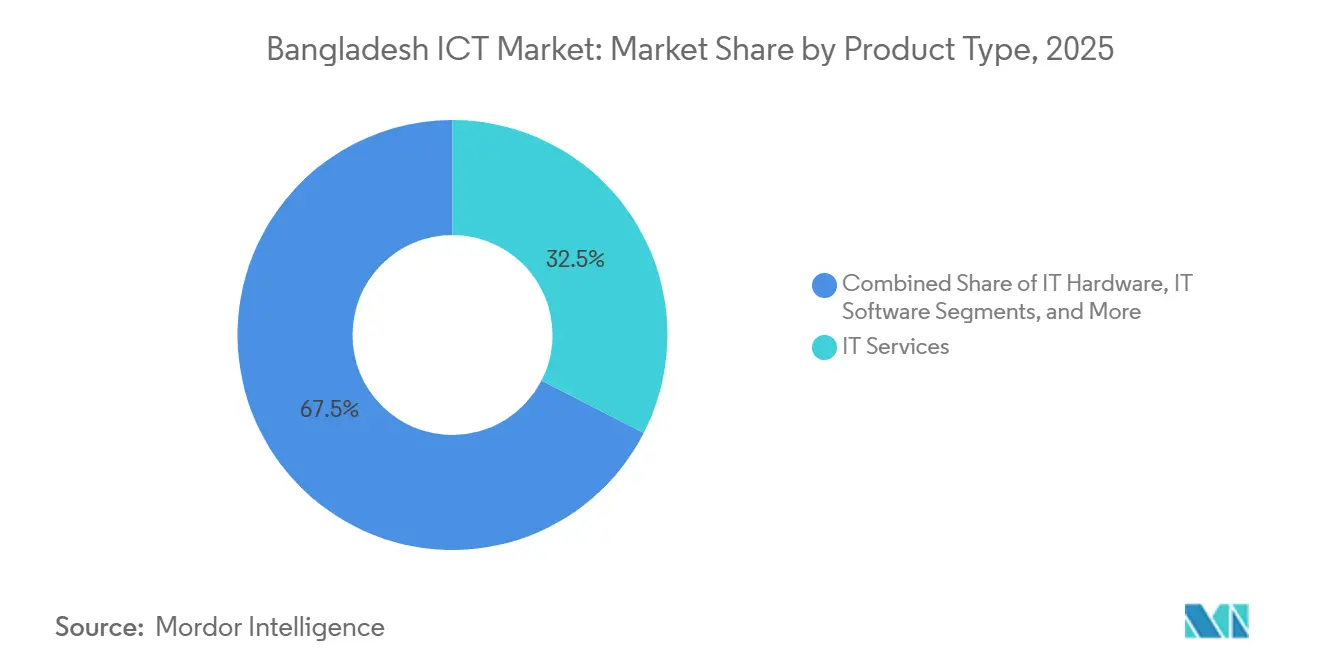
- By product type, IT services led with 32.54% revenue share in 2025, while cloud and platform services are projected to expand at a 6.82% CAGR through 2031.
- By enterprise size, large enterprises accounted for 57.32% of the Bangladesh ICT market share in 2025, whereas small and medium-sized enterprises are forecast to log the fastest growth at 7.18% CAGR between 2026-2031.
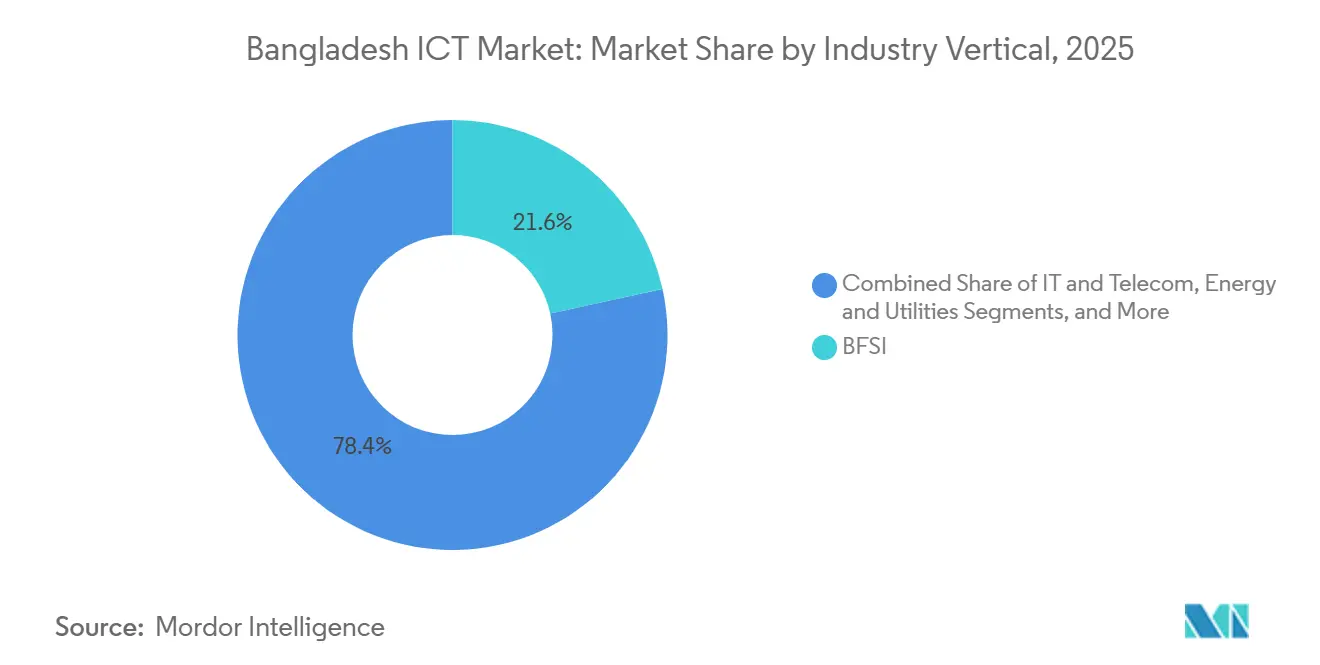
- By industry vertical, banking, financial services, and insurance held 21.56% of spending in 2025, and healthcare and life sciences are expected to expand at an 8.13% CAGR to 2031.
Note: Market size and forecast figures in this report are generated using Mordor Intelligence’s proprietary estimation framework, updated with the latest available data and insights as of 2026.
Bangladesh ICT Market Trends and Insights
Drivers Impact Analysis*
| Driver | (~) % Impact on CAGR Forecast | Geographic Relevance | Impact Timeline |
|---|---|---|---|
| Government's Digital Bangladesh Vision 2041 Investments | +1.8% | National, with concentration in Dhaka, Chittagong, and divisional headquarters | Long term (≥ 4 years) |
| Rapid Growth of Mobile Internet Subscribers | +1.2% | National, urban saturation driving rural expansion focus | Medium term (2-4 years) |
| Rising Demand for Cloud and Platform Services Among SMEs | +1.5% | National, early adoption in Dhaka, Chittagong, Sylhet industrial zones | Medium term (2-4 years) |
| Expansion of 4G and Upcoming 5G Network Rollout | +1.0% | Urban centers (Dhaka, Chittagong), gradual tier-2 city coverage | Medium term (2-4 years) |
| Emergence of Sheikh Hasina Hi-Tech Parks as Domestic Tech Manufacturing Hubs | +0.6% | Kaliakoir, Jashore, Mohakhali, Rajshahi, Sylhet | Long term (≥ 4 years) |
| Increasing Adoption of Islamic FinTech Solutions Within BFSI Sector | +0.9% | National, concentrated in urban and semi-urban banking corridors | Short term (≤ 2 years) |
| Source: Mordor Intelligence | |||
Government's Digital Bangladesh Vision 2041 Investments
BDT 500 billion (USD 4.5 billion) has been earmarked through the Eighth Five-Year Plan to digitize public services, roll out 10,000 rural digital centers, and establish 64 district-level innovation hubs. Contracts already awarded for e-government resource planning suites, biometric citizen databases, and cloud-hosted tax platforms have solidified a multiyear pipeline for local system integrators.[1]Ministry of Finance, “Budget Documents 2025-2026,” MOF.GOV.BD Public-private interfaces, exemplified by social assistance disbursement via bKash and Nagad mobile wallets, showcase how policy can catalyze demand for secure APIs, managed hosting, and identity-as-a-service. Yet execution risk persists because line-ministry technical capacity gaps have historically elongated project timelines by up to two years, keeping revenue recognition lumpy for vendors tied to government cycles.
Rising Demand for Cloud and Platform Services Among SMEs
SME cloud spending is scaling at 7.18% CAGR as entrepreneurs migrate from manual ledgers to mobile-first SaaS applications in Bangla. The Bangladesh Bank’s December 2025 mandate that every registered business accept digital payments compelled 200,000 shops to onboard point-of-sale, inventory, and analytics modules, rapidly enlarging the addressable pool for localized SaaS providers. Microsoft Azure and Amazon Web Services now co-sell via DataSoft Systems and Aamra Companies to satisfy data-residency clauses, reducing migration anxiety for exporters and garment units. Intermittent power supply and cyber-risk awareness remain barriers, but device-financing by micro-lenders and the proliferation of regional language user interfaces are steadily dissolving adoption hurdles across the Bangladesh ICT market.
Rapid Growth of Mobile Internet Subscribers
Subscriber losses from 135.99 million in July 2025 to 131.49 million by October 2025 marked the first pullback in half a decade. Affordability constraints in low-income segments and a shortage of compelling 5G use cases turned the strategic spotlight toward rural expansion, average-revenue-per-user uplift, and platform monetization. To mitigate churn, carriers introduced subsidized smartphone bundles and micro-recharge packs, pivoting network focus from capacity expansion to service quality. Government subsidy of BDT 12 billion (USD 108 million) for rural towers is material, but bureaucratic bottlenecks left one-third of the funds undisbursed in 2025, delaying backhaul upgrades that are crucial for cloud adoption in underserved districts.
Expansion of 4G and Upcoming 5G Network Rollout
The January 2026 700 MHz auction released only 25 MHz of spectrum, leaving limited headroom for ultra-capacity 5G deployments and edge-computing business models. The USD 21.4 million reserve price per MHz exceeds regional benchmarks by 30%, straining carrier balance sheets already absorbing 16% revenue leakage into licensing fees. Grameenphone and Robi piloted 5G in Dhaka and Chittagong, but coverage remains confined to central business districts because fiber reach to towers is still sparse and edge data-center footprints are embryonic. Vendor-financing from Ericsson and Huawei eases capital pressure, yet 25% import tariffs on RAN gear erode the return on invested capital. Monetization thus hinges on enterprise IoT pilots in garments, ports, and power grids where low-latency analytics can command premium pricing inside the Bangladesh ICT market.
Restraints Impact Analysis*
| Restraint | (~) % Impact on CAGR Forecast | Geographic Relevance | Impact Timeline |
|---|---|---|---|
| Inadequate Rural IT Infrastructure | -1.2% | Rural unions, northern and southern peripheral districts | Long term (≥ 4 years) |
| Shortage of Advanced Cybersecurity Talent | -0.8% | National, acute in Dhaka and Chittagong enterprise hubs | Medium term (2-4 years) |
| Persistent Underinvestment in Local Data Center Redundancy | -0.6% | National, affecting tier-1 cities with enterprise concentration | Medium term (2-4 years) |
| Import Tariff Volatility on ICT Hardware Components | -0.5% | National, impacting hardware procurement and project timelines | Short term (≤ 2 years) |
| Source: Mordor Intelligence | |||
Inadequate Rural IT Infrastructure
Fewer than 30% of rural unions had fiber backhaul by late 2025, forcing operators to rely on microwave links that deliver erratic latency incompatible with cloud workspaces and telehealth. Commercial towers in low-density areas yield average revenue per user below BDT 150 (USD 1.35) per month, deterring private capital. Land-title disputes and right-of-way approvals add an average of nine months to tower construction, perpetuating a coverage gap that curtails the addressable base for cloud and e-government applications.
Shortage of Advanced Cybersecurity Talent
A deficit of 15,000 certified cybersecurity specialists in 2025 inflates wage costs and curtails the rollout of managed security services.[2]Bangladesh Computer Council, “Cybersecurity Workforce Assessment 2025,” BCC.GOV.BD Enterprises thus operate with incomplete threat-detection stacks, and only 15% maintain 24/7 security operations centers. While the Cybersecurity Skills Development Program aims to train 5,000 professionals by 2027, curriculum lags and inadequate hands-on labs reduce its near-term impact, leaving the Bangladesh ICT industry exposed to escalating ransomware incidents.
*Our forecasts treat driver/restraint impacts as directional, not additive. The impact forecasts reflect baseline growth, mix effects, and variable interactions.
Segment Analysis
By Product Type: Services Dominance Masks Hardware Tariff Pressure
IT services accounted for 32.54% of 2025 revenues, underscoring the role of consulting, integration, and outsourcing in the backbone of the Bangladesh ICT market. Cloud and platform offerings, although smaller in absolute terms, posted the fastest growth and are projected to command a larger slice of the Bangladesh ICT market as migrations accelerate. Vendor competition is intensifying as Microsoft, AWS, and Oracle have forged alliances with domestic integrators to embed local-language interfaces and ensure data-residency compliance. Hardware demand remains strong, but import tariffs averaging 25% compress margins and lengthen project timelines, prompting resellers to bundle equipment with managed services to protect profitability.
A second growth pocket is managed security, catalyzed by a 40% increase in ransomware attempts in 2025.[3]Bangladesh Bank, "Payment Systems and Digital Financial Services Report 2025," bb.org.bd Although adoption remains concentrated among banks and telecom operators, rising compliance demands are prompting manufacturers and retailers to explore endpoint detection and managed detection and response subscriptions. The Bangladesh ICT market share for traditional communication services continues to shrink in percentage terms because subscriber growth has plateaued, shifting revenue capture toward digital platforms, IoT connectivity, and edge analytics.


By Enterprise Size: SME Digitalization Outpaces Corporate Refresh Cycles
Large enterprises still controlled 57.32% of 2025 spend, anchored by multi-year ERP upgrades, core-banking refreshes, and telecom network modernization. These buyers favor hybrid cloud architectures that balance on-premises control with public cloud agility, resulting in complex systems-integration contracts that sustain consulting billings. However, budget reallocation from capital expenditure to operating expenditure is lengthening hardware refresh cycles, tempering growth in legacy segments of the Bangladesh ICT market.
In contrast, SMEs show the highest velocity. Affordable subscription bundles, device-financing models, and regulatory nudges toward digital invoicing and payment acceptance are closing the technology gap. The SME Foundation’s BDT 3 billion (USD 27 million) grant program subsidized software licenses and connectivity, enabling micro-retailers and light-manufacturing units to deploy accounting, CRM, and e-commerce portals rapidly. As a result, SMEs are expected to contribute an increasingly larger portion of the Bangladesh ICT market size, aided by localized SaaS solutions that reduce language friction and training overhead.
By Industry Vertical: Healthcare Digitalization Accelerates Beyond BFSI Maturity
Banking, financial services, and insurance retained 21.56% of 2025 outlays, sustained by Islamic fintech growth, core-banking modernization, and heightened regulatory scrutiny on cybersecurity. With 70 million bKash customers and interoperable wallets, digital finance constitutes a primary use case propelling API gateways, fraud analytics, and cloud storage services. Yet the most dynamic segment is healthcare, projected to grow at an 8.13% CAGR as the Digital Health Strategy 2026-2032 funds electronic health records, telemedicine hubs, and diagnostic imaging networks.
Public hospitals must digitize patient files by December 2027, and the Bangladesh ICT market is responding through partnerships between hospital chains, cloud providers, and medical-device OEMs. Logistics and retail are also scaling investments in omnichannel platforms, warehouse automation, and last-mile delivery software as online shopping penetrates 15% of urban households. Energy, utilities, and manufacturing remain comparatively nascent adopters, but pilot programs for smart grids and IoT-enabled garment factory floors signal future upside once technical-skills bottlenecks ease.
Geography Analysis
Dhaka and Chittagong jointly account for more than 65% of Bangladesh's ICT market, driven by concentrated corporate headquarters, banking hubs, and telecom switching centers. High fiber density, multiple tier-III data centers, and wide 4G coverage create fertile ground for cloud migration and the uptake of managed services. Edge data center construction is emerging to serve export-oriented garment clusters on the outskirts, reducing latency for computer vision quality-control applications.
Tier-2 cities such as Khulna, Rajshahi, and Sylhet are posting double-digit year-on-year spending as enterprise branches modernize point-of-sale and ERP suites. Government e-service kiosks in district headquarters are driving incremental demand for biometric devices, VSAT connectivity, and managed hosting.
Rural unions remain investment-starved because fiber backhaul covers less than one-third of locations. Microwave links fill the gap but limit consistent throughput, constraining video consultation, distance learning, and payment acceptance. Universal Service Obligation Fund disbursements, if fully executed, could add 5,000 towers by 2028, gradually unlocking new revenue pools for the Bangladesh ICT market.
Regulatory Landscape
Regulation of telecommunications and core digital services is centered on the Bangladesh Telecommunication Regulatory Commission (BTRC), alongside the data-sovereignty and security compliance backdrop shaped by the Digital Security Act 2018. In 2026, the Bangladesh Telecommunication (Amendment) Ordinance, 2026 introduced a governance reset by restoring BTRC autonomy and permanently prohibiting internet and telecommunication service shutdowns. For enterprises running cloud, payments, and e-government workloads, this changes the continuity expectations tied to network operations.
The 2026 ordinance and associated policy direction also streamlined market entry and oversight by reducing license categories to four main types (access networks, national infrastructure, international connectivity, and non-terrestrial networks). Foreign ownership ceilings were revised, including up to 85% for mobile operators (with differentiated caps for other license types). This reinforces the investment framework referenced in the market context, where foreign-ownership liberalization and spectrum actions, such as the January 2026 700 MHz auction, affect operator capex capacity and rollout pacing.
Value Chain Analysis
Bangladesh ICT demand is pulled by government digitalization programs, BFSI digitization, and enterprise modernization focused in Dhaka and Chittagong. Procurement typically flows through domestic systems integrators and channel partners that localize delivery and provide Bangla-language support. On the connectivity side, mobile network operators (Grameenphone, Robi, and Banglalink) remain the primary retail access layer, while fixed and wholesale fiber capacity is anchored by state-linked infrastructure such as BTCL, which maintains the country's largest underground fiber network and holds around 20% market share.
Upstream, global OEMs and platform vendors supply the network and compute foundations (RAN, transmission, servers, cybersecurity tools, and cloud platforms). Huawei is positioned as a major supplier for backbone transmission and national infrastructure projects, including BTCL's ongoing 5G readiness (DWDM) initiative. At the application and services layer, domestic IT firms focus on customized software, integration, and IT-enabled services, while higher-value areas such as large-scale cloud platforms, digital advertising, and advanced data analytics skew toward global platforms. Local players differentiate through compliance alignment, local billing, and managed services packaging.
Competitive Landscape
The Bangladesh ICT market exhibits moderate fragmentation with overlapping spheres of influence. Grameenphone maintained leadership at 85.6 million subscribers in Q3 2025, but revenue growth is tilting toward value-added digital services rather than raw connectivity. Robi Axiata and Banglalink inked network-sharing deals to dilute capital intensity and accelerate rural coverage. On the hardware front, Samsung, Huawei, Cisco, and Dell compete via channel-led enterprise engagements, while IBM and Oracle focus on core-banking and analytics stacks.
Domestic systems integrators such as Aamra Companies, DataSoft Systems, Spectrum Engineering Consortium, and Dohatec New Media secure public-sector tenders by offering Bangla-language support and agile customization. Fintech disruptors bKash and Nagad are diversifying into micro-insurance and credit scoring, challenging traditional banks and nudging core-banking vendors to expose open APIs. Intellectual-property enforcement gaps, however, continue to deter foreign venture capital and depress software license value capture.
Strategic moves in 2025 included Microsoft-Azure’s partnership with DataSoft for localized cloud support, Dell’s rollout of pre-packaged edge servers for garment-factory IoT pilots, and Huawei’s vendor-financed 5G radio deployments in Dhaka. As policy now allows up to 85% foreign ownership in mobile operators, Telenor and Axiata have signaled larger capital commitments, setting the stage for intensified competition across connectivity, cloud, and fintech value chains within the Bangladesh ICT market.
Bangladesh ICT Industry Leaders
-
Grameenphone Ltd.
-
Robi Axiata Limited
-
Banglalink Digital Communications Limited
-
Samsung Electronics Company Limited
-
Huawei Technologies Company Limited
- *Disclaimer: Major Players sorted in no particular order

Market Opportunities and Future Outlook
Regulatory restructuring in 2026, including the Bangladesh Telecommunication (Amendment) Ordinance, 2026 and licensing consolidation into four categories, creates whitespace for operators, infrastructure providers, and enterprise network specialists to rationalize interconnection, wholesale access, and service bundling under clearer licensing boundaries. In parallel, the government’s Smart Bangladesh 2041 execution pipeline, including BDT 500 billion earmarked under the Eighth Five-Year Plan for digitizing public services, supports multi-year demand for e-government platforms, identity systems, managed hosting, and systems integration. Domestic integrators are positioned to capture implementation and operations work.
Device and edge ecosystems also offer near-term commercialization paths where policy incentives and private sector moves intersect. The government has discussed policy incentives and competitive tax regimes to attract South Korean investment in ICT and smart device manufacturing, aligning with the report’s context of production clustering in Sheikh Hasina Hi-Tech Parks and ongoing tariff friction on imported hardware. On the demand side, Bangladesh Bank’s December 2025 mandate on digital payment acceptance expands the addressable base for SME SaaS (POS, inventory, accounting, analytics). Separately, June 2026 saw Huawei re-enter the consumer smartphone market with DX Group distribution, adding competitive intensity in devices that underpin mobile-first SaaS, fintech, and app-based service delivery.
Recent Industry Developments
- July 2026: BTRC upheld an administrative fine of Tk 3 crore against Summit Communications over discriminatory bandwidth pricing. The action reinforced regulatory scrutiny over wholesale connectivity practices, shaping how carriers and large enterprises negotiate backbone and bandwidth terms.
- June 2026: Grameenphone began nationwide deployment of the 700 MHz band acquired in the January 2026 spectrum auction. Low-band rollout strengthens indoor coverage and rural reach, supporting broader adoption of data services at the center of ICT monetization beyond basic connectivity.
- June 2026: Huawei relaunched its consumer device business in Bangladesh at the "Now Is Your Spark" event, introducing 13 products and naming DX Group as national distributor. The re-entry of a major global OEM into local device channels tightened competition for smartphones and wearables that anchor mobile-first SaaS, fintech, and content consumption.


Research Methodology Framework and Report Scope
Market Definition and Coverage
For this study, the Bangladesh ICT market is defined as the total spending generated inside Bangladesh from information technology products and services and communication services that enable connectivity, computing, and digital work across households, firms, and the public sector.
Scope exclusions: We exclude informal gray market device sales and DIY labor that is not billed through an identifiable ICT provider.
Segmentation Overview
-
By Product Type
-
IT Hardware
- Computer Hardware
- Networking Equipment
- Peripherals
- IT Software
-
IT Services
- IT Consulting and Implementation
- IT Outsourcing (ITO)
- Business Process Outsourcing (BPO)
- Managed Security Services
- Cloud and Platform Services
- IT Infrastructure
- IT Security/Cybersecurity
- Communication Services
-
IT Hardware
-
By Enterprise Size
- Small and Medium-sized Enterprises
- Large Enterprises
-
By Industry Vertical
- Government and Public Administration
- BFSI
- IT and Telecom
- Energy and Utilities
- Retail, E-commerce, and Logistics
- Manufacturing and Industry 4.0
- Healthcare and Life Sciences
- Oil and Gas
- Other Industry Verticals
Data Sources, Market Sizing, and Validation
Desk Research
Desk research was used to set the market boundaries and to collect stable reference data that can be checked again later. We typically start from Bangladesh telecom and internet indicators, national accounts series, and trade and device shipment proxies, then map them back to ICT spend pools.
Public sources used for grounding include references such as the Bangladesh Telecommunication Regulatory Commission (subscriber and traffic indicators), Bangladesh Bureau of Statistics (macro and services output series), Bangladesh Bank (payments and foreign exchange context), ITU (cross-country connectivity benchmarks), and World Bank datasets (digital adoption and macro drivers). We also review company annual reports and investor notes where available, along with association releases and reputed press. Where they help validate directionally, we use paid databases for company financial intelligence, patent lookups, and import or export shipment-level checks. The sources listed above are illustrative, and many other public documents were also used to collect, validate, and clarify data points.
Primary Interviews and Surveys
Interviews and surveys with ICT suppliers, distributors, service providers, enterprise technology buyers, and public-sector technology officers in Bangladesh help clarify local pricing, channel mix, procurement timing, and informal activity. Respondents also provide a check on secondary figures where published data do not distinguish between hardware, software, services, and infrastructure. Re-contact is used when answers differ materially, and findings are triangulated before final analysis.
Distribution of primary research fieldwork respondents
| Company type | Respondent position |
|---|---|
| Top tier: 26% | CXOs: 18% |
| Mid tier: 51% | Functional/Unit leaders: 32% |
| Smaller Players: 23% | Managers: 50% |
Market-Sizing & Forecasting
Market sizing was built using a top-down demand pool reconstruction that connects Bangladesh connectivity and IT adoption signals to expected spend by buyer groups and service categories. We then corroborated the totals using selective bottom-up checks, such as sampled vendor revenue patterns, channel feedback on unit volumes, and simple ASP-times-volume builds for key device and service lines, which are adjusted when gaps show up.
Inputs used in the model include mobile and internet subscriber counts, data usage intensity and service mix shifts, device penetration and replacement tendencies, enterprise digitalization spend intent, and public sector digitization programs that translate into procurement demand. For price and value normalization, we track currency timing, inflation direction, and typical contract duration effects that change how revenue is recognized across years.
For forecasting, scenario analysis is used so faster and slower adoption paths can be expressed without forcing one single assumption set. Where bottom-up evidence is thin, we fill gaps with conservative penetration and pricing ranges agreed in interviews, and we only scale up after the values also fit the independent desk indicators.
Data Validation & Update Cycle
Before sign-off, outputs are checked against independent signals so obvious mismatches can be caught early, such as telecom revenue direction, macro services growth, and trade or shipment proxies. Outliers are reviewed in a second pass, and if the variance is large, we re-check the assumptions and re-contact relevant participants to confirm what changed.
Each report is refreshed annually, and interim updates are made when material events impact demand, pricing, or regulation. Right before delivery, an analyst performs a fresh pass on key indicators so clients receive the most up-to-date view based on the latest available data.
Mordor Intelligence's Bangladesh Ict Market Size Versus Other Published Estimates
Published market sizes for Bangladesh ICT can vary because different authors group services differently, pick different base years, and use different price and currency treatments. Another common driver is whether the estimate represents total ICT spend or only a narrower revenue slice such as IT services exports or domestic software activity.
Hardware resale value, telecom service revenues, and IT services are not always counted in the same way across studies, and this creates wide spreads even when the growth story is similar. IT-ITeS focused figures are usually built from service revenue and export narratives, whereas broader ICT totals tend to reflect connectivity plus computing spend, then followed by cross checks against subscriber metrics and macro series.
Benchmark comparison
| Source | Market Size | Gaps in Research Methodology |
|---|---|---|
| Mordor Intelligence | USD 8.82 B (2025) | |
| Industry Promotion Agency A | USD 2.11 B (2025) | This number is limited to domestic IT services and IT enabled services revenues, so telecom services and most hardware value are not included, which keeps the total much smaller. |
| Trade Press B | USD 8.88 B (2025) | The figure is presented without a clear breakdown of included ICT components and without a stated normalization for exchange rate timing, so small differences can come from what is grouped under ICT and how currency is applied. |
The table shows that the largest gap is driven by category coverage, since IT-ITeS totals represent only a service slice inside the full ICT spend pool used by Mordor Intelligence. When scope is aligned and pricing and currency timing are stated clearly, the remaining differences tend to narrow and become easier to explain and replicate.


Key Questions Answered in the Report
How large is the Bangladesh ICT market in 2026?
The Bangladesh ICT market size is estimated at USD 9.44 billion in 2026, and it is projected to reach USD 12.79 billion by 2031.
What is the expected growth rate of the Bangladesh ICT market through 2031?
The market is forecast to expand at a 6.26% CAGR between 2026 and 2031, underpinned by cloud migration, fintech expansion, and government digitalization.
Which product segment is growing fastest inside Bangladesh’s technology landscape?
Cloud and platform services are the fastest-growing product category, projected to rise at 6.82% CAGR over the forecast window as SMEs adopt SaaS and hybrid-cloud architectures.
Why are SMEs important for future ICT spending in Bangladesh?
Affordable SaaS bundles, regulatory mandates for digital payments, and device-financing programs are accelerating technology adoption among SMEs, making them the fastest-expanding customer cohort.
Which vertical will outpace others in technology spending growth?
Healthcare and life sciences are set to grow at an 8.13% CAGR to 2031 because of mandated electronic medical records, telemedicine, and public funding under the Digital Health Strategy 2026-2032.
What challenges could slow ICT growth in Bangladesh?
Key obstacles include limited rural fiber backhaul, a shortage of certified cybersecurity professionals, high import tariffs on hardware, and the constrained release of affordable 5G spectrum.
Page last updated on:


